

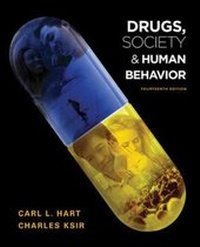
Drugs, Society, and Human Behavior
14th Edition
Published on 16. November 2010
Book
Paperback/Softback
496 pages
978-0-07-338090-2 (ISBN)
Description
Designed for the introduction to drugs and substance abuse course as taught in departments of health education, psychology, biology, sociology, and criminal justice, this full-color market-leading text provides the latest information on drugs and their effects on society and human behavior. For over thirty years, instructors and students have relied on it to examine drugs and behavior from the behavioral, pharmacological, historical, social, legal, and clinical perspectives.
More details
Edition
14th edition
Language
English
Place of publication
United States
Publishing group
McGraw-Hill Education - Europe
Target group
College/higher education
Illustrations
ill
Dimensions
Height: 231 mm
Width: 188 mm
Thickness: 20 mm
Weight
719 gr
ISBN-13
978-0-07-338090-2 (9780073380902)
Copyright in bibliographic data and cover images is held by Nielsen Book Services Limited or by the publishers or by their respective licensors: all rights reserved.
Persons
Dr. Carl Hart is an Associate Professor in both the Departments of Psychiatry and Psychology at Columbia University and is also a Research Scientist in the Division of Substance Abuse at the New York State Psychiatric Institute. A major focus of Dr. Harts research is to understand the complex interactions between neurobiological and environmental factors that mediate and modulate the actions of drugs of abuse, including drug-taking behaviour and cognitive performance. Dr. Harts research has been supported by the National Institute on Drug Abuse for the past several years. In addition to his substantial research responsibilities, Dr. Hart teaches an undergraduate Drugs and Behaviour course and was recently awarded Columbia Universitys highest teaching award.
Charles Ksir received his bachelors degree in Psychology from the University of Texas at Austin and his Ph.D. from Indiana University in Bloomington. Following his postdoctoral training in Neurobiology at the Worcester Foundation in Massachusetts, he began a 34-year career in teaching and research at the University of Wyoming, where he also served in a variety of administrative positions. Now a professor emeritus, he focuses his efforts on teaching and textbook writing. He has taught the psychology course Drugs and Behaviour to more than three thousand students since 1972 and has received several teaching awards.
After graduating from Cornell University and serving a brief stint in the U.S. Army, Oakley Ray became a full-time student at the University of Pittsburgh, training to be a clinical psychologist. He completed his clinical training and moved to animal research even before he received his Ph.D. Working in the behavioral research laboratory of Larry Stein, he learned all the techniques and technologies of brain stimulation and biochemistry relevant to the expanding field of neuropsychopharmacology. Steins laboratory was part of a multidisciplinary research facility so Oakley Ray learned brain anatomy, surgery, biochemistry, and pharmacology. When Larry Stein moved on, Oakley Ray took over the lab, expanded it, and established it as an independent research laboratory. He continued working in Pittsburgh as an Associate Professor at the University of Pittsburgh and at Chatham College while still directing the research laboratory in the Veterans Administration Hospital at Leech Farm Road in Pittsburgh.
Following his move to Nashville to be Professor in Psychology and Pharmacology, and later in Psychiatry, as well as the Chief of the Psychology Program at the Nashville Veterans Administration Hospital, he became more involved in human psychopharmacology. He later served as the Executive Secretary of the American College of Neuropsychopharmacology and the International College of Neuropsychopharmacology.
Charles Ksir received his bachelors degree in Psychology from the University of Texas at Austin and his Ph.D. from Indiana University in Bloomington. Following his postdoctoral training in Neurobiology at the Worcester Foundation in Massachusetts, he began a 34-year career in teaching and research at the University of Wyoming, where he also served in a variety of administrative positions. Now a professor emeritus, he focuses his efforts on teaching and textbook writing. He has taught the psychology course Drugs and Behaviour to more than three thousand students since 1972 and has received several teaching awards.
After graduating from Cornell University and serving a brief stint in the U.S. Army, Oakley Ray became a full-time student at the University of Pittsburgh, training to be a clinical psychologist. He completed his clinical training and moved to animal research even before he received his Ph.D. Working in the behavioral research laboratory of Larry Stein, he learned all the techniques and technologies of brain stimulation and biochemistry relevant to the expanding field of neuropsychopharmacology. Steins laboratory was part of a multidisciplinary research facility so Oakley Ray learned brain anatomy, surgery, biochemistry, and pharmacology. When Larry Stein moved on, Oakley Ray took over the lab, expanded it, and established it as an independent research laboratory. He continued working in Pittsburgh as an Associate Professor at the University of Pittsburgh and at Chatham College while still directing the research laboratory in the Veterans Administration Hospital at Leech Farm Road in Pittsburgh.
Following his move to Nashville to be Professor in Psychology and Pharmacology, and later in Psychiatry, as well as the Chief of the Psychology Program at the Nashville Veterans Administration Hospital, he became more involved in human psychopharmacology. He later served as the Executive Secretary of the American College of Neuropsychopharmacology and the International College of Neuropsychopharmacology.
Content
Section One: Drug Use in Modern Society 1: Drug Use: An Overview 2: Drug Use as a Social Problem 3: Drug Products and Their Regulation Section Two: How Drugs Work 4: The Nervous System 5: The Actions of Drugs Section Three: Uppers and Downers 6: Stimulants 7: Depressants and Inhalants 8: Medication for Mental Disorders Section Four: Alcohol 9: Alcohol Section Five: Familiar Drugs 10: Tobacco 11: Caffeine 12: Dietary Supplements and Over-the-Counter Drugs Section Six: Restricted Drugs 13: Opioids 14: Hallucinogens 15: Marijuana 16: Performance-Enhancing DrugsSection Seven: Prevention and Treatment 17: Preventing Substance Abuse 18: Treating Substance Abuse and DependenceAppendix A Drug NamesAppendix B Resources for Information and AssistanceGlossary