

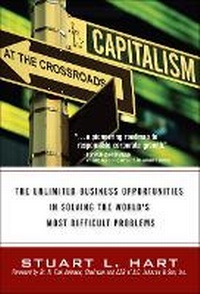
Capitalism at the Crossroads
The Unlimited Business Opportunities in Solving the World's Most Difficult Problems
Published on 24. February 2005
Book
Hardback
288 pages
978-0-13-143987-0 (ISBN)
Description
Capitalism is indeed at a crossroads, facing international terrorism, worldwide environmental change, and an accelerating backlash against globalization. Companies are at crossroads, too: finding new strategies for profitable growth is now more challenging. Both sets of problems are intimately linked. Learn how to identify sustainable products and technologies that can drive new growth while also helping to solve today's most crucial social and environmental problems. Hart shows how to become truly indigenous to all markets -- and avoid the pitfalls of traditional 'greening' and 'sustainability' strategies. This book doesn't just point the way to a capitalism that is more inclusive and more welcome: it offers specific techniques to recharge innovation, growth, and profitability.
Reviews / Votes
http://www.socialfunds.com/news/article.cgi/article1596.htmlBook Review--Capitalism at the Crossroads: The Unlimited Business Opportunities in Solving the World's Most Difficult Problems
by William Baue
According to author Stuart Hart, sustainable global enterprise holds the key to reducing poverty, reversing environmental destruction, and even counteracting terrorism.
SocialFunds.com -- Cornell and University of North Carolina Business Professor Stuart Hart's Capitalism at the Crossroads perfectly complements University of Michigan Business Professor C. K. Prahalad's The Fortune at the Bottom of the Pyramid, perhaps even surpassing it in significance. The two professors collaborated from 1998 through 2002 on the seminal article that gave birth to the "bottom of the pyramid" (BOP) concept that Prof. Prahalad explains so eloquently in his book (see related book review). The BOP market theory holds that multinational corporations (MNCs) can simultaneously profit and help reduce global poverty by serving a market they have largely ignored until recently: the 4 billion people in the world living on less than $2 a day.
As good as Prof. Prahalad's book is, however, it leaves unanswered the question of how the BOP theory fits into the larger context of sustainability, particularly environmental sustainability. Prof. Hart's book not only answers this question, but also presents a comprehensive and compelling argument that capitalism cannot afford to ignore sustainability--indeed, that capitalism will thrive by embracing sustainability (and vice versa).
"This book takes the contrarian's view that business--more than either government or civil society--is uniquely equipped, at this point in history, to lead us toward a sustainable world in the years ahead," writes Prof. Hart. "Properly focused, the profit motive can accelerate (not inhibit) the transformation toward global sustainability, with nonprofits, governments, and multilateral agencies all playing crucial roles as collaborators."
Prof. Hart introduces the book describing how the shift in the relationship between capitalism and environmentalism from antagonistic to (sometimes) complementary forces mirrored his own shift from distrusting capitalism to respecting its power to leverage positive social change. The "greening" revolution of the 1980s demonstrated that companies could profit by employing more environmentally benign processes, such as recycling or waste reduction.
However laudable the greening approach is, it became apparent in the 1990s that reducing the environmental impact of existing business models would prove insufficient to address the imminent environmental and social crises, according to Prof. Hart. He was among those who at that time promoted moving "beyond greening" through "creative destruction" of environmentally and economically wasteful processes, replacing them with environmentally (and economically) beneficial processes.
"Unlike greening, which works through the existing supply chain to effect continuous improvement in the current business system, 'beyond greening' strategies focus on emerging technologies, new markets, and unconventional partners and stakeholders," writes Prof. Hart. "Such strategies are thus disruptive to current industry structure and raise the possibility of significant repositioning, enabling new players to establish leading positions as the process of creative destruction unfolds."
The primary business strategy that promises to arise from the ashes of creative destruction is the BOP approach of serving the needs of the poor in ways that are culturally appropriate,
More details
Language
English
Place of publication
Upper Saddle River
United States
Publishing group
Pearson Education (US)
Target group
Professional and scholarly
Dimensions
Width: 236 mm
Thickness: 22 mm
Weight
530 gr
ISBN-13
978-0-13-143987-0 (9780131439870)
Copyright in bibliographic data and cover images is held by Nielsen Book Services Limited or by the publishers or by their respective licensors: all rights reserved.
Schweitzer Classification
Other editions
New editions
Book
08/2007
2nd Edition
Financial TImes Prentice Hall
€13.61
Article exhausted; check for reprint
Person
About the Author
Stuart L. Hart is one of the world's top authorities on the implications of sustainable development and environmentalism for business strategy. He is currently SC Johnson Chair of Sustainable Global Enterprise and Professor of Management at Cornell's Johnson Graduate School of Management. Previously, he taught strategic management and founded both the Center for Sustainable Enterprise (CSE) at the University of North Carolina's Kenan-Flagler Business School, and the Corporate Environmental Management Program (CEMP) at the University of Michigan. His consulting clients range from DuPont and Hewlett-Packard to Procter & Gamble and Shell.
He wrote the seminal article "Beyond Greening: Strategies for a Sustainable World," which won the McKinsey Award for Best Article in Harvard Business Review in 1997, and helped launch the movement for corporate sustainability. With C.K. Prahalad, Hart also wrote the pathbreaking 2002 article "The Fortune at the Bottom of the Pyramid," which provided the first articulation of how business could profitably serve the needs of the four billion poor in the developing world.
(c) Copyright Pearson Education. All rights reserved.
Stuart L. Hart is one of the world's top authorities on the implications of sustainable development and environmentalism for business strategy. He is currently SC Johnson Chair of Sustainable Global Enterprise and Professor of Management at Cornell's Johnson Graduate School of Management. Previously, he taught strategic management and founded both the Center for Sustainable Enterprise (CSE) at the University of North Carolina's Kenan-Flagler Business School, and the Corporate Environmental Management Program (CEMP) at the University of Michigan. His consulting clients range from DuPont and Hewlett-Packard to Procter & Gamble and Shell.
He wrote the seminal article "Beyond Greening: Strategies for a Sustainable World," which won the McKinsey Award for Best Article in Harvard Business Review in 1997, and helped launch the movement for corporate sustainability. With C.K. Prahalad, Hart also wrote the pathbreaking 2002 article "The Fortune at the Bottom of the Pyramid," which provided the first articulation of how business could profitably serve the needs of the four billion poor in the developing world.
(c) Copyright Pearson Education. All rights reserved.
Content
About the Author.
Acknowledgments.
Foreword: Fisk Johnson, Chairman and CEO, S.C. Johnson & Son, Inc.
Prologue: Capitalism at the Crossroads.
I. MAPPING THE TERRAIN.
1. From Obligation to Opportunity.
The Great Trade-Off Illusion.
The Greening Revolution.
Shattering the Trade-Off Myth.
Breaking Free of Command-and-Control.
Beyond Greening.
Raging Against the Machine.
Smart Mobs Versus Smart Globalization.
Becoming Indigenous.
The Road Ahead.
Overview of the Book.
Notes.
2. Worlds in Collision.
The Three Economies.
The Money Economy.
The Traditional Economy.
Nature's Economy.
Collision Course.
New Lenses on the Global Market.
Developed Markets: Reducing Corporate Footprint.
Emerging Markets: Avoiding the Collision.
Traditional Markets: Understanding Real Needs.
The Value Proposition.
Notes.
3. The Sustainable Value Portfolio.
Sustainability Buzzwords.
Elements of Shareholder Value.
The Buzzword Sort.
Connecting the Dots: The Sustainable Value Portfolio.
Growing Profits and Reducing Risk Through Pollution Prevention.
Enhancing Reputation and Legitimacy Through Product Stewardship.
Accelerating Innovation and Repositioning Through Clean Technology.
Crystallizing the Firm's Growth Path and Trajectory Through Sustainability Vision.
Charting the Sustainable Value Portfolio.
The Road to Sustainability.
Pursuing the White Space.
Notes.
II. BEYOND GREENING.
4. Creative Destruction and Sustainability.
Continuous Improvement Versus Creative Destruction.
Greening = Continuous Improvement.
Beyond Greening = Creative Destruction.
From Textile Dyes to Biomaterials.
Using Carbon Dioxide to Change the World.
Whole Systems Thinking.
Reinventing the Wheels.
Technologies of Liberation.
Eating Your Own Lunch.
Notes.
5. The Great Leap Downward.
On the Horns of a Dilemma.
The Tip of the Iceberg.
Creative Creation.
Driving Innovation from the Base of the Pyramid.
Connecting the World.
Power to the People.
Food, Health, and Hope?
A New Development Paradigm.
Taking the Leap.
Notes.
6. Reaching the Base of the Pyramid.
BOP Pioneers.
It's the Business Model, Stupid.
Removing Constraints.
Increasing Earning Power.
Creating New Potential.
Assessing Sustainability Impact.
Village Phones: The Triple Bottom Line.
The MNC Advantage.
A Common Cause.
Notes.
III. BECOMING INDIGENOUS.
7. Broadening the Corporate Bandwidth.
Learning from Ladakh.
The Post-Development Challenge.
Radical Transactiveness.
Fanning Out: Extending the Scope of the Firm.
Fanning In: Integrating Diverse and Disconfirming Information.
From Transparency to Transactiveness.
From Alien to Native.
Notes.
8. Developing Native Capability.
Expanding Our Concept of the Global Economy.
Engage First, Design Second.
Coinvent Custom Solutions.
Experiment with Low-Cost Probes.
Fly Under the Radar.
Work with Nontraditional Partners.
Build Social, Not Legal, Contracts.
Moving Beyond the Transnational Model.
Notes.
9. Toward a Sustainable Global Enterprise.
Draining the Swamp.
The Next Tsunami
Becoming Indigenous.
Avoid the Top-Down Bias.
Think as a Disrupter.
Reinvent Cost Structures.
Transform the Meaning of Scale.
Align the Organization.
Building the Cathedral.
Postscript.
Notes.
Index.
Acknowledgments.
Foreword: Fisk Johnson, Chairman and CEO, S.C. Johnson & Son, Inc.
Prologue: Capitalism at the Crossroads.
I. MAPPING THE TERRAIN.
1. From Obligation to Opportunity.
The Great Trade-Off Illusion.
The Greening Revolution.
Shattering the Trade-Off Myth.
Breaking Free of Command-and-Control.
Beyond Greening.
Raging Against the Machine.
Smart Mobs Versus Smart Globalization.
Becoming Indigenous.
The Road Ahead.
Overview of the Book.
Notes.
2. Worlds in Collision.
The Three Economies.
The Money Economy.
The Traditional Economy.
Nature's Economy.
Collision Course.
New Lenses on the Global Market.
Developed Markets: Reducing Corporate Footprint.
Emerging Markets: Avoiding the Collision.
Traditional Markets: Understanding Real Needs.
The Value Proposition.
Notes.
3. The Sustainable Value Portfolio.
Sustainability Buzzwords.
Elements of Shareholder Value.
The Buzzword Sort.
Connecting the Dots: The Sustainable Value Portfolio.
Growing Profits and Reducing Risk Through Pollution Prevention.
Enhancing Reputation and Legitimacy Through Product Stewardship.
Accelerating Innovation and Repositioning Through Clean Technology.
Crystallizing the Firm's Growth Path and Trajectory Through Sustainability Vision.
Charting the Sustainable Value Portfolio.
The Road to Sustainability.
Pursuing the White Space.
Notes.
II. BEYOND GREENING.
4. Creative Destruction and Sustainability.
Continuous Improvement Versus Creative Destruction.
Greening = Continuous Improvement.
Beyond Greening = Creative Destruction.
From Textile Dyes to Biomaterials.
Using Carbon Dioxide to Change the World.
Whole Systems Thinking.
Reinventing the Wheels.
Technologies of Liberation.
Eating Your Own Lunch.
Notes.
5. The Great Leap Downward.
On the Horns of a Dilemma.
The Tip of the Iceberg.
Creative Creation.
Driving Innovation from the Base of the Pyramid.
Connecting the World.
Power to the People.
Food, Health, and Hope?
A New Development Paradigm.
Taking the Leap.
Notes.
6. Reaching the Base of the Pyramid.
BOP Pioneers.
It's the Business Model, Stupid.
Removing Constraints.
Increasing Earning Power.
Creating New Potential.
Assessing Sustainability Impact.
Village Phones: The Triple Bottom Line.
The MNC Advantage.
A Common Cause.
Notes.
III. BECOMING INDIGENOUS.
7. Broadening the Corporate Bandwidth.
Learning from Ladakh.
The Post-Development Challenge.
Radical Transactiveness.
Fanning Out: Extending the Scope of the Firm.
Fanning In: Integrating Diverse and Disconfirming Information.
From Transparency to Transactiveness.
From Alien to Native.
Notes.
8. Developing Native Capability.
Expanding Our Concept of the Global Economy.
Engage First, Design Second.
Coinvent Custom Solutions.
Experiment with Low-Cost Probes.
Fly Under the Radar.
Work with Nontraditional Partners.
Build Social, Not Legal, Contracts.
Moving Beyond the Transnational Model.
Notes.
9. Toward a Sustainable Global Enterprise.
Draining the Swamp.
The Next Tsunami
Becoming Indigenous.
Avoid the Top-Down Bias.
Think as a Disrupter.
Reinvent Cost Structures.
Transform the Meaning of Scale.
Align the Organization.
Building the Cathedral.
Postscript.
Notes.
Index.