

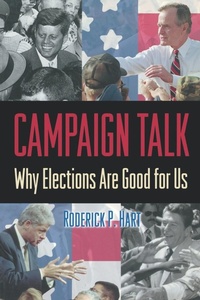
Campaign Talk
Why Elections Are Good for Us
Will be published approx. on 7. April 2002
Book
Paperback/Softback
328 pages
978-0-691-09282-9 (ISBN)
Description
Roderick Hart may be among the few Americans who believe that what politicians say in a campaign actually matters. He also believes that campaigns work. Even as television coverage, political ads, and opinion polls turn elections into field days for marketing professionals, Hart argues convincingly that campaigns do play their role in sustaining democracy, mainly because they bring about a dialogue among candidates, the press, and the people. Here he takes a close look at the exchange of ideas through language used in campaign speeches, political advertising, public debates, print and broadcast news, and a wide variety of letters to the editor. In each case, the participants choose their words differently, and this, according to Hart, can be a frustrating challenge to anyone trying to make sense of the issues. Yet he finds that the process is good for Americans: campaigns inform us about issues, sensitize us to the concerns of others, and either encourage us to vote or at least heighten our sense of the political world.
Hart comes to his conclusions by using DICTION, a computer program that has enabled him to unearth substantive data, such as the many subtle shifts found in political language, over the past fifty years. This approach yields a rich variety of insights, including empirically based explanations of impressions created by political candidates. For example, in 1996 Bill Clinton successfully connected with voters by using many human-interest words--"you," "us," "people," "family." Bob Dole, however, alienated the public and even undermined his own claims of optimism by using an abundance of denial words--"can't," "shouldn't," "couldn't." Hart also tracks issue buzzwords such as "Medicare" to show how candidates and voters define and readjust their positions throughout the campaign dialogue. In the midst of today's increased media hype surrounding elections, Americans and the candidates they elect do seem to be listening to each other--as much as they did in years gone by. Hart's wide-ranging, objective investigation upends many of our stereotypes about political life and presents a new, more bracing, understanding of contemporary electoral behavior.
Hart comes to his conclusions by using DICTION, a computer program that has enabled him to unearth substantive data, such as the many subtle shifts found in political language, over the past fifty years. This approach yields a rich variety of insights, including empirically based explanations of impressions created by political candidates. For example, in 1996 Bill Clinton successfully connected with voters by using many human-interest words--"you," "us," "people," "family." Bob Dole, however, alienated the public and even undermined his own claims of optimism by using an abundance of denial words--"can't," "shouldn't," "couldn't." Hart also tracks issue buzzwords such as "Medicare" to show how candidates and voters define and readjust their positions throughout the campaign dialogue. In the midst of today's increased media hype surrounding elections, Americans and the candidates they elect do seem to be listening to each other--as much as they did in years gone by. Hart's wide-ranging, objective investigation upends many of our stereotypes about political life and presents a new, more bracing, understanding of contemporary electoral behavior.
Reviews / Votes
Winner of the 2009 Doris Graber Book Award, Section on Political Communication of the American Political Science Association "This upbeat assessment is founded on a careful look at language... Readers may not be ready to embrace electoral politics as a national treasure, but Hart's suggestion that at least something positive can be gleaned from the campaign trail is reassuring."--Publishers Weekly "Campaign Talk should be required reading for politicians and their speechwriters. However, it is also for political campaign workers who talk about "staying on the message" and really for anyone who need to be reminded that democracy is not for the complacent but rather it is a dirty-your-fingernails process that anyone can, and should, dive into."--David Kissinger, San Franciso Bay Guardian "Hart is to be complimented for what is ... a brave premise and encouraging analysis... [He] has written a useful and impressive book."--Lane Crothers, Quarterly Journal of Speech "For those cynical and pessimistic about American political campaigns, this book may be an appropriate antidote... The sophisticated research methodology does not detract from the readable text."--Library Journal "In [his] fascinating new book ... Roderick Hart uses a computer to analyze the language of candidates to see how their vocabularies work. Specifically, [he] shows how a candidate is or is not in touch with his times."--Suzanne Fields, Washington Times "The book to buy for the Rodney Dangerfield campaign operative in your life, sure to buck him up on those long bus rides."--Carlin Romano, Philadelphia Inquirer "Hart forces us to rethink some cliches of political kibitzing... Campaigns teach, sensitize, and activate the people as they preach to them."--Carlin Romano, Philadelphia Inquirer "[Hart] treats presidential campaigns as a conversation among the people, the press, and the nation's leaders, and finds they serve the nation well. Such optimistic conclusions seem to run against the conventional wisdom and numerous recent more rigorous analyses, yet it would be difficult to find in Hart's persuasive and enthusiastic analysis flaws serious enough to undermine his conclusions. The success of his volume lies precisely in the mix of "hard" and "soft" methodology. American democracy seen through the prism of work usage looks impressively stable and efficient... No matter how skeptical and cautious readers may be, they must admit that Hart develops his argument in a captivatingly persuasive fashion."--Bohdan Szlarski, The Review of PoliticsMore details
Language
English
Place of publication
New Jersey
United States
Target group
Professional and scholarly
College/higher education
Product notice
Paperback (trade)
Illustrations
20 line illustrations, 11 tables
Dimensions
Height: 229 mm
Width: 152 mm
Thickness: 19 mm
Weight
534 gr
ISBN-13
978-0-691-09282-9 (9780691092829)
Copyright in bibliographic data and cover images is held by Nielsen Book Services Limited or by the publishers or by their respective licensors: all rights reserved.
Schweitzer Classification
Other editions
Additional editions
E-Book
07/2009
1st Edition
Princeton University Press
€188.95
Available for download
Person
Roderick P. Hart holds the Shivers Chair in Communication and Government at the University of Texas, Austin and is Director of the Texas Institute for Civic Participation. He is the author of numerous works, including The Sound of Leadership, Modern Rhetorical Criticism, and Seducing America; How Television Charms the Modern Voter.
Content
List of Figures ix List of Tables xi Preface xiii CHAPTER 1 Campaign Questions 3 CHAPTER 2 Campaign Language 23 CHAPTER 3 Campaign Evolution 46 CHAPTER 4 Campaign Functions 75 CHAPTER 5 Campaign Forums 103 CHAPTER 6 The Political Voice 140 CHAPTER 7 The Media's Voice 169 CHAPTER 8 The People's Voice 199 CHAPTER 9 Campaign Reflections 226 APPENDIX 1 DICTION: The Text Analysis Program 245 APPENDIX 2 Statistical Notes 253 APPENDIX 3 Sampling Details 263 Notes 269 Index 299