

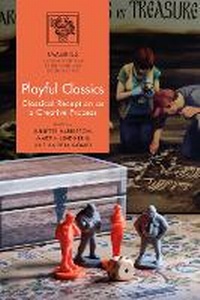
Playful Classics
Classical Reception as a Creative Process
Published on 14. November 2024
Book
Hardback
288 pages
978-1-350-41862-2 (ISBN)
Description
This is the first book to deal exclusively with ludic interactions with classical antiquity - an understudied research area within classical reception studies - that can shed light on current processes of construction and appropriation of the Greco-Roman world. Classical antiquity has, for many years, been sold as a product and consumed in a wide variety of forms of entertainment. As a result, games, playing and playful experiences are a privileged space for the reception of antiquity. Through the medium of games, players, performers and audiences are put into direct contact with the classical past, and encouraged to experience it in a participative, creative and subjective fashion.
The chapters in this volume, written by scholars and practitioners, cover a variety of topics and cultural artefacts including toys, board games and video games, as well as immersive experiences such as museums, theme parks and toga parties. The contributors tackle contemporary ludic practices and several papers establish a dialogue between artists and scholars, contrasting and harmonising their different approaches to the role of playfulness. Other chapters explore the educational potential of these manifestations, or their mediating role in shaping our conceptions of ancient Greece and Rome. Altogether, this edited collection is the first to offer a comprehensive overview of the ways we can play with antiquity.
The chapters in this volume, written by scholars and practitioners, cover a variety of topics and cultural artefacts including toys, board games and video games, as well as immersive experiences such as museums, theme parks and toga parties. The contributors tackle contemporary ludic practices and several papers establish a dialogue between artists and scholars, contrasting and harmonising their different approaches to the role of playfulness. Other chapters explore the educational potential of these manifestations, or their mediating role in shaping our conceptions of ancient Greece and Rome. Altogether, this edited collection is the first to offer a comprehensive overview of the ways we can play with antiquity.
Reviews / Votes
A brilliant and playful demonstration of how to organise, focus and contextualise these important individual contributions from a remarkable conference. -- Gregory N. Daugherty, Professor Emeritus of Classics Randolph-Macon College, USA One of the successes of this edited volume is the wide variety of specialities displayed and insights into varied areas of research. Extensive bibliographies after each entry will guide the novice reader to new possibilities. In the concluding Coda, Juliette Harrisson reiterates that "a playful reception of the ancient world is an active one, not a passive one" (261). 'Playing' in the ancient world not only creates deeper connections with the source material, it bathes it in a new light. * Classical Journal *More details
Series
Language
English
Place of publication
London
United Kingdom
Publishing group
Bloomsbury Publishing PLC
Target group
Professional and scholarly
Illustrations
54 bw illus
Dimensions
Height: 234 mm
Width: 157 mm
Thickness: 20 mm
Weight
580 gr
ISBN-13
978-1-350-41862-2 (9781350418622)
Copyright in bibliographic data and cover images is held by Nielsen Book Services Limited or by the publishers or by their respective licensors: all rights reserved.
Schweitzer Classification
Other editions
Additional editions
Juliette Harrisson | Martin Lindner | Luis Unceta Gomez
Playful Classics
Classical Reception as a Creative Process
E-Book
11/2024
1st Edition
Bloomsbury Academic
€31.99
Available for download
Juliette Harrisson | Martin Lindner | Luis Unceta Gomez
Playful Classics
Classical Reception as a Creative Process
E-Book
10/2024
1st Edition
Bloomsbury Academic
€31.99
Available for download
Persons
Juliette Harrisson is Senior Lecturer in Ancient History at Birmingham Newman University, UK.
Martin Lindner is Lecturer in Ancient History and Curator of the Tom Stern Collection film archive at the University of Goettingen, Germany.
Luis Unceta Gomez is Lecturer in Latin Philology at the Autonomous University of Madrid, Spain.
Martin Lindner is Lecturer in Ancient History and Curator of the Tom Stern Collection film archive at the University of Goettingen, Germany.
Luis Unceta Gomez is Lecturer in Latin Philology at the Autonomous University of Madrid, Spain.
Content
Introduction: Thinking About Playful Classics - A Beginners' Guide, Martin Lindner (University of Goettingen, Germany)
Section I: Toys and Games
1. Playing with Caesar and Cleopatra - Anticising Play Figures and Historical Thinking of (Young) Children, Anabelle Thurn (University of Education Freiburg, Germany)
2. Card Games and Antiquity in Spain, Antonio Dupla Ansuategui (University of the Basque Country, Spain)
3. Designing "Archaeologists vs Treasure Hunters" - Just Another Board Game?, Irina Vagalinska (Independent Scholar, Bulgaria) and Lyudmil Vagalinski (National Archaeological Institute and Museum, Bulgaria)
Section II: Virtual Realities
4. The Playing Field - The Study of Classical Antiquity in Video Games and the Database Project "Paizomen", Alexander Vandewalle (University of Antwerp and Ghent University, Belgium)
5. "Let's Analyse Ancient Greece" - Digital Game-based Learning and "Assassin's Creed Odyssey", Kai Matuszkiewicz (Marburg University, Germany) and Kai Ruffing (Kassel University, Germany)
Section III: Playing on Stage
6. Repraesentatio in Musica: Researches about Antiquity in French Baroque Music and its Impact on Today's Performance Practice, Antonius Adamske (Independent Scholar, Germany)
7. "That's Greek to Me" - Disco Life, Game-shows, and Queer Intimacies in Richard Move's "Achilles' Heels", Zoa Alonso Fernandez (Autonomous University of Madrid, Spain)
8. Playing Classical Drama - "Young" Theatre Festivals and the "Non-school" of Ravenna, Martina Treu (IULM University, Milan) and non scuola (Independent Scholar, Italy)
Section IV: Immersive Antiquities
9. Toga parties - Ludic Re-enactments of a Lubricious Rome, Luis Unceta Gomez (Autonomous University of Madrid, Spain)
10. Curses, Mummies, and Colonial Style - Archaeology in the Theme Park, Filippo Carla-Uhink (Potsdam University, Germany) and Florian Freitag (University of Duisburg-Essen, Germany)
11. Classical Reception in Street Art Performance, Anna Socha (University of Liverpool, UK) and PichiAvo (Independent Scholar, Spain)
Section V: National Traditions
12. Forges' Vision of the Roman Conquest of the Iberian Peninsula, Pepa Castillo (La Rioja University, Spain)
13. Playing with Greek Mythology in Russian Animation, Chiara Sulprizio (Vanderbilt University, USA)
14. Playground "WeChat" - Western Classics in Chinese Social Media, Sven Guenther (Changchun University, China)
Coda: The Interaction of Play and Other Receptions, Juliette Harrisson (Birmingham Newman University, UK)
Notes
Bibliography
Index
Section I: Toys and Games
1. Playing with Caesar and Cleopatra - Anticising Play Figures and Historical Thinking of (Young) Children, Anabelle Thurn (University of Education Freiburg, Germany)
2. Card Games and Antiquity in Spain, Antonio Dupla Ansuategui (University of the Basque Country, Spain)
3. Designing "Archaeologists vs Treasure Hunters" - Just Another Board Game?, Irina Vagalinska (Independent Scholar, Bulgaria) and Lyudmil Vagalinski (National Archaeological Institute and Museum, Bulgaria)
Section II: Virtual Realities
4. The Playing Field - The Study of Classical Antiquity in Video Games and the Database Project "Paizomen", Alexander Vandewalle (University of Antwerp and Ghent University, Belgium)
5. "Let's Analyse Ancient Greece" - Digital Game-based Learning and "Assassin's Creed Odyssey", Kai Matuszkiewicz (Marburg University, Germany) and Kai Ruffing (Kassel University, Germany)
Section III: Playing on Stage
6. Repraesentatio in Musica: Researches about Antiquity in French Baroque Music and its Impact on Today's Performance Practice, Antonius Adamske (Independent Scholar, Germany)
7. "That's Greek to Me" - Disco Life, Game-shows, and Queer Intimacies in Richard Move's "Achilles' Heels", Zoa Alonso Fernandez (Autonomous University of Madrid, Spain)
8. Playing Classical Drama - "Young" Theatre Festivals and the "Non-school" of Ravenna, Martina Treu (IULM University, Milan) and non scuola (Independent Scholar, Italy)
Section IV: Immersive Antiquities
9. Toga parties - Ludic Re-enactments of a Lubricious Rome, Luis Unceta Gomez (Autonomous University of Madrid, Spain)
10. Curses, Mummies, and Colonial Style - Archaeology in the Theme Park, Filippo Carla-Uhink (Potsdam University, Germany) and Florian Freitag (University of Duisburg-Essen, Germany)
11. Classical Reception in Street Art Performance, Anna Socha (University of Liverpool, UK) and PichiAvo (Independent Scholar, Spain)
Section V: National Traditions
12. Forges' Vision of the Roman Conquest of the Iberian Peninsula, Pepa Castillo (La Rioja University, Spain)
13. Playing with Greek Mythology in Russian Animation, Chiara Sulprizio (Vanderbilt University, USA)
14. Playground "WeChat" - Western Classics in Chinese Social Media, Sven Guenther (Changchun University, China)
Coda: The Interaction of Play and Other Receptions, Juliette Harrisson (Birmingham Newman University, UK)
Notes
Bibliography
Index