

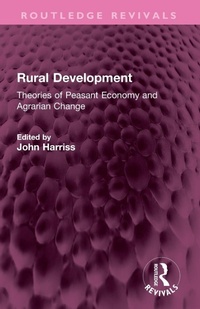
Rural Development
Theories of Peasant Economy and Agrarian Change
1st Edition
Published on 1. August 2025
Book
Paperback/Softback
412 pages
978-1-032-55688-8 (ISBN)
Description
Originally published in 1982, this book provides an important set of basic materials for students of rural development. Key papers have been chosen and arranged, and the editor has provided a general introduction and passages that link the papers, alerting the student to rival theoretical interpretations and to regional parallels and contrasts. The book provides a basis for the analysis of the processes that make rural societies and economies what they are and substantially determine the changes that take place within them. The papers help the reader to understand the nature of the phenomena with which rural development has to deal, and in doing so to begin to evaluate the interventions of agencies and planners.
Reviews / Votes
'What makes the volume more than useful or handy...is the insight John Harriss brings to the introductions which preface each major section and go considerably beyond simply summarising the arguments of the individual papers...It is difficult to be critical of the Harriss volume. Many of the articles...represent classic thinking on rural development...' Susanne D. Mueller, The Journal of Development Studies, Volume 20, Issue 3.More details
Series
Language
English
Place of publication
London
United Kingdom
Publishing group
Taylor & Francis Ltd
Target group
College/higher education
Undergraduate Advanced and Undergraduate Core
Product notice
Paperback (trade)
Dimensions
Height: 216 mm
Width: 140 mm
Thickness: 21 mm
Weight
476 gr
ISBN-13
978-1-032-55688-8 (9781032556888)
Copyright in bibliographic data and cover images is held by Nielsen Book Services Limited or by the publishers or by their respective licensors: all rights reserved.
Schweitzer Classification
Other editions
Additional editions

E-Book
08/2023
1st Edition
Routledge
€41.99
Available for download

E-Book
08/2023
1st Edition
Routledge
€41.99
Available for download
Book
08/2023
1st Edition
Routledge
€133.10
Shipment within 10-20 days
Person
John Harriss a Fellow of the Royal Society of Canada, is Professor Emeritus of International Studies at Simon Fraser University, Vancouver, having taught previously at the London School of Economics and the University of East Anglia. He has carried on research in Asia, mostly in India, since the early 1970s.
Content
Part 1: Analyses of Agrarian Change and Rural Development 'Strategies'. Introduction. 1. 'Unimodal' and 'Bimodal' Strategies of Agrarian Change B. F. Johnston and P. Kilby 2. Why Poor People Stay Poor Michael Lipton 3. Agrarian Transition and the Agrarian Question T. J. Byres 4. Urban Bias, Rural Bias and Industrialization: An Appraisal of the Work of Michael Lipton and Terry Byres Stuart Corbridge Part 2: Structural Analysis of Agrarian Change: Capital and Peasantry Introduction 5. The Differentiation of the Peasantry V. I. Lenin 6. Classical Discussions of Capital and Peasantry: A Critique Goeran Djurfeldt 7. Notes on Capital and Peasantry Henry Bernstein 8. Peasant Economies and the Development of Capitalist Agriculture in the Cauca Valley, Colombia M. Taussig Part 3: Analyses of the Peasant Farm Economy Introduction 9. Polarization and Cyclical Mobility: The Russian Debate Over the Differentiation of the Peasantry Teodor Shanin 10. Chayanov's Theory of Peasant Economy Mark Harrison 11. Game Against Nature: Theories of Peasant Decision Making Michael Lipton 12. Production Conditions in Indian Agriculture Krishna Bharadwaj Part 4: Rural Labour Introduction 13. Population, Involution and Employment in Rural Java Benjamin White 14. Peasants, Proletarianization and the Articulation of Modes of Production: The Case of Sugar Cane Cutters in Norther Peru, 1940-69 C. D. Scott Part 5: The State and the Peasantry. Introduction. 15. The State and the Peasantry in Tanzania Philip Raikes 16. Taking the Part of Peasants Gavin Williams 17. Towards a Practical Theory of Agrarian Transition Mark Harrison.