

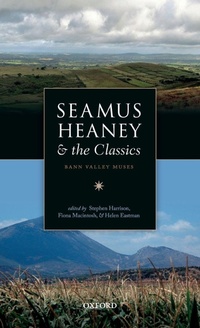
Seamus Heaney and the Classics
Bann Valley Muses
Published on 25. September 2019
Book
Hardback
304 pages
978-0-19-880565-6 (ISBN)
Description
Seamus Heaney, the great Irish poet, made a significant contribution to classical reception in modern poetry; though occasional essays have appeared in the past, this volume is the first to be wholly dedicated to this perspective on his work. Comprising literary criticism by scholars of both classical reception and contemporary literature in English, it includes contributions from critics who are also poets, as well as from theatre practitioners on their interpretations and productions of Heaney's versions of Greek drama; well-known names are joined by early-career contributors, and friends and collaborators of Heaney sit alongside those who admired him from afar.
The papers focus on two main areas: Heaney's fascination with Greek drama and myth - shown primarily in his two Sophoclean versions, but also in his engagement in other poems with Hesiod, with Aeschylus' Agamemnon, and with myths such as that of Antaeus - and his interest in Latin poetry, primarily that of Virgil but also that of Horace; a version of an Horatian ode was famously the vehicle for Heaney's comment on the events of 11 September 2001 in 'Anything Can Happen' (District and Circle, 2006). Although a number of the contributions cover similar material, they do so from distinctively different angles: for example, Heaney's interest in Virgil is linked with the traditions of Irish poetry, his capacity as a translator, and his annotations in his own text of a standard translation, as well as being investigated in its long development over his poetic career, while his Greek dramas are considered as verbal poetry, as comments on Irish politics, and as stage-plays with concomitant issues of production and interpretation. Heaney's posthumous translation of Virgil's Aeneid VI (2016) comes in for considerable attention, and this will be the first volume to study this major work from several angles.
The papers focus on two main areas: Heaney's fascination with Greek drama and myth - shown primarily in his two Sophoclean versions, but also in his engagement in other poems with Hesiod, with Aeschylus' Agamemnon, and with myths such as that of Antaeus - and his interest in Latin poetry, primarily that of Virgil but also that of Horace; a version of an Horatian ode was famously the vehicle for Heaney's comment on the events of 11 September 2001 in 'Anything Can Happen' (District and Circle, 2006). Although a number of the contributions cover similar material, they do so from distinctively different angles: for example, Heaney's interest in Virgil is linked with the traditions of Irish poetry, his capacity as a translator, and his annotations in his own text of a standard translation, as well as being investigated in its long development over his poetic career, while his Greek dramas are considered as verbal poetry, as comments on Irish politics, and as stage-plays with concomitant issues of production and interpretation. Heaney's posthumous translation of Virgil's Aeneid VI (2016) comes in for considerable attention, and this will be the first volume to study this major work from several angles.
Reviews / Votes
The first full examination of the Irish poet's rich contribution to the field of classical reception ... This rich volume provides an excellent handbook for the teaching of Heaney's classical receptions, and a welcome stimulus for further research. * Emma Bridges and Henry Stead, Greece & Rome * ... the essays in this collection offer the reader a comprehensive introduction to the massive ... influence that classical literature had on Heaney, both as a translator and a poet. * Sidney Burris, The Classical Review * In all, this volume is rich in detail and methodological approaches, highly recommended for readers of Heaney and of the Classics. * Will Desmond, Maynooth University *More details
Language
English
Place of publication
Oxford
United Kingdom
Target group
Professional and scholarly
Illustrations
4 colour illustrations
Dimensions
Height: 222 mm
Width: 145 mm
Thickness: 20 mm
Weight
516 gr
ISBN-13
978-0-19-880565-6 (9780198805656)
Copyright in bibliographic data and cover images is held by Nielsen Book Services Limited or by the publishers or by their respective licensors: all rights reserved.
Schweitzer Classification
Other editions
Additional editions
E-Book
09/2019
1st Edition
OUP eBook
€65.49
Available for download
E-Book
09/2019
1st Edition
OUP eBook
€56.49
Available for download
Persons
Stephen Harrison is Professor of Latin Literature at the University of Oxford, Fellow and Tutor in Classics at Corpus Christi College, Oxford, and Adjunct Professor at the universities of Copenhagen and Trondheim. He has published extensively on Latin literature and its reception, including the following volumes: A Commentary on Vergil, Aeneid 10 (OUP, 1991), Generic Enrichment in Vergil and Horace (OUP, 2007), Living Classics: Greece and Rome in Contemporary Poetry in English (edited volume; OUP, 2009), Louis MacNeice: The Classical Radio Plays (co-edited with Amanda Wrigley; OUP, 2013), and Classics in the Modern World: A Democratic Turn? (co-edited with Lorna Hardwick; OUP, 2013).
Fiona Macintosh is Professor of Classical Reception, Director of the Archive of Performances of Greek and Roman Drama (APGRD), and Fellow of St Hilda's College at the University of Oxford. She is the author of Dying Acts: Death in Ancient Greek and Modern Irish Tragic Drama (Cork University Press, 1994), Greek Tragedy and the British Theatre, 1660-1914 (with Edith Hall; OUP, 2005), and Sophocles: Oedipus Tyrannus (CUP, 2009), and has also edited numerous APGRD volumes, including most recently Epic Performances from the Middle Ages into the Twenty-First Century (with Justine McConnell, Stephen Harrison, and Claire Kenward; OUP, 2018) and The Oxford Handbook of Greek Drama in the Americas (with Kathryn Bosher, Justine McConnell, and Patrice Rankine; OUP, 2015).
Helen Eastman trained as a director at LAMDA after graduating from the University of Oxford, where she was the Passmore Edwards Scholar in Classics and English. She is currently an Artistic Associate at the Archive of Performances of Greek and Roman Drama (APGRD) at the University of Oxford, Visiting Lecturer in Contemporary Performance Practice at Westminster University, Artistic Director of Live Canon, and Senior Reader at Soho Theatre. As a freelance director of theatre and opera (and also occasionally of circus), she has worked throughout the UK at venues including Trafalgar Studios, Hackney Empire, Belfast Opera House, Glasgow Citizens Theatre, Queens Theatre, BAC, The National Theatre Studio, The De La Warr Pavilion, and Bath Theatre Royal.
Fiona Macintosh is Professor of Classical Reception, Director of the Archive of Performances of Greek and Roman Drama (APGRD), and Fellow of St Hilda's College at the University of Oxford. She is the author of Dying Acts: Death in Ancient Greek and Modern Irish Tragic Drama (Cork University Press, 1994), Greek Tragedy and the British Theatre, 1660-1914 (with Edith Hall; OUP, 2005), and Sophocles: Oedipus Tyrannus (CUP, 2009), and has also edited numerous APGRD volumes, including most recently Epic Performances from the Middle Ages into the Twenty-First Century (with Justine McConnell, Stephen Harrison, and Claire Kenward; OUP, 2018) and The Oxford Handbook of Greek Drama in the Americas (with Kathryn Bosher, Justine McConnell, and Patrice Rankine; OUP, 2015).
Helen Eastman trained as a director at LAMDA after graduating from the University of Oxford, where she was the Passmore Edwards Scholar in Classics and English. She is currently an Artistic Associate at the Archive of Performances of Greek and Roman Drama (APGRD) at the University of Oxford, Visiting Lecturer in Contemporary Performance Practice at Westminster University, Artistic Director of Live Canon, and Senior Reader at Soho Theatre. As a freelance director of theatre and opera (and also occasionally of circus), she has worked throughout the UK at venues including Trafalgar Studios, Hackney Empire, Belfast Opera House, Glasgow Citizens Theatre, Queens Theatre, BAC, The National Theatre Studio, The De La Warr Pavilion, and Bath Theatre Royal.
Editor
Professor of Latin Literature and Fellow and Tutor in ClassicsProfessor of Latin Literature and Fellow and Tutor in Classics, Corpus Christi College, University of Oxford
Professor of Classical Reception, Director of the Archive of Performances of Greek and Roman Drama (APGRD), and Fellow of St Hilda's CollegeProfessor of Classical Reception, Director of the Archive of Performances of Greek and Roman Drama (APGRD), and Fellow of St Hilda's College, University of Oxford
Freelance director of theatre and opera and Artistic Associate at the Archive of Performances of Greek and Roman Drama (APGRD)Freelance director of theatre and opera and Artistic Associate at the Archive of Performances of Greek and Roman Drama (APGRD), University of Oxford
Content
Frontmatter
List of Figures
List of Contributors
1: Stephen Harrison and Fiona Macintosh: Introduction
2: Oliver Taplin: Boustrophedon between Hellas and Home
3: Neil Corcoran: Antaeus on the Move
4: Rowena Fowler: Heaney and Hesiod
5: Rosie Lavan: Mycenae Lookout' and the Example of Aeschylus
6: Lucy Pitman-Wallace: A Door into the Dark: Staging The Burial at Thebes
7: Helen Eastman: Ancient Greek Sailors with Twentieth-Century Metaphors (and Pan-Chronic Trousers): Directing Seamus Heaney's The Cure at Troy
8: Michael Parker: Speaking Truth to Power: Seamus Heaney's The Burial at Thebes and the Poetry of Redress
9: Marianne McDonald: Seamus Heaney: An Irish Poet Mines the Classics
10: Bernard O'Donoghue: Heaney, Yeats, and the Language of Pastoral
11: Peter McDonald: Weird Brightness' and the Riverbank: Seamus Heaney, Virgil, and the Need for Translation
12: Rachel Falconer: Heaney and Virgil's Underworld Journey
13: Kathleen Riley: The Forewarned Journey Back': Katabasis as Nostos in the Poetry of Seamus Heaney
14: Edith Hall: Paving and Pencilling: Heaney's Inscriptions in J. W. Mackail's Translation of the Aeneid
15: Stephen Harrison: Heaney as Translator: Virgil and Horace
16: Lorna Hardwick: Epilogue: Heaney's Classical Ground
Endmatter
Bibliography
Index of Works of Seamus Heaney Cited
Index of Classical Works Cited
General Index
List of Figures
List of Contributors
1: Stephen Harrison and Fiona Macintosh: Introduction
2: Oliver Taplin: Boustrophedon between Hellas and Home
3: Neil Corcoran: Antaeus on the Move
4: Rowena Fowler: Heaney and Hesiod
5: Rosie Lavan: Mycenae Lookout' and the Example of Aeschylus
6: Lucy Pitman-Wallace: A Door into the Dark: Staging The Burial at Thebes
7: Helen Eastman: Ancient Greek Sailors with Twentieth-Century Metaphors (and Pan-Chronic Trousers): Directing Seamus Heaney's The Cure at Troy
8: Michael Parker: Speaking Truth to Power: Seamus Heaney's The Burial at Thebes and the Poetry of Redress
9: Marianne McDonald: Seamus Heaney: An Irish Poet Mines the Classics
10: Bernard O'Donoghue: Heaney, Yeats, and the Language of Pastoral
11: Peter McDonald: Weird Brightness' and the Riverbank: Seamus Heaney, Virgil, and the Need for Translation
12: Rachel Falconer: Heaney and Virgil's Underworld Journey
13: Kathleen Riley: The Forewarned Journey Back': Katabasis as Nostos in the Poetry of Seamus Heaney
14: Edith Hall: Paving and Pencilling: Heaney's Inscriptions in J. W. Mackail's Translation of the Aeneid
15: Stephen Harrison: Heaney as Translator: Virgil and Horace
16: Lorna Hardwick: Epilogue: Heaney's Classical Ground
Endmatter
Bibliography
Index of Works of Seamus Heaney Cited
Index of Classical Works Cited
General Index