

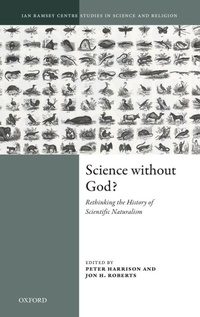
Science Without God?
Rethinking the History of Scientific Naturalism
Published on 17. January 2019
Book
Hardback
280 pages
978-0-19-883458-8 (ISBN)
Description
Can scientific explanation ever make reference to God or the supernatural? The present consensus is no; indeed, a naturalistic stance is usually taken to be a distinguishing feature of modern science. Some would go further still, maintaining that the success of scientific explanation actually provides compelling evidence that there are no supernatural entities, and that true science, from the very beginning, was opposed to religious thinking. Science without God? Rethinking the History of Scientific Naturalism shows that the history of Western science presents us with a more nuanced picture. Beginning with the naturalists of ancient Greece, and proceeding through the middle ages, the scientific revolution, and into the nineteenth century, the contributors examine past ideas about 'nature' and 'the supernatural'. Ranging over different scientific disciplines and historical periods, they show how past thinkers often relied upon theological ideas and presuppositions in their systematic investigations of the world. In addition to providing material that contributes to a history of 'nature' and naturalism, this collection challenges a number of widely held misconceptions about the history of scientific naturalism.
Reviews / Votes
I would highly recommend Science without God? to anyone who is interested in the relationship between science and religion and/or the history of scientific naturalism. * Nathan Bossoh, UCL/RI, Science & Christian Belief, Vol 33, No. 2 * This is a book for scholars with a serious interest in the relationship between religion and science. * C.G. Wood, CHOICE * this anthology provides a highly informative historical survey of the complicated tri-relation between science, naturalism, and theology. It can be recommended to anyone who is considering the emergence of scientific naturalism, its implications for theology, and the place of God in science. * Mikael Leidenhag, Philosophy, Theology and the Sciences * The book is an excellent source if one wishes to know anything about the religious and supernatural commitments and motivations of scientists over the course of the last 2,500 years. It deserves also to be noted that there is an impressive consistency in style throughout, with some of the authors even drawing parallels between their own arguments and those found in other chapters. * Tiddy Smith, Journal of the American Academy of Religion * Peter Harrison and Jon H. Roberts provide a highly compelling alternative history of the sciences and their relation to naturalism that will be of direct relevance to contemporary philosophical arguments about the nature of scientific explanation and the enduring importance of religious belief. * Jamie Boulding, University of Leeds, Religious Studies *More details
Series
Language
English
Place of publication
Oxford
United Kingdom
Target group
Professional and scholarly
Dimensions
Height: 240 mm
Width: 161 mm
Thickness: 20 mm
Weight
599 gr
ISBN-13
978-0-19-883458-8 (9780198834588)
Copyright in bibliographic data and cover images is held by Nielsen Book Services Limited or by the publishers or by their respective licensors: all rights reserved.
Schweitzer Classification
Other editions
Additional editions
E-Book
01/2019
1st Edition
OUP eBook
€62.49
Available for download
E-Book
11/2018
1st Edition
OUP eBook
€62.49
Available for download
Persons
Peter Harrison is an Australian Laureate Fellow and Director of the Institute for Advanced Studies in the Humanities at the University of Queensland. He is the former Idreos Professor of Science and Religion at the University of Oxford. He has published extensively in the field of intellectual history with a focus on the relations between science and religion. His publications include The Bible, Protestantism and the Rise of Natural Science (1998) and The Territories of Science and Religion (2015).
Jon H. Roberts is the Tomorrow Foundation Professor of History at Boston University. He has written a number of articles dealing primarily with the history of the relationship between science and religion, as well as the book Darwinism and the Divine in America: Protestant Intellectuals and Organic Evolution, 1859-1900, which received the Frank S. and Elizabeth D. Brewer Prize from the American Society of Church History. He has also co-authored with James Turner The Sacred and the Secular University (2001).
Jon H. Roberts is the Tomorrow Foundation Professor of History at Boston University. He has written a number of articles dealing primarily with the history of the relationship between science and religion, as well as the book Darwinism and the Divine in America: Protestant Intellectuals and Organic Evolution, 1859-1900, which received the Frank S. and Elizabeth D. Brewer Prize from the American Society of Church History. He has also co-authored with James Turner The Sacred and the Secular University (2001).
Content
List of contributors
Peter Harrison: Introduction
1: Daryn Lehoux: All Things are Full of Gods: Naturalism in the Classical World
2: Michael H. Shank: Naturalist Tendencies in Medieval Science
3: Peter Harrison: Laws of God or Laws of Nature? Natural Order in the Early Modern Period
4: J. B. Shank: Between Newton and Newtonianism: Posing the 'God Question' in the Eighteenth-Century
5: Matthew Stanley: God and the Uniformity of Nature: The Case of Nineteenth-Century Physics
6: John Hedley Brooke: Chemistry with and without God
7: Michael Ruse: Removing God from Biology
8: Michelle Pfeffer: Christian Materialism and the Prospect of Immortality
9: Jon H. Roberts: The Science of the Soul: Naturalising the Mind in Great Britain and North America
10: Nicolaas Rupke: Down to Earth: Untangling the Secular from the Sacred in Late-Modern Geology
11: Scott Gerard Prinster: Naturalising the Bible: The Shifting Role of the Biblical Account of Nature
12: Constance Clark: Anthropology and Original Sin: Naturalizing Religion, Theorizing the Primitive
13: Bernard Lightman: The Theology of Victorian Scientific Naturalists
Peter Harrison: Introduction
1: Daryn Lehoux: All Things are Full of Gods: Naturalism in the Classical World
2: Michael H. Shank: Naturalist Tendencies in Medieval Science
3: Peter Harrison: Laws of God or Laws of Nature? Natural Order in the Early Modern Period
4: J. B. Shank: Between Newton and Newtonianism: Posing the 'God Question' in the Eighteenth-Century
5: Matthew Stanley: God and the Uniformity of Nature: The Case of Nineteenth-Century Physics
6: John Hedley Brooke: Chemistry with and without God
7: Michael Ruse: Removing God from Biology
8: Michelle Pfeffer: Christian Materialism and the Prospect of Immortality
9: Jon H. Roberts: The Science of the Soul: Naturalising the Mind in Great Britain and North America
10: Nicolaas Rupke: Down to Earth: Untangling the Secular from the Sacred in Late-Modern Geology
11: Scott Gerard Prinster: Naturalising the Bible: The Shifting Role of the Biblical Account of Nature
12: Constance Clark: Anthropology and Original Sin: Naturalizing Religion, Theorizing the Primitive
13: Bernard Lightman: The Theology of Victorian Scientific Naturalists