

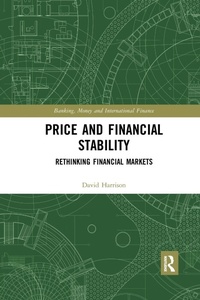
Price and Financial Stability
Rethinking Financial Markets
1st Edition
Published on 14. August 2020
Book
Paperback/Softback
118 pages
978-0-367-59065-9 (ISBN)
Description
Why are financial prices so much more crisis-prone and unstable than real economy prices? Because they are doing different things. Unlike real economy prices, rooted in the real goods and services produced and exchanged, financial prices attempt to value future income flows from financial and capital assets. These valuations fluctuate erratically because expectations of the future fluctuate - and large liquid financial markets can amplify, rather than correct, these effects. The book builds on the insights of economists Frank Knight and John Maynard Keynes, that uncertainty of the future is essential to understand the processes of economic production and capital investment, and adds to this Karl Popper's general explanation of how expectations of an uncertain future are formed and tested through a trial and error process. Rather than relying on fluctuating financial prices to provide a guide to an uncertain future, it suggests a better approach would be to adopt the methods common to other branches of science, and create testable (falsifiable) theories allowing reasonable predictions to be made. In finance, the elements of one such theory could be based on the concept of forecasting yield from capital assets, which is a measurable phenomenon tending towards aggregate and long-term stability, and where there is a plentiful supply of historic data. By methods like this, financial economics could become a branch of science like any other. To buttress this approach, the widely accepted public policy objective of promoting real economy price stability could be widened to include financial price stability.
Reviews / Votes
"How do producers form the expectations necessary to commit to new capital investment when the future is radically uncertain? How does the price system diffuse knowledge about prices? Is that knowledge reliable? These are among the crucial questions in economics. Drawing on the teaching of great 20th century philosophers such as Karl Popper as well as economists such as Maynard Keynes and Hyman Minsky, David Harrison offers an original analysis of these questions - and a solution.Authorities such as central banks, financial regulators and competition authorities should promote the public good of relative asset price stability. A new monetary standard, based on underlying yields, would not only reduce the severity of financial crises but also stimulate new investment, thus restoring the dynamism of the market economy." - Robert Pringle, Chairman of Central Banking journal, and author of The Money Trap
"David Harrison makes valuable contributions to understanding the underlying causes of the persistent instability of the financial system. Guided by the insights of some great thinkers of the last century - Hayek, Keynes and Popper - he shows that financial asset prices are inherently too volatile to be entrusted to overly emotional speculators. His suggestions for a better way are intriguing. This is an excellent introduction for newcomers to this debate, and a stimulating addition for weary veterans." - Edward Hadas, Economic and financial journalist, and Reuters Breakingviews columnist
"David Harrison shows that, in the decades since the end of the Bretton Woods system, many political crises turn out to have an economic origin - and that most economic crises are rooted in finance. How to stabilise financial markets and harness short-term speculation for more productive long-term investment remains a major unsolved global policy problem, with important implications for the UK and Europe as a whole. As we continue to grapple with the aftershocks of the last financial crisis, Harrison's suggestions for avoiding future crises are timely and deserve serious attention." - Anthony Teasdale, author of The Penguin Companion to European Union
"[W]e really need "a new European long term capital market". While there are many short term trading platforms for securities, there exists no long term capital market of a pan-European scale. As has recently been suggested by David Harrison, and in line with the proposals [...] on a special asset class for infrastructure investment, we need a market "designed for the purchase of securities to be held over the long term". [...] Imaginative solutions are called for and such proposals should be examined by the Commission." - Jacques de Larosiere, former Managing Director of the International Monetary Fund, and author of Cinquante Ans de Crises Financieres, speaking before the European Parliament, June 2016
More details
Series
Language
English
Place of publication
London
United Kingdom
Publishing group
Taylor & Francis Ltd
Target group
College/higher education
Postgraduate and Undergraduate
Dimensions
Height: 234 mm
Width: 156 mm
Thickness: 7 mm
Weight
207 gr
ISBN-13
978-0-367-59065-9 (9780367590659)
Copyright in bibliographic data and cover images is held by Nielsen Book Services Limited or by the publishers or by their respective licensors: all rights reserved.
Schweitzer Classification
Other editions
Additional editions
Book
05/2018
1st Edition
Routledge
€215.41
Shipment within 10-20 days
E-Book
05/2018
1st Edition
Routledge
€61.99
Available for download
E-Book
05/2018
1st Edition
Routledge
€61.99
Available for download
Person
David Harrison is Legal Director at London law firm DAC Beachcroft LLP, UK. He previously held several positions relating to economic and international affairs, including speechwriter for the UK Foreign Secretary and for the President of the European Bank for Reconstruction and Development. Previous publications include The Organisation of Europe (Routledge, 1995) and Competition Law and Financial Services (Routledge, 2014).
Content
Preface; 1 A brief history of our time; 2 Expectations, knowledge and prices; 3 Beyond price; 4 Savings, investment and liquidity; 5 Models, theories and apples; 6 Policy implications - finance; 7 Competition policy; 8 A new European capital market; 9 Geopolitics; Technical annex: Do we really need a new Bretton Woods?