

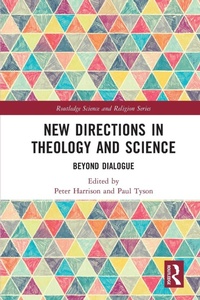
New Directions in Theology and Science
Beyond Dialogue
1st Edition
Published on 25. September 2023
Book
Paperback/Softback
208 pages
978-1-032-14644-7 (ISBN)
Description
This book sets out a new agenda for science-theology interactions and offers examples of what that agenda might look like when implemented. It explores, in innovative ways, what follows for science-theology discussions from recent developments in the history of science. The contributions take seriously the historically conditioned nature of the categories 'science' and 'religion' and consider the ways in which these categories are reinforced in the public sphere. Reflecting on the balance of power between theology and the sciences, the authors demonstrate a commitment to moving beyond traditional models of one-sided dialogue and seek to give theology a more active role in determining the interdisciplinary agenda.
More details
Series
Language
English
Place of publication
London
United Kingdom
Publishing group
Taylor & Francis Ltd
Target group
College/higher education
Dimensions
Height: 234 mm
Width: 156 mm
Thickness: 12 mm
Weight
342 gr
ISBN-13
978-1-032-14644-7 (9781032146447)
Copyright in bibliographic data and cover images is held by Nielsen Book Services Limited or by the publishers or by their respective licensors: all rights reserved.
Schweitzer Classification
Other editions
Additional editions
E-Book
01/2022
1st Edition
Routledge
€55.49
Available for download
E-Book
01/2022
1st Edition
Routledge
€55.49
Available for download
Book
01/2022
1st Edition
Routledge
€206.20
Shipment within 10-20 days
Persons
Peter Harrison is Director of the Institute for Advanced Studies of the Humanities, University of Queensland. He is an Australian Laureate Fellow who has published extensively in the field of intellectual history with a focus on the philosophical, scientific and religious thought of the early modern period. He is a Fellow of the Australian Academy of the Humanities, and a corresponding member of the International Academy for the History of Science. His six books include The Bible, Protestantism, and the Rise of Natural Science (Cambridge University Press, 1998), and The Territories of Science and Religion (University of Chicago Press, 2015), based on his 2011 Gifford Lectures and winner of the Aldersgate Prize.
Paul Tyson is an Honorary Senior Fellow at the Institute for Advanced Studies in the Humanities at the University of Queensland. His scholarship works across the sociology of knowledge and philosophical theology with a particular interest in applied theological metaphysics and applied theological epistemology in a contemporary Christian NeoPlatonist register. His books include: Returning to Reality (Cascade, 2014); Seven Brief Lessons on Magic (Cascade, 2019); Theology and Climate Change (Routledge, 2021).
Paul Tyson is an Honorary Senior Fellow at the Institute for Advanced Studies in the Humanities at the University of Queensland. His scholarship works across the sociology of knowledge and philosophical theology with a particular interest in applied theological metaphysics and applied theological epistemology in a contemporary Christian NeoPlatonist register. His books include: Returning to Reality (Cascade, 2014); Seven Brief Lessons on Magic (Cascade, 2019); Theology and Climate Change (Routledge, 2021).
Content
Introduction PART ONE: theology and the sciences 1. More history, more theology, more philosophy, more science: the state of theological engagement with science 2. Theology and science in the field 3. Religion and the science of climate destabilisation: the case for (re)entanglement 4. The inflation of nature and the Extended Evolutionary Synthesis PART TWO: 'science' and 'religion' in the public sphere 5. Pop science and pop theology: new ways of exploring an old dialogue David Wilkinson 6. An unfortunate communicatio idiomatum: on the curious spectacle of two modern inventions morphing into one another in the public square 7. Is science the theology of modernity? PART THREE: theologies of science 8. Why do scientific research in the 21st century? 9. After an apologetics of conflict: biblical exegesis for a creation theology of science 10. Creation as deconstruction in Cusanus, Luther, and Hamann AFTERWORD: The bigger picture: science, religion, and historical change 11. Divine pedagogy - speculations about 'science' and 'religion' after the next great breakthrough