

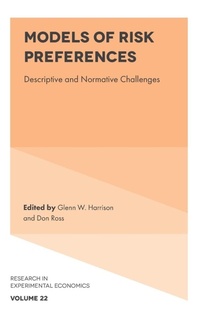
Models of Risk Preferences
Descriptive and Normative Challenges
Published on 23. October 2023
Book
Hardback
264 pages
978-1-83797-269-2 (ISBN)
Description
Behavioural economists have developed alternatives to Expected Utility Theory as descriptive and normative models of risk preferences. One popular view is that these alternative descriptive models are generally better descriptively, but that they tend to be inferior normative models for guiding risky decisions. Models of Risk Preferences collects studies that critically review these two claims from the perspective of experimental economics.
The Research in Experimental Economics series focuses on laboratory experimental economics, but includes theoretical, empirical, or field economic research to encompass the broader experimental economics community.
The Research in Experimental Economics series focuses on laboratory experimental economics, but includes theoretical, empirical, or field economic research to encompass the broader experimental economics community.
More details
Series
Language
English
Place of publication
Bingley
United Kingdom
Target group
Professional and scholarly
Dimensions
Height: 235 mm
Width: 157 mm
Thickness: 19 mm
Weight
540 gr
ISBN-13
978-1-83797-269-2 (9781837972692)
Copyright in bibliographic data and cover images is held by Nielsen Book Services Limited or by the publishers or by their respective licensors: all rights reserved.
Schweitzer Classification
Other editions
Additional editions
E-Book
10/2023
1st Edition
Emerald Publishing Limited
€111.99
Available for download
Persons
Glenn W. Harrison is University Distinguished Professor, C.V. Starr Chair of Risk Management & Insurance and Director of the Center for the Economic Analysis of Risk, Maurice R. Greenberg School of Risk Science, J. Mack Robinson College of Business, Georgia State University. His current research spans risk management & perception, experimental economics, behavioural econometrics, behavioural welfare economics and development economics.
Don Ross is Professor in the School of Society, Politics, and Ethics at University College Cork, Professor in the School of Economics at the University of Cape Town, and Program Director for Methodology at the Centre for the Economic Analysis of Risk at Georgia State University. His current research focuses on experimental studies and theoretical modeling of risk and time preferences in humans and other animals, gambling disorders and policy, economic methodology, the economics of road transport networks in Africa, and the metaphysical implications of science.
Don Ross is Professor in the School of Society, Politics, and Ethics at University College Cork, Professor in the School of Economics at the University of Cape Town, and Program Director for Methodology at the Centre for the Economic Analysis of Risk at Georgia State University. His current research focuses on experimental studies and theoretical modeling of risk and time preferences in humans and other animals, gambling disorders and policy, economic methodology, the economics of road transport networks in Africa, and the metaphysical implications of science.
Content
Introduction; Glenn W. Harrison and Don Ross
Chapter 1. Behavioral Welfare Economics and the Quantitative Intentional Stance; Glenn W. Harrison and Don Ross
Chapter 2. Unusual Estimates of Probability Weighting Functions; Nathaniel T. Wilcox
Chapter 3. Cumulative Prospect Theory in the Laboratory: A Reconsideration; Glenn W. Harrison and J. Todd Swarthout
Chapter 4. Temporal Stability of Cumulative Prospect Theory; Morten I. Lau, Hong Il Yoo, and Hongming Zhao
Chapter 5. The Welfare Consequences of Individual-Level Risk Preference Estimation; Brian Albert Monroe
Chapter 1. Behavioral Welfare Economics and the Quantitative Intentional Stance; Glenn W. Harrison and Don Ross
Chapter 2. Unusual Estimates of Probability Weighting Functions; Nathaniel T. Wilcox
Chapter 3. Cumulative Prospect Theory in the Laboratory: A Reconsideration; Glenn W. Harrison and J. Todd Swarthout
Chapter 4. Temporal Stability of Cumulative Prospect Theory; Morten I. Lau, Hong Il Yoo, and Hongming Zhao
Chapter 5. The Welfare Consequences of Individual-Level Risk Preference Estimation; Brian Albert Monroe