

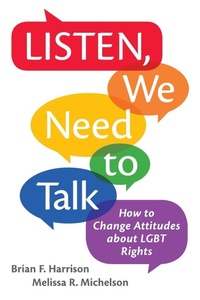
Listen, We Need to Talk
How to Change Attitudes about LGBT Rights
Published on 10. January 2017
Book
Paperback/Softback
240 pages
978-0-19-065475-7 (ISBN)
Description
American public opinion tends to be sticky. Although the news cycle might temporarily affect the public zeitgeist about abortion, the death penalty, or gun control, public support or opposition on these issues has remained remarkably constant over decades. But there are notable exceptions, particularly with regard to polarizing issues that highlight identity politics. Over the past three decades, public support for same-sex marriage has risen from scarcely more than a tenth to a majority of the population. Why have people's minds changed so dramatically on this issue, and why so quickly?
Listen, We Need to Talk tests a theory that when prominent people representing particular interest groups voice support for a culturally contentious issue, they sway the opinions of others who identify with the same group, even if the interest group and the issue at hand have no obvious connection. In fact this book shows that the more the message counters prevailing beliefs or attitudes of a particular identity group, the more persuasive it is. While previous studies of political attitude change have looked at the effects of message priming (who delivers a message) on issues directly related to particular identity groups, this study is unique in that it looks at how identity priming affects attitudes and behaviors toward an issue that is not central or directly related to the targeted group. The authors prove their theory through a series of random experiments testing the positive effects of identity-based messaging regarding same-sex marriage among fans of professional sports, religious groups, and ethnoracial (Black and Latino) groups.
Listen, We Need to Talk tests a theory that when prominent people representing particular interest groups voice support for a culturally contentious issue, they sway the opinions of others who identify with the same group, even if the interest group and the issue at hand have no obvious connection. In fact this book shows that the more the message counters prevailing beliefs or attitudes of a particular identity group, the more persuasive it is. While previous studies of political attitude change have looked at the effects of message priming (who delivers a message) on issues directly related to particular identity groups, this study is unique in that it looks at how identity priming affects attitudes and behaviors toward an issue that is not central or directly related to the targeted group. The authors prove their theory through a series of random experiments testing the positive effects of identity-based messaging regarding same-sex marriage among fans of professional sports, religious groups, and ethnoracial (Black and Latino) groups.
Reviews / Votes
This fascinating, well-researched book includes helpful methodological discussions about theory of dissonant identity priming experiments and will greatly interest researchers and activists seeking to change attitudes about controversial social issues (e.g., transgender equality, marijuana legalization). * CHOICE * This book, while covering a wide breadth of populations, experimental methodologies and technical jargon, is written in a way which is approachable for persons both in and out of academia. It provides highly detailed statistics, tables and appendices, while also covering necessary historical and background information concerning the fight for equal rights among LGBT persons ... This book is a timely and informative piece and a must-read for any and all interested in LGBT rights, marriage equality, identity-priming and attitudinal change. * Marina Costa, Society for the Psychology of Sexual Orientation and Gender Diversity *More details
Language
English
Place of publication
New York
United States
Target group
Professional and scholarly
Dimensions
Height: 234 mm
Width: 156 mm
Thickness: 15 mm
Weight
445 gr
ISBN-13
978-0-19-065475-7 (9780190654757)
Copyright in bibliographic data and cover images is held by Nielsen Book Services Limited or by the publishers or by their respective licensors: all rights reserved.
Schweitzer Classification
Other editions
Additional editions
Brian F. Harrison | Melissa R. Michelson
Listen, We Need to Talk
How to Change Attitudes about LGBT Rights
E-Book
01/2017
1st Edition
OUP eBook
€22.99
Available for download
Brian F. Harrison | Melissa R. Michelson
Listen, We Need to Talk
How to Change Attitudes about LGBT Rights
Book
01/2017
Oxford University Press Inc
€205.50
Shipment within 15-20 days
Brian F. Harrison | Melissa R. Michelson
Listen, We Need to Talk
How to Change Attitudes about LGBT Rights
E-Book
01/2017
OUP USA
€18.49
Available for download
Persons
Brian F. Harrison is Lecturer in Political Science at Northwestern University.
Melissa R. Michelson is Professor of Political Science at Menlo College.
Melissa R. Michelson is Professor of Political Science at Menlo College.
Content
List of Figures
List of Tables
Acknowledgments
Chapter 1: The Theory of Dissonant Identity Priming: How Identity, Source Similarity, and Message Characteristics Intersect to Influence Attitudes
Chapter 2: Marriage Equality and Other LGBT Issues in the U.S.
Chapter 3: More than a Game: Sports Fans and Marriage Equality
Chapter 4: God and Marriage: Activating Religious Identity to Influence Attitudes on Same-Sex Marriage
Chapter 5: It Does Matter if You're Black or White (or Brown): Ethnoracial Identity Priming
Chapter 6: Come Join the Party: The Power of Partisan Elite Cues
Chapter 7: Conclusion: On the Frontier of Public Opinion and LGBT Rights Research
Appendix A: Supplemental Tables
Appendix B: Experiment Scripts
Notes
Bibliography
Index
List of Tables
Acknowledgments
Chapter 1: The Theory of Dissonant Identity Priming: How Identity, Source Similarity, and Message Characteristics Intersect to Influence Attitudes
Chapter 2: Marriage Equality and Other LGBT Issues in the U.S.
Chapter 3: More than a Game: Sports Fans and Marriage Equality
Chapter 4: God and Marriage: Activating Religious Identity to Influence Attitudes on Same-Sex Marriage
Chapter 5: It Does Matter if You're Black or White (or Brown): Ethnoracial Identity Priming
Chapter 6: Come Join the Party: The Power of Partisan Elite Cues
Chapter 7: Conclusion: On the Frontier of Public Opinion and LGBT Rights Research
Appendix A: Supplemental Tables
Appendix B: Experiment Scripts
Notes
Bibliography
Index