

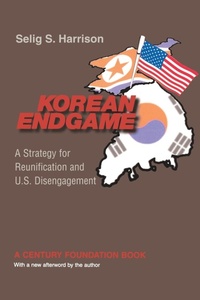
Korean Endgame
A Strategy for Reunification and U.S. Disengagement
Published on 21. August 2003
Book
Paperback/Softback
448 pages
978-0-691-11626-6 (ISBN)
Description
Nearly half a century after the fighting stopped, the 1953 Armistice has yet to be replaced with a peace treaty formally ending the Korean War. While Russia and China withdrew the last of their forces in 1958, the United States maintains 37,000 troops in South Korea and is pledged to defend it with nuclear weapons. In Korean Endgame, Selig Harrison mounts the first authoritative challenge to this long-standing U.S. policy. Harrison shows why North Korea is not--as many policymakers expect--about to collapse. And he explains why existing U.S. policies hamper North-South reconciliation and reunification. Assessing North Korean capabilities and the motivations that have led to its forward deployments, he spells out the arms control concessions by North Korea, South Korea, and the United States necessary to ease the dangers of confrontation, centering on reciprocal U.S. force redeployments and U.S. withdrawals in return for North Korean pullbacks from the thirty-eighth parallel. Similarly, he proposes specific trade-offs to forestall the North's development of nuclear weapons and missile delivery systems, calling for the withdrawal of the U.S. nuclear umbrella in conjunction with agreements to denuclearize Korea embracing China, Russia, and Japan.
The long-term goal of U.S. policy, he argues, should be the full disengagement of U.S. combat forces from Korea as part of regional agreements insulating the peninsula from all foreign conventional and nuclear forces. A veteran journalist with decades of extensive firsthand knowledge of North Korea and long-standing contacts with leaders in Washington, Seoul, and Pyongyang, Harrison is perfectly placed to make these arguments. Throughout, he supports his analysis with revealing accounts of conversations with North Korean, South Korean, and U.S. leaders over thirty-five years. Combining probing scholarship with a seasoned reporter's on-the-ground experience and insights, he has given us the definitive book on U.S. policy in Korea--past, present, and future.
The long-term goal of U.S. policy, he argues, should be the full disengagement of U.S. combat forces from Korea as part of regional agreements insulating the peninsula from all foreign conventional and nuclear forces. A veteran journalist with decades of extensive firsthand knowledge of North Korea and long-standing contacts with leaders in Washington, Seoul, and Pyongyang, Harrison is perfectly placed to make these arguments. Throughout, he supports his analysis with revealing accounts of conversations with North Korean, South Korean, and U.S. leaders over thirty-five years. Combining probing scholarship with a seasoned reporter's on-the-ground experience and insights, he has given us the definitive book on U.S. policy in Korea--past, present, and future.
Reviews / Votes
Winner of the 2002 Award for Best Professional/Scholarly Book in Government and Political Science, Association of American Publishers Finalist for the 2002 Kiriyama Pacific Rim Book Prize "At a time when North Korean nuclear developments have created a crisis in world affairs, we are fortunate to have this thoughtful and provocative book... [Harrison] covers a wide range of issues and much inside history, making this read ... valuable."--Foreign Affairs "At a time when North Korean nuclear developments have created a crisis in world affairs, we are fortunate to have this thoughtful and provocative book."--Lucian W. Pye, Foreign AffairsMore details
Edition
Revised edition
Language
English
Place of publication
New Jersey
United States
Target group
Professional and scholarly
College/higher education
Edition type
Revised edition
Product notice
Paperback (trade)
Illustrations
1 Maps
Dimensions
Height: 229 mm
Width: 152 mm
Thickness: 26 mm
Weight
722 gr
ISBN-13
978-0-691-11626-6 (9780691116266)
Copyright in bibliographic data and cover images is held by Nielsen Book Services Limited or by the publishers or by their respective licensors: all rights reserved.
Schweitzer Classification
Other editions
Additional editions
E-Book
02/2009
1st Edition
Princeton University Press
€206.95
Available for download
Person
Selig S. Harrison is a former "Washington Post" Bureau Chief in Northeast Asia and the author of five books about the continent. He served as Senior Fellow and Director of Asian Studies at the Brookings Institution and, for twenty-two years, as a Senior Associate of the Carnegie Endowment for International Peace. He has visited North Korea seven times and met the late President Kim Il Sung twice. He played a key role in setting the stage for the 1994 U.S. nuclear freeze agreement with Pyongyang.
Content
Foreword ix Overview: The United States and Korea xiii PART I: Will North Korea Collapse? 1 Chapter 1: The Paralysis of American Policy 3 Chapter 2: Nationalism and the "Permanent Siege Mentality" 8 Chapter 3: The Confucian Legacy 21 Chapter 4: Reform by Stealth 25 Chapter 5: Gold, Oil, and the Basket-Case Image 48 Chapter 6: Kim Jong Il and His Successors 53 PART II: Reunification: Postponing the Dream 67 Chapter 7: Trading Places 69 Chapter 8: Confederation or Absorption? 74 Chapter 9: The United States and Reunification 102 PART III: Toward U.S. Disengagement 111 Chapter 10: Tripwire 113 Chapter 11: The United States and the Military Balance 124 Chapter 12: New Opportunities for Arms Control 138 Chapter 13: Ending the Korean War 154 Chapter 14: The Tar Baby Syndrome 174 Chapter 15: Guidelines for U.S. Policy 190 PART IV: Toward a Nuclear-Free Korea 195 Chapter 16: The U.S. Nuclear Challenge to North Korea 197 Chapter 17: The North Korean Response 201 Chapter 18: The 1994 Compromise: Can It Survive? 215 Chapter 19: Japan and Nuclear Weapons 231 Chapter 20: South Korea and Nuclear Weapons 245 Chapter 21: Guidelines for U.S. Policy 257 PART V: Korea in Northeast Asia 285 Chapter 22: Will History Repeat Itself? 287 Chapter 23: Korea, Japan, and the United States 290 Chapter 24: Korea, China, and the United States 306 Chapter 25: Korea, Russia, and the United States 328 Chapter 26: Then and Now: The Case for a Neutral Korea 347 Notes to the Chapters 357 Index 393