

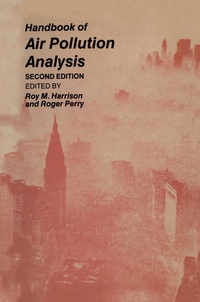
Handbook of Air Pollution Analysis
Published on 8. October 2011
Book
Paperback/Softback
XXII, 634 pages
978-94-010-8311-9 (ISBN)
Description
The contributing authors have been chosen because of their depth of knowledge and experience in air pollution work, and we are confident that this is reflected in a Handbook which will find very wide application wherever air pollution analysis is practised. Roy M. Harrison Roger Perry February 1985 Readers are recommended to follow all the usual laboratory safety pre- cautions. While care has been taken to ensure that the information in this book is correct, neither the authors nor the publisher can accept responsibility for any outcome of the application of methods and procedures outlined in this book. Contributors A. Apling BSc, PhD Air Pollution Division Warren Spring Laboratory Gunnels Wood Road Stevenage Hertfordshire SG 1 2BX UK H. W. de Koning DSc Environmental Pollution Division of Environmental Health World Health Organization Geneva Switzerland R. M. Harrison PhD Department of Chemistry University of Essex Wivenhoe Park Colchester C04 3SQ UK P. W. W. Kirk BSc, MSc, PhD, DIC, C Chern, MRSC Department of Civil Engineering Imperial College London SW7 2BU UK J. R. Kramer Professor in Geochemistry Department of Geology McMaster University Hamilton Ontario L8S 4Ml Canada J. N.
Lester B. Tech, MSc, DIC, PhD, MIPHE, Department of Civil Engineering Imperial College London SW7 2BU UK xxi xxii Contributors A. E. Mcintyre BSc, PhD, DIC, MIWES Consultants in Environmental Sciences Ltd Yeoman House 63 Croydon Road London SW20 7TW UK D. J.
Lester B. Tech, MSc, DIC, PhD, MIPHE, Department of Civil Engineering Imperial College London SW7 2BU UK xxi xxii Contributors A. E. Mcintyre BSc, PhD, DIC, MIWES Consultants in Environmental Sciences Ltd Yeoman House 63 Croydon Road London SW20 7TW UK D. J.
More details
Edition
Softcover reprint of the original 1st ed. 1986
Language
English
Place of publication
Dordrecht
Netherlands
Target group
Professional and scholarly
Research
Illustrations
XXII, 634 p.
Dimensions
Height: 235 mm
Width: 155 mm
Thickness: 36 mm
Weight
984 gr
ISBN-13
978-94-010-8311-9 (9789401083119)
DOI
10.1007/978-94-009-4083-3
Schweitzer Classification
Other editions
Additional editions
Roy M. Harrison
Handbook of Air Pollution Analysis
E-Book
12/2012
Springer
€96.29
Available for download

Roy M. Harrison | Roger Perry | R. Young
Handbook of Air Pollution Analysis
Book
07/1986
2nd Edition
Chapman and Hall
€89.13
Article exhausted; check different version
Content
1 General sampling techniques.- 1.1 Sampling goals and requirements.- 1.2 Sampling methods.- References.- 2 Air pollution meteorology.- 2.1 Introduction.- 2.2 Meteorological measurements.- 2.3 Outline of the more important features of the atmospheric transport and dispersion of pollutants.- 2.4 Calculation of the atmospheric transmission of pollutants.- 2.5 Examples of calculations using Gaussian models.- References.- 3 Air pollution chemistry.- 3.1 Introduction.- 3.2 Inorganic reactions.- 3.3 Reactions involving organic compounds.- 3.4 Gas-to-particle conversion.- 3.5 Conclusion.- References.- 4 Analysis of particulate pollutants.- 4.1 Introduction.- 4.2 Suspended material.- 4.3 Dustfall sampling.- 4.4 Physical techniques for classification of particulates.- References.- 5 Metal analysis.- 5.1 Introduction.- 5.2 Analysis of particulate matter.- 5.3 Gases and vapours.- References.- 6. Nitrogen and sulphur compounds.- 6.1 Introduction.- 6.2 Basic analytical techniques.- 6.3 Experimental section.- 6.4 Particulate compounds of S and N.- References.- 7 Secondary pollutants.- 7.1 Introduction.- 7.2 Basic analytical techniques for the analysis of gaseous secondary pollutants.- 7.3 Experimental section.- References.- 8 Hydrocarbons and carbon monoxide.- 8.1 Introduction.- 8.2 Volatile hydrocarbons.- 8.3 Hydrocarbon fraction of airborne particulate matter.- 8.4 Carbon monoxide.- References.- 9 Halogen compounds.- 9.1 Fluorides.- 9.2 Chlorine.- 9.3 HCl and particulate chloride.- 9.4 Bromides.- 9.5. Halogenated hydrocarbons.- 10. Remote monitoring techniques.- 10.1 Introduction.- 10.2 Correlation spectroscopy.- 10.3 Single wavelength lidar.- 10.4 Differential lidar.- 10.5 Laser safety.- 10.6 Long pathlength absorption spectroscopy (this section by A.M. Winer).- 10.7 Meteorological measurements.- 10.8 The use of remote sensing in field studies.- 10.9 Conclusions.- Acknowledgements.- References.- 11. Physico-chemical speciation techniques for atmospheric particles.- 11.1 Introduction.- 11.2 Speciation methods.- References.- 12. Analysis of precipitation.- 12.1 Introduction.- 12.2 Sampling.- 12.3 Analysis.- 12.4 Concluding comment.- References.- 13. Low-cost methods for air pollution analysis.- 13.1 Introduction.- 13.2 General considerations.- 13.3 Selected methods for measuring air pollutants.- 13.4 Additional considerations for selecting a low-cost air pollution measurement method.- References.- 14 Planning and execution of an air pollution study.- 14.1 Introduction.- 14.2 Objectives of the monitoring programme.- 14.3 Effluent history from source to receptor.- 14.4 The monitoring network.- 14.5 The design of pollution monitoring systems.- 14.6 Data handling.- 14.7 Analysis of results.- 14.8 Examples of monitoring networks and data presentations.- Acknowledgements.- References.- 15 Quality assurance in air pollution monitoring.- 15.1 Quality and quality assurance.- 15.2 Definitions.- 15.3 Elements of the monitoring chain.- 15.4 Site location and character.- 15.5 Sampling line integrity.- 15.6 Instrument performance.- 15.7 Calibration.- 15.8 Discussion and further checks.- References.