

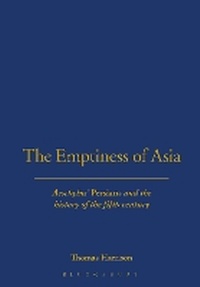
The Emptiness of Asia
Aeschylus' 'Persians' and the History of the Fifth Century
Published on 2. May 2019
Book
Paperback/Softback
192 pages
978-1-350-11341-1 (ISBN)
Description
This is a literary study of Aeschylus' Persians alongside Herodotus' Histories, which offers a comprehensive understanding what actually happened at the battle of Salamis and afterwards. Thomas Harrison examines the political and ideological motivating factors underpinning Persai in the context of the times.
Aeschylus' Persians is not only the first surviving Greek drama. It is also the only tragedy to take for its subject historical rather than mythical events: the repulse of the army of Xerxes at Salamis in 480 B.C. It has frequently been mined for information on the tactics of Salamis or the Greeks' knowledge of Persian names or institutions, but it also has a broader value, one that has not often been realised. What does it tell us about Greek representations of Persia, or of the Athenians' self-image? What can we glean from it of the politics of early fifth-century Athens, or of the Athenians' conception of their empire? How, if at all, can such questions be approached without doing violence to the Persians as a drama? What are the implications of the play for the nature of tragedy?
Aeschylus' Persians is not only the first surviving Greek drama. It is also the only tragedy to take for its subject historical rather than mythical events: the repulse of the army of Xerxes at Salamis in 480 B.C. It has frequently been mined for information on the tactics of Salamis or the Greeks' knowledge of Persian names or institutions, but it also has a broader value, one that has not often been realised. What does it tell us about Greek representations of Persia, or of the Athenians' self-image? What can we glean from it of the politics of early fifth-century Athens, or of the Athenians' conception of their empire? How, if at all, can such questions be approached without doing violence to the Persians as a drama? What are the implications of the play for the nature of tragedy?
Reviews / Votes
[This] is a literary study of Aeschylus' Persai alongside Herodotus' Histories which will provide the reader with comprehensive understanding what actually happened at the battle of Salamis and afterwards. A scholarly dissection of political and ideological motivating factors underpinning the Persai in the context of the times, The Emptiness of Asia is a fascinating and thoughtfully insightful analysis -- and a welcome addition to Hellenic Studies reference collections and supplemental reading lists. -- The Midwest Book Review This is a vigorous and captivating book with a mighty sting in its tail. Tom Harrison does what many have done before, he reads Aeschylus' Persai alongside Herodotus' Histories. But...he compares them to reveal the commonplaces and assumptions about Persia that shaped not only the writing of the play, but the reactions of the audiences. The powerful account of the play's political and ideological force that results overturns a century of modern scholarship, unmasking the projections of their own views that literary critics have wished upon the play and questioning our romantic assertion of the uniqueness of classical Athenian culture. -- Robin OsborneMore details
Language
English
Place of publication
London
United Kingdom
Publishing group
Bloomsbury Publishing PLC
Target group
College/higher education
Professional and scholarly
Dimensions
Height: 232 mm
Width: 154 mm
Thickness: 12 mm
Weight
300 gr
ISBN-13
978-1-350-11341-1 (9781350113411)
Copyright in bibliographic data and cover images is held by Nielsen Book Services Limited or by the publishers or by their respective licensors: all rights reserved.
Schweitzer Classification
Other editions
Additional editions
E-Book
05/2019
1st Edition
Bloomsbury Academic
€35.49
Available for download
Person
Thomas Harrison is Professor of Ancient History at the University of St Andrews, UK. His publications include Divinity and History: the religion of Herodotus (2000), and as editor Greeks and Barbarians (2002) and the Edinburgh Companion to Ancient Greece and Rome (2006).
Content
Acknowledgements
Abbreviations
Introduction
Part I. Framing the play
1. Aeschylus the historian?
2. Politics and partisanship
3. Aeschylus, Atossa and Athenian ideology
Part II. Finding Athens
4. The use and abuse of Persia
5. Where is Athens?
6. Athens and Greece
7. The emptiness of Asia
8. Democracy and tyranny
Part III. Conclusions
9. Themistocles and Aristides
10. Athens and Persia
Notes
Bibliography
Index
Abbreviations
Introduction
Part I. Framing the play
1. Aeschylus the historian?
2. Politics and partisanship
3. Aeschylus, Atossa and Athenian ideology
Part II. Finding Athens
4. The use and abuse of Persia
5. Where is Athens?
6. Athens and Greece
7. The emptiness of Asia
8. Democracy and tyranny
Part III. Conclusions
9. Themistocles and Aristides
10. Athens and Persia
Notes
Bibliography
Index