

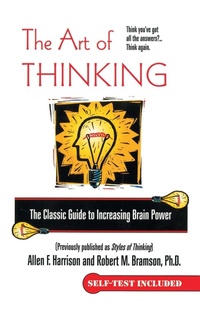
The Art of Thinking
The Classic Guide to Increasing Brain Power
Published on 5. February 2002
Book
Paperback/Softback
240 pages
978-0-425-18322-9 (ISBN)
Description
What style of thinker are you?The Synthesist: Sees likeness in apparent opposites, interested in change
The Idealist: Welcomes broad range of views, seeks ideal solutions
The Pragmatist: Seeks shortest route to payoff: "Whatever works,"
The Analyst: Seeks "one best way," interested in scientific solutions
The Realist: Relies on facts and expert opinions, interested in concrete results
There are five basic styles of thinking, each greatly influenced by the thinker's fundamental beliefs. It is these beliefs that limit people to thinking about things in only one way. With everyday examples, this practical and hands-on guide will show you how to unbind the mind from narrow thinking. Learning to approach situations in different ways is an invaluable life lesson. Learning to recognize others' thinking styles can transform communication. And learning to distinguish and choose the right style of thinking for any situation is an art that can help you achieve goals, influence others, and avoid making errors?while enhancing every area of your life.
The Art of Thinking will expand your repertoire of strategies for asking questions, making decisions, getting along with people and solving problems. By learning why you think the way you do?and gaining surprising new insight into the thinking styles of others?you'll be able to get past obstacles, turn conflict into cooperation, and enjoy more success in everyday life.
Includes a test to determine your own style of thinking.
The Idealist: Welcomes broad range of views, seeks ideal solutions
The Pragmatist: Seeks shortest route to payoff: "Whatever works,"
The Analyst: Seeks "one best way," interested in scientific solutions
The Realist: Relies on facts and expert opinions, interested in concrete results
There are five basic styles of thinking, each greatly influenced by the thinker's fundamental beliefs. It is these beliefs that limit people to thinking about things in only one way. With everyday examples, this practical and hands-on guide will show you how to unbind the mind from narrow thinking. Learning to approach situations in different ways is an invaluable life lesson. Learning to recognize others' thinking styles can transform communication. And learning to distinguish and choose the right style of thinking for any situation is an art that can help you achieve goals, influence others, and avoid making errors?while enhancing every area of your life.
The Art of Thinking will expand your repertoire of strategies for asking questions, making decisions, getting along with people and solving problems. By learning why you think the way you do?and gaining surprising new insight into the thinking styles of others?you'll be able to get past obstacles, turn conflict into cooperation, and enjoy more success in everyday life.
Includes a test to determine your own style of thinking.
More details
Language
English
Place of publication
New York, NY
United States
Publishing group
Penguin Putnam Inc
Product notice
Paperback (trade)
Dimensions
Height: 210 mm
Width: 133 mm
Thickness: 14 mm
Weight
318 gr
ISBN-13
978-0-425-18322-9 (9780425183229)
Copyright in bibliographic data and cover images is held by Nielsen Book Services Limited or by the publishers or by their respective licensors: all rights reserved.
Schweitzer Classification
Persons
Allen F. Harrison
Content
The Art of Thinking
Foreword
1. Thinking About Thinking?An Introduction
2. Styles of Thinking?The InQ
3. The Strange Ways of Synthesis
4. The Wholesome Ways of Idealists
5. The Piecemeal Ways of Pragmatists
6. The Orderly Ways of Analysts
7. The No-Nonsense Ways of Realists
8. Compatibilities, Affinities, and Conflicts?How the Styles Work Together
9. Influencing Others
10. The Productive Use of Your Strengths
11. Extending and Augmenting Your Thinking Strategies
12. Theory for Those Who Want Theory
InQ
Reading List
Index
Foreword
1. Thinking About Thinking?An Introduction
2. Styles of Thinking?The InQ
3. The Strange Ways of Synthesis
4. The Wholesome Ways of Idealists
5. The Piecemeal Ways of Pragmatists
6. The Orderly Ways of Analysts
7. The No-Nonsense Ways of Realists
8. Compatibilities, Affinities, and Conflicts?How the Styles Work Together
9. Influencing Others
10. The Productive Use of Your Strengths
11. Extending and Augmenting Your Thinking Strategies
12. Theory for Those Who Want Theory
InQ
Reading List
Index