

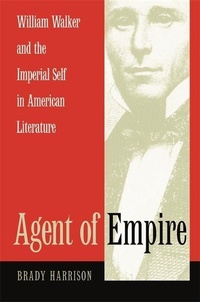
Agent of Empire
William Walker and the Imperial Self in American Literature
Will be published approx. on 2. August 2004
Book
Hardback
240 pages
978-0-8203-2544-6 (ISBN)
Description
Agent of Empire is a detailed study of creative works inspired by the escapades of the American soldier of fortune William Walker. The leader of several fractious, bloody forays into Mexico and Central America in the 1850s, Walker was executed in 1860 by a Honduran firing squad. Brady Harrison looks at a dozen works, such as Bret Harte's novel The Crusade of Excelsior (1887) and Alex Cox's film Walker (1987), to show how Walker's life and legacy have been explored in journalism, poetry, fiction, drama, and cinema for over a century. At the heart of our ongoing interest in Walker, says Harrison, is the need to understand the ever-shifting ambitions and arguments that have driven American economic, military, and paramilitary ventures around the globe over the past 150 years.
Harrison discusses how the mercenary romance, an understudied subgenre of the historical romance first popularized by Bret Harte and Richard Harding Davis, owes its conception to William Walker. Engaging the work of other scholars such as Quentin Anderson and Judith Butler, Harrison places Walker in the company of Aaron Burr, Theodore Roosevelt, Oliver North, and other American conquistadors. Walker and such fellow agents of empire, Harrison argues, exemplify a peculiar merging of Emersonian inner mastery and the American habit of equating self with nation. Inward-looking at first, they soon set their sights, as special agents of providence or the state, on such places as Mexico, Nicaragua, Cuba, the Philippines, and more recently, Vietnam and Iraq.
Agent of Empire is a timely exploration of American imperialism and its troubling components of hypermasculinity, racism, and ambition. Harrison shows how literature helps us gauge the ever-shifting desires, fantasies, arguments, and ideologies that continue to underwrite our imperial ventures, private and public.
Harrison discusses how the mercenary romance, an understudied subgenre of the historical romance first popularized by Bret Harte and Richard Harding Davis, owes its conception to William Walker. Engaging the work of other scholars such as Quentin Anderson and Judith Butler, Harrison places Walker in the company of Aaron Burr, Theodore Roosevelt, Oliver North, and other American conquistadors. Walker and such fellow agents of empire, Harrison argues, exemplify a peculiar merging of Emersonian inner mastery and the American habit of equating self with nation. Inward-looking at first, they soon set their sights, as special agents of providence or the state, on such places as Mexico, Nicaragua, Cuba, the Philippines, and more recently, Vietnam and Iraq.
Agent of Empire is a timely exploration of American imperialism and its troubling components of hypermasculinity, racism, and ambition. Harrison shows how literature helps us gauge the ever-shifting desires, fantasies, arguments, and ideologies that continue to underwrite our imperial ventures, private and public.
Reviews / Votes
Harrison covers an impressive range of genre and mode-journalistic report, essay, short story, novel, poem, play, movie-and works likewise across a spectrum of literary and cultural discourses. Agent of Empire is a learned, interesting, and important book. -- Philip D. Beidler * University of Alabama * Harrison reinterprets the United States' relationship to the empire with great subtlety and nuance. -- Robert Bennett * <i>The Montana Professor</i> * Harrison's account of the representations of Walker is a strong indictment of U.S. imperial policy in the late-twentieth century. . . . This is a provocative and stimulating study, of real relevance to those interested in the links between popular culture and foreign policy. -- Ralph Lee Woodward * H-LatAm * "Well researched and intelligently argued. . . . The key to Brady Harrison's captivating study, Agent of Empire, is a concept of 'performative masculinity.' For Harrison, Walker is the prototype of the mercenary romance in literature and film. -- Andrew Burstein * American Literature *More details
Language
English
Place of publication
Georgia
United States
Target group
Professional and scholarly
College/higher education
Product notice
sewn/stitched
Cloth over boards
Dimensions
Height: 234 mm
Width: 158 mm
Thickness: 25 mm
Weight
567 gr
ISBN-13
978-0-8203-2544-6 (9780820325446)
Copyright in bibliographic data and cover images is held by Nielsen Book Services Limited or by the publishers or by their respective licensors: all rights reserved.
Schweitzer Classification
Person
BRADY HARRISON is an associate professor of English at the University of Montana-Missoula. He is editor of a forthcoming scholarly edition of Richard Harding Davis's Soldiers of Fortune.