

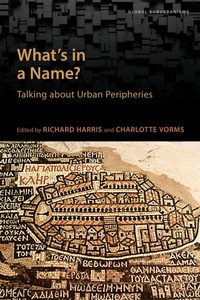
What's in a Name?
Talking About Urban Peripheries
Published on 18. July 2017
Book
Paperback/Softback
376 pages
978-1-4426-2696-6 (ISBN)
Description
'Borgata', 'favela', 'periurbain', and 'suburb' are but a few of the different terms used throughout the world that refer specifically to communities that develop on the periphery of urban centres.
In What's in a Name? editors Richard Harris and Charlotte Vorms have gathered together experts from around the world in order to provide a truly global framework for the study of the urban periphery. Rather than view these distinct communities through the lens of the western notion of urban sprawl, the contributors focus on the variety of everyday terms that are used, together with their connotations. This volume explores the local terminology used in cities such as Beijing, Bucharest, Montreal, Mumbai, Rio de Janeiro, Rome, Sofia, as well as more broadly across North America, Australia, Southeast Asia, and elsewhere. What's in a Name? is the first book in English to pay serious and sustained attention to the naming of the urban periphery worldwide. By exploring the ways in which local individuals speak about the urban periphery Harris and Vorms bridge the assumed divide between the global North and the global South.
In What's in a Name? editors Richard Harris and Charlotte Vorms have gathered together experts from around the world in order to provide a truly global framework for the study of the urban periphery. Rather than view these distinct communities through the lens of the western notion of urban sprawl, the contributors focus on the variety of everyday terms that are used, together with their connotations. This volume explores the local terminology used in cities such as Beijing, Bucharest, Montreal, Mumbai, Rio de Janeiro, Rome, Sofia, as well as more broadly across North America, Australia, Southeast Asia, and elsewhere. What's in a Name? is the first book in English to pay serious and sustained attention to the naming of the urban periphery worldwide. By exploring the ways in which local individuals speak about the urban periphery Harris and Vorms bridge the assumed divide between the global North and the global South.
More details
Series
Language
English
Place of publication
Toronto
Canada
Target group
College/higher education
Product notice
Paperback (trade)
Illustrations
10 b&w illustrations, 5 b&w tables
Dimensions
Height: 226 mm
Width: 152 mm
Thickness: 23 mm
Weight
544 gr
ISBN-13
978-1-4426-2696-6 (9781442626966)
Copyright in bibliographic data and cover images is held by Nielsen Book Services Limited or by the publishers or by their respective licensors: all rights reserved.
Schweitzer Classification
Persons
Richard Harris is a professor emeritus of urban geography at McMaster University.
Charlotte Vorms is an assistant professor in the Department of History at the University of Paris 1-Pantheon Sorbonne.
Charlotte Vorms is an assistant professor in the Department of History at the University of Paris 1-Pantheon Sorbonne.
Content
List of Figures
List of Tables
Preface, and acknowledgements
1. Introduction - Richard Harris and Charlotte Vorms
2. The Naming Process - Christian Topalov
3. 'Suburb' is not a rude word in Australia'. A lexical history of Australian suburbs - Graeme Davison
4. Doubts about 'suburbs' in Canada - Amy Shanks, V. Coates and R. Harris
5. Defining peripheral places in Quebec. A review of key planning reports and media (1960-2012) - Claire Poitras
6. Bombay's Urban Edge: Villages, Suburbs, Slums, and the expanding city - N. Rao
7. Kampungs, Buitenwijken and Kota Mandiri. Naming the urban fringe on Java, Indonesia - Freek Colombijn and Abidin Kusno
8. From favela to communidade, and beyond. The taming of Rio de Janeiro - Rafael S. Goncalves and Francesca Pilo'
9. Naming Rome's Edge. Cultural and Political Representations of the Borgata - Francesco Bartolini
10. Naming Madrid's working-class periphery, 1860-1970. The construction of urban illegitimacy - Charlotte Vorms
11. To name or not to name. Contradictions in naming processes of one Bucharest district - Ioana Florea
12. Some reflections on comparing (post-)suburbs in U.S. and France - R. Le Goix
13. Periurbain, from woes to words. Political and social uses of a new administrative category - Anne Lambert
14. The new neighbourhoods. The discursive (and other) transformation of South Sofia's modest beginnings - Sonia Hirt
15. Lost in Translation: Names, Meanings, and Development Strategies of Beijing's Periphery - Xuefei Ren
16. Concluding suggestions - Richard Harris
Contributors
List of Tables
Preface, and acknowledgements
1. Introduction - Richard Harris and Charlotte Vorms
2. The Naming Process - Christian Topalov
3. 'Suburb' is not a rude word in Australia'. A lexical history of Australian suburbs - Graeme Davison
4. Doubts about 'suburbs' in Canada - Amy Shanks, V. Coates and R. Harris
5. Defining peripheral places in Quebec. A review of key planning reports and media (1960-2012) - Claire Poitras
6. Bombay's Urban Edge: Villages, Suburbs, Slums, and the expanding city - N. Rao
7. Kampungs, Buitenwijken and Kota Mandiri. Naming the urban fringe on Java, Indonesia - Freek Colombijn and Abidin Kusno
8. From favela to communidade, and beyond. The taming of Rio de Janeiro - Rafael S. Goncalves and Francesca Pilo'
9. Naming Rome's Edge. Cultural and Political Representations of the Borgata - Francesco Bartolini
10. Naming Madrid's working-class periphery, 1860-1970. The construction of urban illegitimacy - Charlotte Vorms
11. To name or not to name. Contradictions in naming processes of one Bucharest district - Ioana Florea
12. Some reflections on comparing (post-)suburbs in U.S. and France - R. Le Goix
13. Periurbain, from woes to words. Political and social uses of a new administrative category - Anne Lambert
14. The new neighbourhoods. The discursive (and other) transformation of South Sofia's modest beginnings - Sonia Hirt
15. Lost in Translation: Names, Meanings, and Development Strategies of Beijing's Periphery - Xuefei Ren
16. Concluding suggestions - Richard Harris
Contributors