

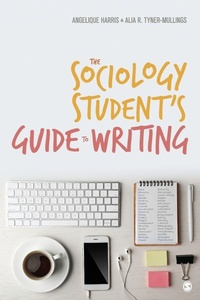
The Sociology Student's Guide to Writing
Description
The Sociology Student's Guide to Writing is a brief, economical reference work that gives practical advice about the writing tasks and issues that undergraduate students face in their first sociology courses. Along with more traditional topics, it incorporates valuable information about composing emails, writing for online forums, and using technology for information-gathering and note-taking. Used by itself or in combination with other texts, this book will increase the quality of student writing and enhance their knowledge of how sociologists communicate in writing.
More details
Other editions
Previous edition
Persons
Angelique Harris is Associate Professor of Sociology at Marquette University. While a graduate student, she served as a Writing Fellow for the Writing Across the Curriculum (WAC) program at Queens College of the City University of New York for two years. Her current research and teaching interests include the sociology of health and illness, race and ethnicity, gender and sexuality, sociology of religion, urban studies, media studies, and social movements. Dr. Harris′ research program examines social problems and issues within minority communities, primarily focusing on the experiences of women, people of color, and lesbian, gay, bisexual, transgender, and queer communities. In addition to her work with faculty and students, Angelique has contributed essays to anthologies, published book reviews, peer-reviewed journal articles, encyclopedia entries, and has authored the book AIDS, Sexuality, and the Black Church: Making the Wounded Whole and co-authored the writing reference book Writing for Emerging Sociologists.
Alia Tyner-Mullings is Assistant Professor of Sociology at Guttman Community College - CUNY. She earned a doctorate in sociology at the CUNY Graduate Center, where she researched alternative educational models. She has taught graduate and undergraduate courses on sociology, deviance, statistics, and education. After finishing her doctorate, she was a post-doctoral fellow at Teachers College, Columbia University, in the Sociology and Education Program and then an assistant professor at Morgan State University in Baltimore, Maryland. A former high school math teacher, Dr. Tyner-Mullings serves on assessment committees for three small high schools. She has also worked as a statistical or academic consultant for several colleges and universities. Her research interests include the sociology of education, communities, sports, and cultural studies. Dr. Tyner-Mullings recently authored Enter the Alternative School: Critical Answers to Questions in Urban Education (Paradigm Publishers, 2014), an in-depth examination of public school alternatives to traditional educational models. She is also the co-editor of Critical Small Schools: Beyond Privatization in New York City Urban Educational Reform (Information Age, 2012) and co-author of Writing for Emerging Sociologists (Sage Publications, Inc., 2013).
Content
Chapter 1: Introduction to Writing in Sociology
How to Use This Book
The Structure of the Book
Chapter 2: The Bricks and Mortar of Writing
The Structure of Writing
The Voice on the Paper
Form
Letters
Notetaking
Summary
Writing in Practice
Chapter 3: Writing and the Search for Literature: Proposals, Library Research, and the Preparation of Literature
Selecting a Research Topic
Searching for Literature
Selecting Appropriate Literature
Writing From Sources
Preparing to Write
Summary
Writing in Practice
Chapter 4: Writing and the Data Collection Process
Research Ethics
Method Writing
Questions
Observation
Transcripts
Data Analysis
Summary
Writing in Practice
Chapter 5: Writing Papers for Sociology Class: Essays, Capstone Papers, and Literature Reviews
Approaching Writing Assignments
College Papers
Capstone Projects
Additional Manuscript Sections
Review Your Work
Summary
Writing in Practice
Chapter 6: Editing and Revising
First Draft
First Revision
Quick Edit
Extensive First Edit
General Revision
Full Document
Subsections/Subheadings
Detail Work
Summary
Writing in Practice
Chapter 7: Writing for the Public
Writing Online
Presentations
Summary
Writing in Practice
Appendix
Biographies