

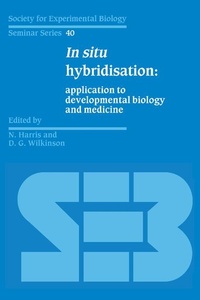
In Situ Hybridisation
Application to Developmental Biology and Medicine
Published on 31. August 1990
Book
Hardback
302 pages
978-0-521-38062-1 (ISBN)
Description
Advances in our understanding of biological mechanisms have frequently been associated with the development of techniques. In situ hybridisation is a classic case of just such an advance. The technique effectively combines histochemistry with molecular biology and enables the rapid analysis of the distribution of RNA, or DNA, in the tissues. The information gained from this has caused something of a revolution in our understanding of developmental biology, since a fundamental aspect of development is the spatial and temporal expression of genes. In addition the technique has found application in the field of medicine, providing insights into the functioning of healthy tissues and the diagnosis and study of diseases. This book brings together contributions from leaders in the application of in situ hybridisation and guides the would-be exponent through the various options and variations of the technique.
Reviews / Votes
"...very useful for biologists, molecular biologists, biophysicists, and advanced students." Journal of Steroid Biochemistry and Molecular BiologyMore details
Series
Language
English
Place of publication
Cambridge
United Kingdom
Target group
Professional and scholarly
Dimensions
Height: 235 mm
Width: 157 mm
Thickness: 21 mm
Weight
591 gr
ISBN-13
978-0-521-38062-1 (9780521380621)
Copyright in bibliographic data and cover images is held by Nielsen Book Services Limited or by the publishers or by their respective licensors: all rights reserved.
Schweitzer Classification
Other editions
Additional editions
Book
06/2011
Cambridge University Press
€55.80
Shipment within 15-20 days
Persons
Content
1. Non radio isotopic labels for in situ hybridisation histochemistry: a histochemist's view G. Coulton; 2. Use of haptenised nucleic acid probes in fluorescent in situ hybridisation A. K. Raap; 3. The use of complementary RNA probes for the identification and localisation of peptide messenger RNA in the diffuse neuroendocrine system A. Giaid; 4. Contributions of the spatial analysis of gene expression to the study of sea urchin development R. C. Aangerer; 5. Advantages and limitations of in situ hybridisation as exemplified by the molecular genetic analysis of Drosophila development P. W. Ingham; 6. The use of in situ hybridisation to study the localisation of maternal mRNAs during Xenopus oogenesis H. Perry-O'Keefe; 7. In situ hybridisation in the analysis of genes with potential roles in mouse embryogenesis D. G. Wilkinson; 8. Evolution of algal plasmids from eukaryotic endosymbionts G. I. McFadden; 9. Localisation of expression of male flower specific genes from maize by in situ hybridisation S. Y. Wright and A. J. Greenland; 10. Tissue preparation techniques for in situ hybridisation studies of storage-protein gene expression during pea seed development N. Harris; 11. Investigation of gene expression during plant gametogenesis by in situ hybridisation K. G. Jones; 12. Sexing the human conceptus by in situ hybridisation J. D. West; 13. Nonisotopic in situ hybridisation in human pathology C. S. Herrington; 14. The demonstration of viral DNA in human tissues by in situ hybridisation M. Wells.