

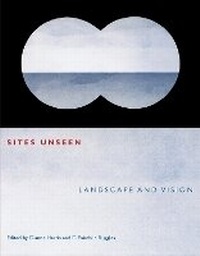
Sites Unseen
Landscape and Vision
Published on 18. May 2007
Book
Hardback
304 pages
978-0-8229-4308-2 (ISBN)
Description
Sites Unseen challenges conventions for viewing and interpreting the landscape, using visual theory to move beyond traditional practices of describing and classifying objects to explore notions of audience and context. While other fields, such as art history and geography, have engaged poststructuralist theory to consider vision and representation, the application of such inquiry to the natural or built environment has lagged behind. This book, by treating landscape as a spatial, psychological, and sensory encounter, aims to bridge this gap, opening a new dialogue for discussing the landscape outside the boundaries of current art criticism and theory.
As the contributors reveal, the landscape is a widely adaptable medium that can be employed literally or metaphorically to convey personal or institutional ideologies. Walls, gates, churchyards, and arches become framing devices for a staged aesthetic experience or to suit a sociopolitical agenda. The optic stimulation of signs, symbols, bodies, and objects combines with physical acts of climbing and walking and sensory acts of touching, smelling, and hearing to evoke an overall \u201cvision\u201d of landscape.
Sites Unseen considers a variety of different perspectives, including ancient Roman visions of landscape, the framing techniques of a Moghul palace, and a contemporary case study of Christo's The Gates, as examples of human attempts to shape our sensory, cognitive, and emotional experiences in the landscape.
As the contributors reveal, the landscape is a widely adaptable medium that can be employed literally or metaphorically to convey personal or institutional ideologies. Walls, gates, churchyards, and arches become framing devices for a staged aesthetic experience or to suit a sociopolitical agenda. The optic stimulation of signs, symbols, bodies, and objects combines with physical acts of climbing and walking and sensory acts of touching, smelling, and hearing to evoke an overall \u201cvision\u201d of landscape.
Sites Unseen considers a variety of different perspectives, including ancient Roman visions of landscape, the framing techniques of a Moghul palace, and a contemporary case study of Christo's The Gates, as examples of human attempts to shape our sensory, cognitive, and emotional experiences in the landscape.
Reviews / Votes
This well-illustrated volume gathers together an impressive list of contributors to present an authoritative exploration of the relationship between landscape and vision. The innovative essays cross disciplinary divides to present a fresh synthesis of approaches and methodologies which will be essential reading for those working in the field of landscape history." - Dana Arnold, Professor of Architectural History, University of Southampton, UKMore details
Language
English
Place of publication
Pittsburgh PA
United States
Target group
College/higher education
Dimensions
Height: 229 mm
Width: 178 mm
ISBN-13
978-0-8229-4308-2 (9780822943082)
Copyright in bibliographic data and cover images is held by Nielsen Book Services Limited or by the publishers or by their respective licensors: all rights reserved.
Schweitzer Classification
Other editions
Additional editions
E-Book
05/2007
Penguin Random House South Africa
€59.49
Available for download
Persons
Dianne Harris (Editor)
Dianne Harris is dean of the College of Arts & Sciences at the University of Washington. From 2017-2021 she was a senior program officer at the Andrew W. Mellon Foundation. Prior to that she served as dean of the College of Humanities and as professor of history at the University of Utah. Among her most recent publications are Second Suburb: Levittown, Pennsylvania and Little White Houses: How the Postwar Home Constructed Race in America. She is also editor of the book series Culture, Politics, and the Built Environment.
D. Fairchild Ruggles (Editor)
D. Fairchild Ruggles is associate professor of landscape architecture, architecture, art history, and gender and women's studies at University of Illinois, Urbana-Champaign. She is the author of Gardens, Landscape, and Vision in the Palaces of Islamic Spain.
Dianne Harris is dean of the College of Arts & Sciences at the University of Washington. From 2017-2021 she was a senior program officer at the Andrew W. Mellon Foundation. Prior to that she served as dean of the College of Humanities and as professor of history at the University of Utah. Among her most recent publications are Second Suburb: Levittown, Pennsylvania and Little White Houses: How the Postwar Home Constructed Race in America. She is also editor of the book series Culture, Politics, and the Built Environment.
D. Fairchild Ruggles (Editor)
D. Fairchild Ruggles is associate professor of landscape architecture, architecture, art history, and gender and women's studies at University of Illinois, Urbana-Champaign. She is the author of Gardens, Landscape, and Vision in the Palaces of Islamic Spain.