

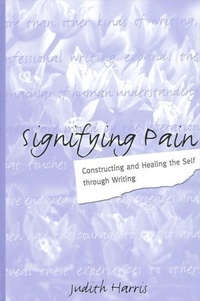
Signifying Pain
Constructing and Healing the Self through Writing
Published on 19. March 2003
Book
Hardback
320 pages
978-0-7914-5683-5 (ISBN)
Description
Explores the therapeutic uses and effects of writing in a post-Freudian age.
A deeply personal yet universal work, Signifying Pain applies the principles of therapeutic writing to such painful life experiences as mental illness, suicide, racism, domestic abuse, and even genocide. Probing deep into the bedrock of literary imagination, Judith Harris traces the odyssey of a diverse group of writers-John Keats, Derek Walcott, Jane Kenyon, Michael S. Harper, Robert Lowell, and Ai, as well as student writers-who have used their writing to work through and past such personal traumas. Drawing on her own experience as a poet and teacher, Harris shows how the process can be long and arduous, but that when exercised within the spirit of one's own personal compassion, the results can be limitless. Signifying Pain will be of interest not only to teachers of creative and therapeutic writing, but also to those with a critical interest in autobiographical or confessional writing more generally.
A deeply personal yet universal work, Signifying Pain applies the principles of therapeutic writing to such painful life experiences as mental illness, suicide, racism, domestic abuse, and even genocide. Probing deep into the bedrock of literary imagination, Judith Harris traces the odyssey of a diverse group of writers-John Keats, Derek Walcott, Jane Kenyon, Michael S. Harper, Robert Lowell, and Ai, as well as student writers-who have used their writing to work through and past such personal traumas. Drawing on her own experience as a poet and teacher, Harris shows how the process can be long and arduous, but that when exercised within the spirit of one's own personal compassion, the results can be limitless. Signifying Pain will be of interest not only to teachers of creative and therapeutic writing, but also to those with a critical interest in autobiographical or confessional writing more generally.
More details
Series
Language
English
Place of publication
Albany, NY
United States
Target group
US School Grade: College Graduate Student and over
Product notice
sewn/stitched
Cloth over boards
Dimensions
Height: 235 mm
Width: 162 mm
Thickness: 22 mm
Weight
540 gr
ISBN-13
978-0-7914-5683-5 (9780791456835)
Copyright in bibliographic data and cover images is held by Nielsen Book Services Limited or by the publishers or by their respective licensors: all rights reserved.
Schweitzer Classification
Other editions
Additional editions
E-Book
02/2012
State University of New York Press
€38.49
Available for download
Person
Judith Harris is Assistant Professor of English at George Washington University. She is the author of Atonement: Poems.
Content
Acknowledgments
Preface
Introduction
Part I. Speaking Pain: Women, Psychoanalysis, and Writin g
1. The Healing Effects of Writing about Pain: Literature and Psychoanalysis
2. Violating the Sanctuary/Asylum: Freudian Treatment of Hysteria in "Dora" and "The Yellow Wallpaper"
3. Breaking the Code of Silence: Ideology and Women's Confessional Poetry
4. Fathering Daughters: Oedipal Rage and Aggression in Women's Writing
Part II. Soul-making: Conflict and the Construction of Identity
5. Carving the Mask of Language: Self and Otherness in Dramatic Monologues
6. Giotto's Invisible Sheep: Lacanian Mirroring and Modeling in Walcott's Another Life
7. Rescuing Psyche: Keats's Containment of the Beloved but Fading Woman in the "Ode to Psyche"
8. God Don't Like Ugly: Michael S. Harper's Soul-Making Music
9. Kenyon's Melancholic Vision in "Let Evening Come"
Part III. Healing Pain: Acts of Therapeutic Writing
10. Using the Psychoanalytic Process in Creative Writing Classes
11. Rewriting the Subject: Psychoanalytic Approaches to Creative Writing and Composition Pedagogy
12. "To Bedlam and Almost All the Way Back": The Image and Function of the Institution in Confessional Poetry
13. Asylum: A Personal Essay
14. Signifying Pain: Recovery and Beyond
Afterword
Notes
Bibliography
Index
Preface
Introduction
Part I. Speaking Pain: Women, Psychoanalysis, and Writin g
1. The Healing Effects of Writing about Pain: Literature and Psychoanalysis
2. Violating the Sanctuary/Asylum: Freudian Treatment of Hysteria in "Dora" and "The Yellow Wallpaper"
3. Breaking the Code of Silence: Ideology and Women's Confessional Poetry
4. Fathering Daughters: Oedipal Rage and Aggression in Women's Writing
Part II. Soul-making: Conflict and the Construction of Identity
5. Carving the Mask of Language: Self and Otherness in Dramatic Monologues
6. Giotto's Invisible Sheep: Lacanian Mirroring and Modeling in Walcott's Another Life
7. Rescuing Psyche: Keats's Containment of the Beloved but Fading Woman in the "Ode to Psyche"
8. God Don't Like Ugly: Michael S. Harper's Soul-Making Music
9. Kenyon's Melancholic Vision in "Let Evening Come"
Part III. Healing Pain: Acts of Therapeutic Writing
10. Using the Psychoanalytic Process in Creative Writing Classes
11. Rewriting the Subject: Psychoanalytic Approaches to Creative Writing and Composition Pedagogy
12. "To Bedlam and Almost All the Way Back": The Image and Function of the Institution in Confessional Poetry
13. Asylum: A Personal Essay
14. Signifying Pain: Recovery and Beyond
Afterword
Notes
Bibliography
Index