

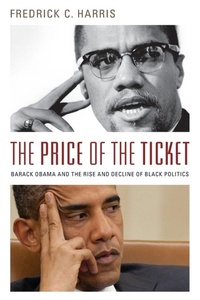
The Price of the Ticket
Barack Obama and Rise and Decline of Black Politics
Published on 23. January 2014
Book
Paperback/Softback
240 pages
978-0-19-932523-8 (ISBN)
Description
The historical significance of Barack Obama's triumph in the presidential election of 2008 scarcely requires comment. Yet it contains an irony: he won a victory as an African American only by denying that he should discuss issues that target the concerns of African Americans. Obama's very success, writes Fredrick Harris, exacted a heavy cost on black politics.
In The Price of the Ticket, Harris puts Obama's career in the context of decades of black activism, showing how his election undermined the very movement that made it possible. The path to his presidency began just before passage of the 1965 Voting Rights Act, when black leaders began to discuss strategies to make the most of their new access to the ballot. Some argued that black voters should organize into a cohesive, independent bloc to promote both targeted and universal polices; others urged a more race-neutral approach, working together with other racial minorities as well as like-minded whites. This has been the fundamental divide within black politics ever since. At first, the gap did not seem serious. But the post-civil-rights era has accelerated a shift towards race-neutral politics. Obama made a point of distancing himself from older race-conscious black leaders, such as Jesse Jackson- and leaders of the Congressional Black Caucus-even though, as Harris shows, he owes much to Jackson's earlier campaigns for the White House. Unquestionably Obama's approach won support among whites, but Harris finds the results troublesome. The social problems targeted by an earlier generation of black politicians--racial disparities in income and education, stratospheric incarceration and unemployment rates--all persist, yet Obama's election, ironically, marginalized those issues, keeping them off the political agenda. Meanwhile, the civil-rights movement's militancy to attack the vestiges of racial inequality is fading.
Written by one of America's leading scholars of race and politics, The Price of the Ticket will reshape our understanding of the rise of Barack Obama and the decline of a politics dedicated to challenging racial inequality head on.
In The Price of the Ticket, Harris puts Obama's career in the context of decades of black activism, showing how his election undermined the very movement that made it possible. The path to his presidency began just before passage of the 1965 Voting Rights Act, when black leaders began to discuss strategies to make the most of their new access to the ballot. Some argued that black voters should organize into a cohesive, independent bloc to promote both targeted and universal polices; others urged a more race-neutral approach, working together with other racial minorities as well as like-minded whites. This has been the fundamental divide within black politics ever since. At first, the gap did not seem serious. But the post-civil-rights era has accelerated a shift towards race-neutral politics. Obama made a point of distancing himself from older race-conscious black leaders, such as Jesse Jackson- and leaders of the Congressional Black Caucus-even though, as Harris shows, he owes much to Jackson's earlier campaigns for the White House. Unquestionably Obama's approach won support among whites, but Harris finds the results troublesome. The social problems targeted by an earlier generation of black politicians--racial disparities in income and education, stratospheric incarceration and unemployment rates--all persist, yet Obama's election, ironically, marginalized those issues, keeping them off the political agenda. Meanwhile, the civil-rights movement's militancy to attack the vestiges of racial inequality is fading.
Written by one of America's leading scholars of race and politics, The Price of the Ticket will reshape our understanding of the rise of Barack Obama and the decline of a politics dedicated to challenging racial inequality head on.
Reviews / Votes
Harris is a vivid storyteller, bringing to life the men and women responsible for the rise of black politics in the 20th century. He doesn't shy away from juicy foibles of character, although his focus is on ideological conflict . . . This is an enlightening, readable, important, and deeply worrying book. * Publishers Weekly *More details
Series
Language
English
Place of publication
New York
United States
Target group
College/higher education
Professional and scholarly
Dimensions
Height: 234 mm
Width: 156 mm
Thickness: 14 mm
Weight
412 gr
ISBN-13
978-0-19-932523-8 (9780199325238)
Copyright in bibliographic data and cover images is held by Nielsen Book Services Limited or by the publishers or by their respective licensors: all rights reserved.
Schweitzer Classification
Other editions
Additional editions
Book
06/2012
1st Edition
Oxford University Press Inc
€21.03
Article exhausted; check different version
E-Book
06/2012
1st Edition
OUP eBook
€17.49
Available for download
E-Book
05/2012
1st Edition
OUP eBook
€17.49
Available for download
Person
Fredrick C. Harris is Professor of Political Science and the Director of the Institute for Research in African-American Studies at Columbia University. He is the triple award winner of the book Something Within: Religion in African-American Political Activism and the co-author of Countervailing Forces in African-American Civic Activism, 1973-1994, which received the 2006 W.E.B. DuBois Award from the National Conference of Black Political Scientists and the 2007 Ralph Bunche Award from the American Political Science Association. He has been a visiting scholar at the Woodrow Wilson International Center for Scholars in Washington, D.C. and is a 2012 recipient of the Lenfest Distinguished Faculty Award at Columbia University.
Content
Preface ; Chapter 1: A Clash of Visions ; Chapter 2: Chicago, The Political Capital of Black America ; Chapter 3: Entering the Land of Milk and Honey ; Chapter 4: Respectability as Public Philosophy ; Chapter 5: Winks, Nods, and Votes ; Chapter 6: Price of the Ticket