

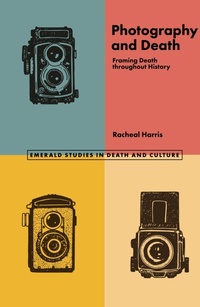
Photography and Death
Framing Death throughout History
Published on 30. June 2020
Book
Paperback/Softback
200 pages
978-1-83909-048-6 (ISBN)
Description
Photography represents a medium in which the moment of death can be captured and preserved, the image becoming a mechanism through which audiences are beguiled by the certainty of their own mortality. Examining a spectrum of post-mortem images, Photography and Death considers various ways in which the death image has been framed and what these styles communicate about changing social attitudes related to dying, mourning and the afterlife.
Presenting a fresh perspective on how we might view death photography in the context of our contemporary cultural milieu, this book brings together a range of historical examples to create a richer narrative of how we see, understand and discuss death in both the private and public forum. Building upon existing publications which relate explicitly to the study of death, dying and cultures of mourning, the book discusses topics such as post-mortem portraiture, the Civil War, Spiritualism and lynching. These are positioned alongside contemporary representations of death, as seen in celebrity death images and forensic photography. Uncovering an important historical contrast, in which modern notions of death are a comment on ownership or an emotionless, clinical state, Harris highlights the various ways that the deceased body is a site of contestation and fascination.
An engaging read for students and researchers with an interest in death studies, this book represents a unique account of the various ways that attitudes about death have been shaped through the photographic image.
Presenting a fresh perspective on how we might view death photography in the context of our contemporary cultural milieu, this book brings together a range of historical examples to create a richer narrative of how we see, understand and discuss death in both the private and public forum. Building upon existing publications which relate explicitly to the study of death, dying and cultures of mourning, the book discusses topics such as post-mortem portraiture, the Civil War, Spiritualism and lynching. These are positioned alongside contemporary representations of death, as seen in celebrity death images and forensic photography. Uncovering an important historical contrast, in which modern notions of death are a comment on ownership or an emotionless, clinical state, Harris highlights the various ways that the deceased body is a site of contestation and fascination.
An engaging read for students and researchers with an interest in death studies, this book represents a unique account of the various ways that attitudes about death have been shaped through the photographic image.
More details
Series
Language
English
Place of publication
Bingley
United Kingdom
Target group
Professional and scholarly
Dimensions
Height: 198 mm
Width: 129 mm
Thickness: 12 mm
Weight
221 gr
ISBN-13
978-1-83909-048-6 (9781839090486)
Copyright in bibliographic data and cover images is held by Nielsen Book Services Limited or by the publishers or by their respective licensors: all rights reserved.
Schweitzer Classification
Other editions
Additional editions
E-Book
06/2020
1st Edition
Emerald Publishing Limited
€36.99
Available for download
Persons
Racheal Harris is an author and researcher working within the areas of religion, death, popular culture and science fiction. Her previous publications include Skin, Meaning, and Symbolism in Pet Memorials (2019).
Content
Introduction: Time, Death and Post-mortem Photography in History Chapter 1. Romance: Post-mortem Photography
Chapter 2. Anonymity: War Photography
Chapter 3. Continuance: Spirit Photography
Chapter 4. Violence: Lynching Photographs
Chapter 5. Ownership: Celebrity Death
Chapter 6. Science: Forensic
Conclusion: Future Living through Death Images
Chapter 2. Anonymity: War Photography
Chapter 3. Continuance: Spirit Photography
Chapter 4. Violence: Lynching Photographs
Chapter 5. Ownership: Celebrity Death
Chapter 6. Science: Forensic
Conclusion: Future Living through Death Images