

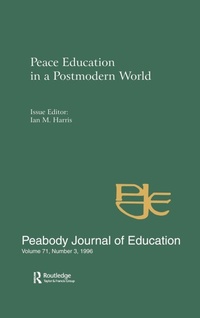
Peace Education in a Postmodern World
A Special Issue of the Peabody Journal of Education
Published on 1. July 1996
Book
Hardback
192 pages
978-0-8058-9912-2 (ISBN)
Description
This special issue of the Peabody Journal of Education provides a comprehensive overview of the latest developments in peace education reform. School reforms based upon principles of peace education have in common a belief in the power of peace to create a positive learning climate in schools and to address the problems of violence in the broader culture. A peace education strategy for improving school productivity rests upon three main assumptions:
1. Violence contributes to the poor performance of many students.
2. Adults in school settings need to address problems created by violence in order for schools to improve.
3. Anxieties that make it hard for students to master traditional subject matter can best be addressed by a comprehensive peace education strategy that makes school a safe place to learn and provides students with knowledge about alternative nonviolent ways to resolve conflicts.
Peace building reforms go beyond responding to immediate forms of violence that may be overwhelming students and teachers to promoting positive images of peace through the study of nonviolence. Written by established experts in the field of peace education from six different countries, this collection of articles not only represents a wide variety of peace education practices from different corners of the globe, but it also represents varying academic perspectives. Educators can play a key role in helping human societies progress toward more sustainable ways of living by implementing peacemaking, peacekeeping, and peace building strategies in school programs. Peace education reforms point to a new way of thinking about schools as vehicles for promoting a peace culture through insights offered by nonviolent theory.
1. Violence contributes to the poor performance of many students.
2. Adults in school settings need to address problems created by violence in order for schools to improve.
3. Anxieties that make it hard for students to master traditional subject matter can best be addressed by a comprehensive peace education strategy that makes school a safe place to learn and provides students with knowledge about alternative nonviolent ways to resolve conflicts.
Peace building reforms go beyond responding to immediate forms of violence that may be overwhelming students and teachers to promoting positive images of peace through the study of nonviolence. Written by established experts in the field of peace education from six different countries, this collection of articles not only represents a wide variety of peace education practices from different corners of the globe, but it also represents varying academic perspectives. Educators can play a key role in helping human societies progress toward more sustainable ways of living by implementing peacemaking, peacekeeping, and peace building strategies in school programs. Peace education reforms point to a new way of thinking about schools as vehicles for promoting a peace culture through insights offered by nonviolent theory.
More details
Language
English
Place of publication
New York
United States
Publishing group
Taylor & Francis Inc
Target group
Professional and scholarly
Dimensions
Height: 235 mm
Width: 157 mm
Thickness: 15 mm
Weight
440 gr
ISBN-13
978-0-8058-9912-2 (9780805899122)
Copyright in bibliographic data and cover images is held by Nielsen Book Services Limited or by the publishers or by their respective licensors: all rights reserved.
Schweitzer Classification
Other editions
Additional editions
Ian M. Harris
Peace Education in a Postmodern World
A Special Issue of the Peabody Journal of Education
Book
05/2015
1st Edition
Routledge
€53.80
Shipment within 10-20 days
Ian M. Harris
Peace Education in a Postmodern World
A Special Issue of the Peabody Journal of Education
E-Book
12/2013
1st Edition
Routledge
€47.49
Available for download
Ian M. Harris
Peace Education in a Postmodern World
A Special Issue of the Peabody Journal of Education
E-Book
12/2013
1st Edition
Routledge
€47.49
Available for download
Person
Ian M. Harris
Content
Volume 71, Number 3, 1996 Contents: I.M. Harris,OverviewEditor's Introduction. B. Chetkow-Yanoov, Conflict Resolution Skills Can Be Taught. S. Hagglund, Developing Concepts of Peace and War: Aspects of Gender and Culture. F.P. Hutchinson, Educating for the 21st Century: Beyond Racist, Sexist, and Ecologically Violent Futures. Peace Education in Different Cultures.I.M. Harris, Peace Education in an Urban School District in the United States. J. Synott, Australian Aboriginal Constructions of Humans, Society, and Nature in Relation to Peace Education. B. Thelin, Early Tendencies of Peace Education in Sweden. D. Bretherton, Nonviolent Conflict Resolution in Children. V. Dovey, Exploring Peace Education in South African Settings. C. Harber, Educational Violence and Education for Peace in Africa. B. Brock-Utne, Peace Education in Post Colonial Africa.