

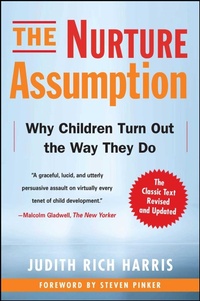
The Nurture Assumption
Why Children Turn Out the Way They Do
2nd Edition
Published on 24. February 2009
Book
Paperback/Softback
480 pages
978-1-4391-0165-0 (ISBN)
Description
This groundbreaking book, a Pulitzer Prize finalist and "New York Times" notable pick, rattled the psychological establishment when it was first published in 1998 by claiming that parents have little impact on their children's development. In this tenth anniversary edition of "The Nurture Assumption," Judith Harris has updated material throughout and provided a fresh introduction. Combining insights from psychology, sociology, anthropology, primatology, and evolutionary biology, she explains how and why the tendency of children to take cues from their peers works to their evolutionary advantage. This electrifying book explodes many of our unquestioned beliefs about children and parents and gives us a radically new view of childhood.
More details
Edition
2nd Revised, Updated ed.
Language
English
Place of publication
United States
Product notice
Paperback (trade)
Unsewn / adhesive bound
Dimensions
Height: 231 mm
Width: 150 mm
Thickness: 36 mm
Weight
499 gr
ISBN-13
978-1-4391-0165-0 (9781439101650)
Copyright in bibliographic data and cover images is held by Nielsen Book Services Limited or by the publishers or by their respective licensors: all rights reserved.
Schweitzer Classification
Other editions
Additional editions

E-Book
10/2011
Free Press
€16.80
Available for download
Person
Judith Rich Harris is the author of No Two Alike: Human Nature and Human Individuality . A former writer of college textbooks, Harris is a recipient of a George A. Miller award, given to the author of an outstanding article in psychology. She is an independent investigator and theoretician whose interests include evolutionary psychology, social psychology, developmental psychology, and behavioral genetics.
Content
CONTENTS
Foreword by Steven Pinker
Preface
1 "Nurture" Is Not the Same as "Environment"
2 The Nature (and Nurture) of the Evidence
3 Nature, Nurture, and None of the Above
4 Separate Worlds
5 Other Times, Other Places
6 Human Nature
7 Us and Them
8 In the Company of Children
9 The Transmission of Culture
10 Gender Rules
11 Schools of Children
12 Growing Up
13 Dysfunctional Families and Problem Kids
14 What Parents Can Do
15 The Nurture Assumption on Trial
Appendixes
1 Personality and Birth Order
2 Testing Theories of Child Development
Notes
References
Index
Foreword by Steven Pinker
Preface
1 "Nurture" Is Not the Same as "Environment"
2 The Nature (and Nurture) of the Evidence
3 Nature, Nurture, and None of the Above
4 Separate Worlds
5 Other Times, Other Places
6 Human Nature
7 Us and Them
8 In the Company of Children
9 The Transmission of Culture
10 Gender Rules
11 Schools of Children
12 Growing Up
13 Dysfunctional Families and Problem Kids
14 What Parents Can Do
15 The Nurture Assumption on Trial
Appendixes
1 Personality and Birth Order
2 Testing Theories of Child Development
Notes
References
Index