

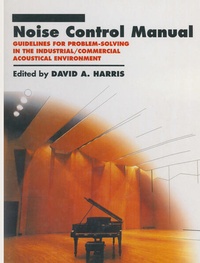
Noise Control Manual
Guidelines for Problem-Solving in the Industrial / Commercial Acoustical Environment
Published on 3. March 2013
Book
Paperback/Softback
XIII, 162 pages
978-1-4757-6011-8 (ISBN)
Description
Excessive noise levels are generally acknowledged to have adverse effects on our environment. Studies indicate that excessive noise levels can cause fatigue in exposed individuals, lower efficiency and productivity, impaired speech communication, and hearing loss. Excessive noise is almost everywhere today - in the office, in schools, hospitals and other institutional facilities, in all classes of public buildings, and in our factories. INDUSTRIAL NOISE High noise levels in factories can make speech communication in the plant difficult and at times impossible. Foremen are often unable to hear warning shouts from co-workers. The problem of hearing loss due to excessive noise exposure is of particular concern to industry, and to the federal government. In the early 1970s, the United States Congress passed the Occupational Safety and Health Act (OSHA) which sets criteria for health hazards and established limits for noise exposure of industrial workers. The OSHA Noise Standard was amended in 1982 to require audiometric testing of all employees exposed to noise levels of 85 dB or above for eight hours. A NOISE IN COMMERCIAL AND INSTITUTIONAL BUILDINGS While noise levels in offices, stores, schools, and other commercial and institutional buildings seldom reach those encountered in many industrial environments, they often reach levels which are distracting to the occupants of such buildings. Impairment of speech communica tion among workers, or inversely the lack of speech privacy, are both deterrents to effiCiency and productivity and are detrimental to the occupants' comfort and sense of well-being.
Reviews / Votes
...this is a really practical and sensible book. - Occupational Safety and HealthMore details
Edition
Softcover reprint of the original 1st ed. 1991
Language
English
Place of publication
New York
United States
Target group
Professional and scholarly
Research
Illustrations
109 s/w Abbildungen
XIII, 162 p. 109 illus.
Dimensions
Height: 279 mm
Width: 210 mm
Thickness: 11 mm
Weight
455 gr
ISBN-13
978-1-4757-6011-8 (9781475760118)
DOI
10.1007/978-1-4757-6009-5
Schweitzer Classification
Other editions
Additional editions
David A. Harris
Noise Control Manual
Guidelines for Problem-Solving in the Industrial / Commercial Acoustical Environment
E-Book
03/2013
Springer
€96.29
Available for download

Hans Boesch
Geography of World Economy
Book
11/1974
2nd Edition
Kluwer Academic Publishers
€109.13
Article exhausted; check different version
Content
1 - Noise Control Technology.- 2 - Materials for Noise Control.- 3 - Sound Barrier Materials/Systems.- 4 - Vibration Damping Materials.- 5 - Silencers.- 6 - Vibration Isolation Materials.- 7 - Systems for Noise Control.- 8 - Office Acoustics.- Appendix 1 - Glossary of Acoustical Terms.- Appendix 2 - Acoustical Standards.- Appendix 3 - Design Guide and Worksheets.- Guidelines for Reverberant Noise Control.- Worksheet for Reverberant Noise Control.- Source, Path and Receiver Control (SPR).- Sound Attenuation Nomogram.- Controlling Noise at Receiver.- Controlling Environmental Noise.- Appendix 4 - Acoustical Data.- Appendix 5 - BIBLIOGRAPHY and INDEX.