

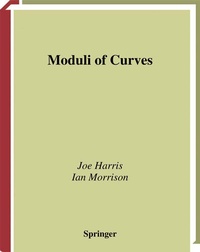
Moduli of Curves
Published on 1. July 1998
Book
Paperback/Softback
XIII, 369 pages
978-0-387-98429-2 (ISBN)
Description
The aim of this book is to provide a guide to a rich and fascinating subject: algebraic curves, and how they vary in families. The revolution that the field of algebraic geometry has undergone with the introduction of schemes, together with new ideas, techniques and viewpoints introduced by Mumford and others, have made it possible for us to understand the behavior of curves in ways that simply were not possible a half-century ago. This in turn has led, over the last few decades, to a burst of activity in the area, resolving longstanding problems and generating new and unforeseen results and questions. We hope to acquaint you both with these results and with the ideas that have made them possible. The book isn't intended to be a definitive reference: the subject is developing too rapidly for that to be a feasible goal, even if we had the expertise necessary for the task. Our preference has been to focus on examples and applications rather than on foundations. When discussing techniqueswe've chosen to sacrifice proofs of some, even basic,results-particularly where we can provide a good reference- in order to show how the methods are used to study moduli of curves. Likewise, we often prove results in special cases which we feel bring out the important ideas with a minimum of technical complication.
More details
Series
Edition
1998 ed.
Language
English
Place of publication
New York
United States
Target group
Primary & secondary/elementary & high school
Graduate
Illustrations
XIII, 369 p.
Dimensions
Height: 235 mm
Width: 155 mm
Thickness: 21 mm
Weight
587 gr
ISBN-13
978-0-387-98429-2 (9780387984292)
DOI
10.1007/b98867
Schweitzer Classification
Other editions
Additional editions
Joe Harris | Ian Morrison
Moduli of Curves
Book
07/1998
Springer
€90.94
Article exhausted; check different version
Content
Parameter spaces: Constructions and examples.- Basic facts about moduli spaces of curves.- Techniques.- Construction of $$ \overline M _g $$ .- Limit Linear Series and Brill-Noether theory.- Geometry of moduli spaces: Selected results.