

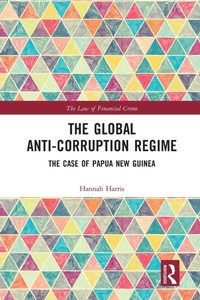
The Global Anti-Corruption Regime
The Case of Papua New Guinea
1st Edition
Published on 30. June 2020
Book
Paperback/Softback
266 pages
978-0-367-58683-6 (ISBN)
Description
This book tackles the challenging topic of corruption. It explores the evolution of a global prohibition regime against corrupt activity (the global anti-corruption regime). It analyses the structure of the transnational legal framework against corruption, evaluating the impact of global anti-corruption efforts at a national level. The book focuses on the United Nations Convention against Corruption (UNCAC) as the primary tool of the global anti-corruption regime. It provides new and engaging material gathered in the field, including first-hand accounts from actors at international, regional, and domestic levels. By documenting the experiences of diverse actors, the book makes a substantial contribution to literature on corruption and anti-corruption efforts. Synthesising empirical research with an exploration of theoretical literature on corruption and regime evolution results in novel suggestions for improvement of the global anti-corruption regime and its legal tools.
The Global Anti-Corruption Regime is a well-rounded text with a wealth of new information that will be valuable to both academic and policy audiences. It clarifies the factors that prevent current anti-corruption efforts from successfully eliminating corrupt activity and applies the five-stage model of global prohibition regime evolution to the global anti-corruption regime. It will be of interest to researchers, academics, policymakers, and students interested in anti-corruption law, comparative law, transnational criminal law, international law, international relations, politics, economics, and trade.
The Global Anti-Corruption Regime is a well-rounded text with a wealth of new information that will be valuable to both academic and policy audiences. It clarifies the factors that prevent current anti-corruption efforts from successfully eliminating corrupt activity and applies the five-stage model of global prohibition regime evolution to the global anti-corruption regime. It will be of interest to researchers, academics, policymakers, and students interested in anti-corruption law, comparative law, transnational criminal law, international law, international relations, politics, economics, and trade.
More details
Series
Language
English
Place of publication
London
United Kingdom
Publishing group
Taylor & Francis Ltd
Target group
College/higher education
Professional and scholarly
Postgraduate
Dimensions
Height: 234 mm
Width: 156 mm
Thickness: 15 mm
Weight
412 gr
ISBN-13
978-0-367-58683-6 (9780367586836)
Copyright in bibliographic data and cover images is held by Nielsen Book Services Limited or by the publishers or by their respective licensors: all rights reserved.
Schweitzer Classification
Other editions
Additional editions
E-Book
09/2018
1st Edition
Routledge
€59.49
Available for download
Book
08/2018
1st Edition
Routledge
€230.27
Shipment within 10-20 days
Person
Dr Hannah Harris is a legal research specialist focusing on transnational dynamics that impact law and policy. She teaches in the Faculty of Law at the University of New South Wales Sydney and is also a freelance data scientist.
Content
Introduction; 1: Setting the Stage - Corruption and the Global Anti-Corruption Regime; 2: The United Nations Convention against Corruption - The Primary Tool of the Global Anti-Corruption Regime; 3: Corruption and Anti-Corruption in the South Pacific Context - Key Actors, Values, and Interests; 4: The Case Study of Papua New Guinea; 5: Experience from the Field - Insight into the Implementation and Enforcement of the United Nations Convention against Corruption in Papua New Guinea; 6: Seeking Answers - Understanding the United Nations Convention against Corruption and its Role in Papua New Guinea; 7: The Final Question - Possibilities for the Future and Concluding Remarks;