

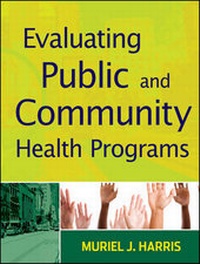
Evaluating Public and Community Health Programs
Published on 26. March 2010
Book
Paperback/Softback
240 pages
978-0-470-40087-6 (ISBN)
Description
The key to improving public health care programs is to understand the elements of program evaluation. Evaluating Public and Community Health Programs provides the essentials of public health by examining the planning, implementation, and evaluation of public health programs and policies. Through a practical approach, this book combines the CDC?s six-step model for program evaluation as well as the Donaldson three-step program theory driven evaluation model. Including tables, examples, worksheets, and guidelines, this handbook presents a simple, successful standards-based five-step model for effective results for students, faculty, and researchers.
More details
Language
English
Place of publication
Chichester
United Kingdom
Publishing group
John Wiley and Sons Ltd
Target group
Professional and scholarly
Illustrations
Illustrations
Dimensions
Height: 233 mm
Width: 177 mm
Thickness: 12 mm
Weight
410 gr
ISBN-13
978-0-470-40087-6 (9780470400876)
Copyright in bibliographic data and cover images is held by Nielsen Book Services Limited or by the publishers or by their respective licensors: all rights reserved.
Schweitzer Classification
Other editions
New editions
Muriel J. Harris
Evaluating Public and Community Health Programs
Book
12/2016
2nd Edition
Jossey-Bass
€96.00
Shipment within 15-20 days
Person
Muriel J. Harris, PhD, MPH is an assistant professor, University of Louisville, School of Public Health and Information Sciences. Dr. Harris was the 2004 co-recipient of the CDC/ATSDR Honor Award and in 2000 was awarded membership in the national Delta Omega Honorary Society in Public Health. In 2008 she won the Delta Omega Innovative Curriculum award for her program evaluation course.
Content
Figures and Tables. Preface. The Author. 1 An Introduction to Public and Community Health Evaluation. The Links Among Community Assessment, Program Implementation, and Evaluation. Overview of Evaluation. Preassessment Evaluations. Community-Based Participatory Research. The Participatory Model for Evaluation. Cultural Considerations in Evaluation. 2 The Community Assessment: An Overview. Theoretical Considerations. The Ecological Model. Data Collection. Process. Data Sources. Reviewing the Scientific Literature. The Report. Stakeholders Participation in Community Assessments. 3 Developing Initiatives: An Overview. The Organization's Mission. Planning the Initiative. Goals and Objectives. The Initiative Activities Using Existing Evidence-Based Programs. The Program's Theory of Change. The Logic Model Depicting the Theory of Change. Criteria for Successful Initiatives. 4 Planning for Evaluation: Purpose and Processes. The Timing of the Evaluation. The Purpose of Evaluation. Establishing the Contract for Evaluation. The Evaluation Team. Creating and Maintaining Effective Partnerships. Evaluation Standards. Managing the Evaluation Process. Factors That Influence the Evaluation Process. Involving Stakeholders. 5 Designing the Evaluation: Describing the Program. The Context. Justifications for the Initiative. The Initiative's Goals, Objectives, and Activities. The Initiative's Theory of Change and Logic Model. 6 Designing the Evaluation: Determining the Evaluation Questions and the Evaluation Design. Bases for Selecting the Evaluation Questions. Approaches to Selecting the Evaluation Questions. Types of Evaluations. Process Evaluation. Outcome Evaluation. 7 Collecting the Data: Quantitative. Choosing a Data-Collection Approach. Using Surveys. Designing Survey Instruments. Pilot Testing. Triangulation. Institutional Review Boards. Stakeholder Involvement. 8 Analyzing and Interpreting the Data: Quantitative. Analyzing and Reporting Quantitative Data. Reaching Conclusions. Stakeholder Involvement. Steps in Quantitative-Data Analysis and Interpretation. 9 Collecting the Data: Qualitative. Qualitative Data. Ensuring Validity and Reliability. Interview-Format Approaches. Document and Record Review. Observational Approaches. Case Reviews. Digital Approaches. Geographic Information Systems. Training Data Collectors. Pilot Testing. Managing and Storing Qualitative Data. Stakeholder Involvement. 10 Analyzing and Interpreting the Data: Qualitative. Analyzing Qualitative Data. Interpreting the Data and Reaching Conclusions. The Role of Stakeholders 11 Reporting Evaluation Findings. The Content of the Report. The Timing of the Report. The Audience for the Report. The Format of the Report. Include the following. 12 Case Study. The Community Assessment. The Intervention. Design the Evaluation. Collect the Data. Analyze and Interpret the Data. Report the Results. Glossary. References. Index.