

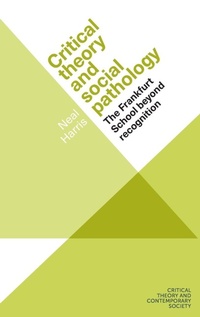
Critical Theory and Social Pathology
The Frankfurt School Beyond Recognition
Published on 22. November 2022
Book
Hardback
200 pages
978-1-5261-5473-6 (ISBN)
Description
In the neoliberal world of the twenty-first century, the progressive academy urgently needs a vehicle for normative social research. Critical theory once answered this call, but today its programme is in crisis. The 'pathologies of recognition' approach, popular among contemporary critical theorists, aids neoliberalism rather than challenging it, in part because it is unable to grasp the structural nature of power.
To offer an alternative, this book returns to the work of Erich Fromm and Herbert Marcuse, using it as the basis for a revivified social theoretical foundation. As the first generation of critical theorists knew, thought itself can be reified, our imaginations debased, and our desires artificially induced. We need to think beyond recognition and embrace a more potent and aggressive form of social critique, true to the founding spirit of the Frankfurt School. -- .
To offer an alternative, this book returns to the work of Erich Fromm and Herbert Marcuse, using it as the basis for a revivified social theoretical foundation. As the first generation of critical theorists knew, thought itself can be reified, our imaginations debased, and our desires artificially induced. We need to think beyond recognition and embrace a more potent and aggressive form of social critique, true to the founding spirit of the Frankfurt School. -- .
Reviews / Votes
'Critical theory and social pathology provides a necessary recapturing of social pathology, unseating it from its position as a 'second order' phenomenon to the process of recognition. Harris recognises the important contribution of recent critiques of Critical Theory, but sets them aside, proposing a new way forward. Here, social pathology is regarded as an important platform for a renewed programme of social research. By engaging with this new synthesis of Fromm and Marcuse's work, Harris allows critical theorists to, once again, step beyond recognition.'Owen Brown, Marx and Philosophy Review of Books
'Critical theory and social pathology makes a major contribution to the field. Harris shows how Erich Fromm's work offers profound and timely insights into the nature of societal pathologies. As such, the book points beyond the recognition approach to social research and offers the foundations for a critical theory of society which reconnects with the founding aspirations of the Frankfurt School.'
Gerard Delanty, Emeritus Professor of Sociology, University Of Sussex
'This timely and lucid study makes an important contribution to the growing chorus of voices that claim that Frankfurt School Critical theory is in crisis. Its thinkers have abandoned their animating commitment to radical and uncompromising criticism of the pathologies of capitalism and adopted instead a defanged, reformist political stance. In his scholarly and engaging work, Neal Harris identifies the roots of this domestication in the work of Axel Honneth and other theorists of recognition who have substituted the deep critique of power with superficial epistemological concerns. Through a distinctive rereading of the work of Erich Fromm and Herbert Marcuse, Harris demonstrates how the radical thrust of Frankfurt School critique might yet be restored in a revivified diagnosis of the pathologies of neoliberal societies. Thought provoking and essential reading for anyone interested in the state of contemporary critical theory and possible pathways for the renewal of its original emancipatory aims.'
Lois McNay, Professor of Political Theory, University of Oxford
'Critical theory, once the purview of thinkers that were independent, iconoclastic and engaged, has sadly become academic and pedantic, flitting from one intellectual fad to the next. Neal Harris is a welcome exception to this trend. With original and committed intelligence, he reveals the pretensions of academic critical theory and exposes the pedantry that dominates the field. Above the deafening bleats of what now passes for critical theory, Harris's book renews the faith that critique can once again be fused with emancipatory political purpose and the best traditions of modern reason.'
Michael J. Thompson, Professor of Political Theory, William Paterson University -- .
More details
Product info
Print PDF
Series
Language
English
Place of publication
Manchester
United Kingdom
Target group
College/higher education
Professional and scholarly
Dimensions
Height: 240 mm
Width: 161 mm
Thickness: 16 mm
Weight
473 gr
ISBN-13
978-1-5261-5473-6 (9781526154736)
Copyright in bibliographic data and cover images is held by Nielsen Book Services Limited or by the publishers or by their respective licensors: all rights reserved.
Schweitzer Classification
Other editions
Additional editions
E-Book
11/2022
1st Edition
Manchester University Press
from
€189.99
Available for download
E-Book
11/2022
1st Edition
Manchester University Press
€189.99
Available for download
Person
Neal Harris is Senior Lecturer in Sociology at Oxford Brookes University -- .
Content
Introduction: on the battle for critical theory
Part I: Social pathology and the crisis of critical theory
1 Social pathology: the 'explosive charge' of critical theory
2 Distorted by recognition
3 Pathologies of recognition
Part II: Foundations of pathology diagnosing critique
4 Rousseau and the foundations of pathology diagnosing social criticism
5 Hegelian-Marxism: pathologies of reason, pathologies of production
Part III: A Fromm-Marcuse synthesis
6 Erich Fromm and pathological normalcy
7 The pathological normalcy of what? Towards a Fromm-Marcuse synthesis
Conclusion: the Frankfurt School beyond recognition
Index -- .
Part I: Social pathology and the crisis of critical theory
1 Social pathology: the 'explosive charge' of critical theory
2 Distorted by recognition
3 Pathologies of recognition
Part II: Foundations of pathology diagnosing critique
4 Rousseau and the foundations of pathology diagnosing social criticism
5 Hegelian-Marxism: pathologies of reason, pathologies of production
Part III: A Fromm-Marcuse synthesis
6 Erich Fromm and pathological normalcy
7 The pathological normalcy of what? Towards a Fromm-Marcuse synthesis
Conclusion: the Frankfurt School beyond recognition
Index -- .