

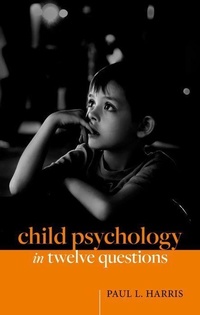
Child Psychology in Twelve Questions
Published on 28. July 2022
Book
Hardback
264 pages
978-0-19-286650-9 (ISBN)
Description
Child psychology as a scientific enterprise is about 100 years old, but while numerous textbooks and practical guides are available, the more meditative questions about the nature of a child's mind are rarely asked. This book explores some of the enduring questions in developmental psychology: How do children form an attachment to their caregivers? How do they learn words? In their imagination, are they confused - or clear-sighted - about the difference between fantasy and reality? How do they decide who to trust? In each case, Paul Harris shows why these questions are important, proposes likely answers, and explains the uncertainties that persist. He outlines important landmarks, both well-known and neglected, and explores broader questions about theories of mind, morality, and cross-cultural differences.
Reviews / Votes
A fantastic read - authoritative and thought provoking, yet easily accessible. Paul Harris is one of the main figures in the field of developmental psychology, and his book has some wonderful details of the actual experiments involved. * Bruce Hood, University of Bristol * Books on child development abound, ranging from academic textbooks to practical guides. Paul Harris's new book occupies a unique place in this landscape. Here is one of the leading researchers in developmental psychology sharing his expertise in a rigorous and scientific, yet still very reader friendly, manner. Students of all shapes and sizes are the beneficiaries. A wonderful book. * Michael Tomasello, Duke University * This is simply a terrific contribution. * Choice *More details
Language
English
Place of publication
Oxford
United Kingdom
Target group
Professional and scholarly
Dimensions
Height: 225 mm
Width: 147 mm
Thickness: 25 mm
Weight
462 gr
ISBN-13
978-0-19-286650-9 (9780192866509)
Copyright in bibliographic data and cover images is held by Nielsen Book Services Limited or by the publishers or by their respective licensors: all rights reserved.
Schweitzer Classification
Other editions
Additional editions
Paul L. Harris
Child Psychology in Twelve Questions
E-Book
08/2022
1st Edition
OUP eBook
€9.99
Available for download
Paul L. Harris
Child Psychology in Twelve Questions
E-Book
08/2022
1st Edition
OUP eBook
€9.99
Available for download
Person
Paul L. Harris is a developmental psychologist with interests in the development of cognition, emotion, and imagination. After studying psychology at Sussex and Oxford, he taught at the University of Lancaster, the Free University of Amsterdam, and the London School of Economics. In 1980, he moved to Oxford where he became Professor of Developmental Psychology and Fellow of St John's College. In 2001, he migrated to Harvard University where he teaches developmental psychology in the Graduate School of Education. He is a fellow of the British Academy and the American Academy of Arts and Sciences. His book Trusting What You're Told: How Children Learn from Others (Harvard University Press, 2012) won the Cognitive Development Society Book Award in 2013 and the Eleanor Maccoby Book Award from the American Psychological Association in 2014.
Content
1: Where does love come from? Attachment theory
2: How do children learn words? Universality and variation
3: Does language change how children think? The contested relation between language and thought
4: Do children live in a fantasy world? Pretending and the origins of the imagination
5: Are children natural psychologists? One or two early theories of mind
6: Can we trust children's memory? The vulnerable eyewitness
7: Do children understand emotion? Children's insight into their inner lives
8: How do children tell right from wrong? The origins of morality
9: Do children trust what they are told? The role of trust in cognitive development
10: Do children believe in magic? Magic and miracles
11: Is developmental psychology ethnocentric? Cross-cultural differences in ways of thinking
12: What have we learned? Children's minds
2: How do children learn words? Universality and variation
3: Does language change how children think? The contested relation between language and thought
4: Do children live in a fantasy world? Pretending and the origins of the imagination
5: Are children natural psychologists? One or two early theories of mind
6: Can we trust children's memory? The vulnerable eyewitness
7: Do children understand emotion? Children's insight into their inner lives
8: How do children tell right from wrong? The origins of morality
9: Do children trust what they are told? The role of trust in cognitive development
10: Do children believe in magic? Magic and miracles
11: Is developmental psychology ethnocentric? Cross-cultural differences in ways of thinking
12: What have we learned? Children's minds