

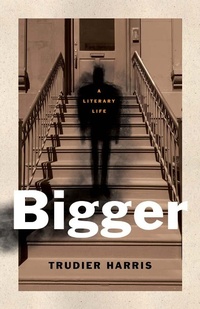
Bigger
A Literary Life
Published on 13. August 2024
Book
Hardback
200 pages
978-0-300-26932-1 (ISBN)
Description
A biography of Native Son's Bigger Thomas that examines his continued relevance in debates over Black men and the violence of racism
Bigger Thomas, the central figure in Richard Wright's novel Native Son (1940), eludes easy categorization. A violent and troubled character who rejects the rules of society, Bigger is both victim and perpetrator, damaged by racism and segregation on the South Side of Chicago, seemingly raping and killing without regrets. His story has electrified readers for more than eight decades, and it continues to galvanize debates around representation, respectability, social justice, and racism in American life.
In this book, distinguished scholar Trudier Harris examines the literary life of Bigger Thomas from his birth to the current day. Harris explores the debates between Black critics and Communist artists in the 1930s and 1940s over the "political novel," the censorship of Native Son by white publishers, and the work's initial reception-as well as interpretations from Black feminists and Black Power activists in the decades that followed, up to the novel's resonance with the Black Lives Matter movement today. Bigger, Harris argues, represents the knotted heart of American racism, damning and unsettling, and still very much with us.
Bigger Thomas, the central figure in Richard Wright's novel Native Son (1940), eludes easy categorization. A violent and troubled character who rejects the rules of society, Bigger is both victim and perpetrator, damaged by racism and segregation on the South Side of Chicago, seemingly raping and killing without regrets. His story has electrified readers for more than eight decades, and it continues to galvanize debates around representation, respectability, social justice, and racism in American life.
In this book, distinguished scholar Trudier Harris examines the literary life of Bigger Thomas from his birth to the current day. Harris explores the debates between Black critics and Communist artists in the 1930s and 1940s over the "political novel," the censorship of Native Son by white publishers, and the work's initial reception-as well as interpretations from Black feminists and Black Power activists in the decades that followed, up to the novel's resonance with the Black Lives Matter movement today. Bigger, Harris argues, represents the knotted heart of American racism, damning and unsettling, and still very much with us.
Reviews / Votes
2025 CHOICE Outstanding Academic Title"As one of our most celebrated literary critics, Trudier Harris has done it again. Bigger is the definitive study of one of the most (in)famous characters in American literary history."-E. Patrick Johnson, author of Sweet Tea
"Bigger Thomas is unquestionably one of the most memorable figures in American fiction. Scrupulously charting his literary life, Trudier Harris richly illuminates the complex meanings of Wright's masterpiece."-Arnold Rampersad, author of The Life of Langston Hughes
"Finally, a sustained scholarly exploration of a character who, for over eight decades, has haunted our literary and cultural imaginations. Trudier Harris, one of our leading experts on Black literature, takes us on a journey into the worlds of Richard Wright's Bigger Thomas."-Howard Rambsy II, author of Bad Men
More details
Series
Language
English
Place of publication
United States
Product notice
Cloth over boards
Dimensions
Height: 220 mm
Width: 144 mm
Thickness: 21 mm
Weight
370 gr
ISBN-13
978-0-300-26932-1 (9780300269321)
Copyright in bibliographic data and cover images is held by Nielsen Book Services Limited or by the publishers or by their respective licensors: all rights reserved.
Schweitzer Classification
Person
Trudier Harris is J. Carlyle Sitterson Distinguished Professor of English, emerita, University of North Carolina, Chapel Hill, and University Distinguished Research Professor of English, emerita, University of Alabama. She is the author of numerous books, including From Mammies to Militants: Domestics in Black American Literature and The Scary Mason-Dixon Line: African American Writers and the South. She lives in Tuscaloosa, AL.