

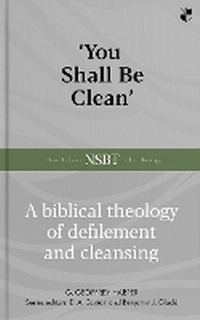
'You Shall Be Clean'
A Biblical Theology Of Defilement And Cleansing
Published on 16. October 2025
Book
Hardback
304 pages
978-1-78974-272-5 (ISBN)
Description
What do 'clean' and 'unclean' really mean in the Bible? Biblical purity categories are often misconstrued either in hygienic terms or as a straightforward synonym for sin.
Geoffrey Harper's stimulating study adopts a canonical approach to explore the causes, objects, implications and remedies for ritual and moral uncleanness throughout the Scriptures in order to construct a biblical theology of cleansing and defilement.
Careful consideration of the biblical texts suggests the language of 'unclean' is most frequently used to demarcate a state of being of people or objects rendered unfit or 'out of place' (and requiring separation or removal) with respect to God's presence.
Harper teases out the implications for Christian theology and mission. This will help you gain a more rounded appreciation of what Christ has achieved for his people. You will also be better equipped to explain the gospel in a winsome way to those whose felt needs often orbit around issues of ritual and/or moral defilement.
Geoffrey Harper's stimulating study adopts a canonical approach to explore the causes, objects, implications and remedies for ritual and moral uncleanness throughout the Scriptures in order to construct a biblical theology of cleansing and defilement.
Careful consideration of the biblical texts suggests the language of 'unclean' is most frequently used to demarcate a state of being of people or objects rendered unfit or 'out of place' (and requiring separation or removal) with respect to God's presence.
Harper teases out the implications for Christian theology and mission. This will help you gain a more rounded appreciation of what Christ has achieved for his people. You will also be better equipped to explain the gospel in a winsome way to those whose felt needs often orbit around issues of ritual and/or moral defilement.
Reviews / Votes
'When the psalmist declares that only those who have "clean hands and a pure heart" can ascend into God's presence (Psalm 24:4), he highlights the significance of the concepts of defilement and cleansing. Addressing this much-neglected topic, Dr Harper skilfully engages with its ubiquitous presence throughout the Bible. By offering new perspectives on the biblical text, this careful study enriches our understanding of the Bible. Importantly, it sheds fresh light on the scope and impact of Christ's atoning ministry, reminding readers of the necessity of engaging with the whole canon of Scripture.' -- T. Desmond Alexander, Senior Lecturer in Biblical Studies and Director of Postgraduate Studies, Union Theological College, Belfast 'The biblical laws and language about purity and impurity are so utterly foreign to us and we struggle to know what to do with them. But Geoff Harper's study of the relevant materials provides insight and clarity on the subject and helps us to understand what it means to have hearts cleansed by faith and to be white as snow before God. A book that will open up vistas of study for understanding a confusing topic.' -- Michael F. Bird, Deputy Principal, Ridley College, Melbourne, Australia 'With clarity, insight and humility, Geoff Harper demonstrates that the theme of defilement and cleansing is woven into the whole of Scripture. Far from being an obscure part of the Old Testament, it has vital connections to Christian theology, discipleship and witness. This is a study that deserves to be widely read for both the challenges and encouragement it provides.' -- David G. Firth, Tutor in Old Testament, Trinity College Bristol 'Geoffrey Harper has written a robust and readable study on Israel's purity system, filling the scholarly gap on a vital and yet heretofore neglected topic. Without equal in its breadth, 'You Shall Be Clean' will surely become a frequently consulted standard on purity. More than this, Harper's fine treatment will open up significant, canon-wide avenues of meaning in Scripture, as well as a greater view of the wondrous incarnation of God's Son and the marvel of his cleansing work.' -- L. Michael Morales, Professor of Biblical Studies, Greenville Presbyterian Theological Seminary 'Geoffrey Harper skilfully draws the reader into an often neglected, yet vital aspect of the Bible's redemptive narrative. In insightful exposition, he demonstrates how the dynamic categories of defilement and cleansing shape the biblical world and frame the theological vision of its eschaton logical hope. As a result, the person and work of Christ emerge in clearer relief, as does the Lord's unwavering commitment to make his people fit for his holy presence. This significant contribution to biblical theology will inspire faithful preaching and discipleship in the church and open productive pathways to present the gospel to a world longing to be made clean.' -- Christine Palmer, Faculty in Old Testament, Gordon-Conwell Theological Seminary 'Issues of defilement, cleansing and purity were central to the daily lives of the ancient Israelites. Yet today, these themes are often overlooked and misunderstood by readers of the Bible. In this insightful and timely study, Geoff Harper builds on his important work on Leviticus to skilfully trace the themes of defilement and cleansing across both the Old and New Testaments. The result is a deeper understanding of these themes across the Bible, a richer appreciation for the person and work of Jesus, and fresh insights for Christian life and mission.' -- Anthony R. Petterson, Morling College, Australian University of Theology 'As one of the leading scholars on Leviticus today, Geoff Harper is well positioned to write a biblical theology of purity and impurity. With tremendous clarity, he shows us what the concepts of purity and impurity mean and how they play out, not just in the Old Testament, but in the entire biblical story. In doing so, he helps us to understand that story better - and does so in a way that is academically strong, theologically rich and pastorally warm. Even in places where I came to different conclusions, Harper still challenged me to see just how pervasive the themes of purity and impurity are - and how important it is to understand them if we are to understand the text. Harper's book will help you to gain that understanding.' -- Jay Sklar, Professor of Old Testament, Covenant Theological SeminaryMore details
Series
Language
English
Place of publication
Nottingham
United Kingdom
Publishing group
Inter-Varsity Press
Dimensions
Height: 216 mm
Width: 138 mm
ISBN-13
978-1-78974-272-5 (9781789742725)
Copyright in bibliographic data and cover images is held by Nielsen Book Services Limited or by the publishers or by their respective licensors: all rights reserved.
Schweitzer Classification
Other editions
Additional editions
E-Book
10/2025
IVP
€25.49
Available for download
Person
Lecturer in Old Testament and Hebrew at Sydney Missionary and Bible College, Australia. Author of 'I Will Walk Among You' (Eisenbrauns), co-editor of Finding Lost Words: The Church's Right to Lament (Wipf & Stock).
Content
Introduction 1
Recovering a crucial theme 1
The task of biblical theology 4
The language of defilement and cleansing 6
What to expect from this book 13
1 Defilement and cleansing in Leviticus and Numbers 17
Defilement and cleansing in Leviticus 18
Defilement and cleansing in Numbers 34
Summary 38
2 Conceptualizing defilement and cleansing 39
Clarifying concepts and terminology 40
Summary 52
3 Defilement and cleansing in the Pentateuch and Former
Prophets 55
The Pentateuch 56
The Former Prophets 68
Conclusion 78
4 Defilement and cleansing in the Latter Prophets 81
Isaiah 82
Jeremiah 89
Ezekiel 94
The Book of the Twelve 100
Excursus: defilement and cleansing of land 104
Conclusion 108
5 Defilement and cleansing in the Writings 109
Psalms 109
Proverbs and Job 113
Megilloth: The five Scrolls 117
Daniel 120
Ezra-Nehemiah 122
1 - 2 Chronicles 126
Conclusion 130
6 Defilement and cleansing in Second Temple literature 131
Ritual purity in Second Temple literature 132
Moral purity in Second Temple literature 137
Gentile impurity, genealogical impurity and the question of
intermarriage 145
Conclusion 149
7 Defilement and cleansing in the Gospels and Acts 151
Mark 153
Matthew 163
John 166
Luke-Acts 173
Conclusion 179
8 Defilement and cleansing in the epistles 181
The Pauline epistles 182
The non-Pauline epistles 194
Conclusion 205
9 A biblical theology of defilement and cleansing 207
Toward a biblical theology of defilement and cleansing 208
Thinking about the incarnation 211
Thinking about (the) atonement 214
Thinking about global mission 216
Final words 219
Recovering a crucial theme 1
The task of biblical theology 4
The language of defilement and cleansing 6
What to expect from this book 13
1 Defilement and cleansing in Leviticus and Numbers 17
Defilement and cleansing in Leviticus 18
Defilement and cleansing in Numbers 34
Summary 38
2 Conceptualizing defilement and cleansing 39
Clarifying concepts and terminology 40
Summary 52
3 Defilement and cleansing in the Pentateuch and Former
Prophets 55
The Pentateuch 56
The Former Prophets 68
Conclusion 78
4 Defilement and cleansing in the Latter Prophets 81
Isaiah 82
Jeremiah 89
Ezekiel 94
The Book of the Twelve 100
Excursus: defilement and cleansing of land 104
Conclusion 108
5 Defilement and cleansing in the Writings 109
Psalms 109
Proverbs and Job 113
Megilloth: The five Scrolls 117
Daniel 120
Ezra-Nehemiah 122
1 - 2 Chronicles 126
Conclusion 130
6 Defilement and cleansing in Second Temple literature 131
Ritual purity in Second Temple literature 132
Moral purity in Second Temple literature 137
Gentile impurity, genealogical impurity and the question of
intermarriage 145
Conclusion 149
7 Defilement and cleansing in the Gospels and Acts 151
Mark 153
Matthew 163
John 166
Luke-Acts 173
Conclusion 179
8 Defilement and cleansing in the epistles 181
The Pauline epistles 182
The non-Pauline epistles 194
Conclusion 205
9 A biblical theology of defilement and cleansing 207
Toward a biblical theology of defilement and cleansing 208
Thinking about the incarnation 211
Thinking about (the) atonement 214
Thinking about global mission 216
Final words 219