

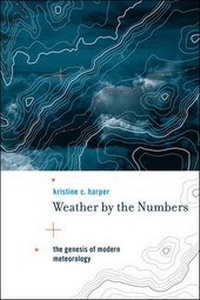
Weather by the Numbers
The Genesis of Modern Meteorology
Published on 1. September 2008
Book
Hardback
320 pages
978-0-262-08378-2 (ISBN)
Description
For much of the first half of the twentieth century, meteorology was more art than
science, dependent on an individual forecaster's lifetime of local experience. In Weather
by the Numbers, Kristine Harper tells the story of the transformation of meteorology from
a "guessing science" into a sophisticated scientific discipline based on physics and
mathematics. What made this possible was the development of the electronic digital computer; earlier
attempts at numerical weather prediction had foundered on the human inability to solve nonlinear
equations quickly enough for timely forecasting. After World War II, the combination of an expanded
observation network developed for military purposes, newly trained meteorologists, savvy about math
and physics, and the nascent digital computer created a new way of approaching atmospheric theory
and weather forecasting. This transformation of a discipline, Harper writes, was the most important
intellectual achievement of twentieth-century meteorology, and paved the way for the growth of
computer-assisted modeling in all the sciences.
science, dependent on an individual forecaster's lifetime of local experience. In Weather
by the Numbers, Kristine Harper tells the story of the transformation of meteorology from
a "guessing science" into a sophisticated scientific discipline based on physics and
mathematics. What made this possible was the development of the electronic digital computer; earlier
attempts at numerical weather prediction had foundered on the human inability to solve nonlinear
equations quickly enough for timely forecasting. After World War II, the combination of an expanded
observation network developed for military purposes, newly trained meteorologists, savvy about math
and physics, and the nascent digital computer created a new way of approaching atmospheric theory
and weather forecasting. This transformation of a discipline, Harper writes, was the most important
intellectual achievement of twentieth-century meteorology, and paved the way for the growth of
computer-assisted modeling in all the sciences.
More details
Series
Language
English
Place of publication
Cambridge, Mass.
United States
Publishing group
MIT Press Ltd
Target group
College/higher education
Professional and scholarly
Interest Age: From 18 years
Illustrations
10 s/w Abbildungen, 10 s/w Photographien bzw. Rasterbilder
20 illus.
Dimensions
Height: 229 mm
Width: 152 mm
Thickness: 0 mm
Weight
454 gr
ISBN-13
978-0-262-08378-2 (9780262083782)
Copyright in bibliographic data and cover images is held by Nielsen Book Services Limited or by the publishers or by their respective licensors: all rights reserved.
Schweitzer Classification
Other editions
Additional editions
Book
01/2012
MIT Press
€24.76
Article exhausted; check different version
Person
Kristine C. Harper is Kristine C. Harper is Associate Professor of History at The Florida State University in Tallahassee. In 2007-2008, she was a Fellow at the Tanner Humanities Center at the University of Utah and a National Endowment for the Humanities Fellow.
Content
Acknowledgements vii Introduction 1 A Stagnant Atmosphere The Weather Services before World War II 2 Toward a More Dynamic Atmosphere Discipline Development in the Interwar Period (1919-1938) 49 3 An Expanding Atmosphere The War Years (1939-1945) 69 4 Initial Atmospheric Conditions Scientific Goals, Civilian Manpower, and Military Funding (1944-1948) 91 5 An International Atmosphere Carl-Gustav Rossby and the Scandinavian Connection (1948-1950) 121 6 Creating a Realistic Atmosphere (1950-1952) 151 7 A Changing Atmosphere From Developmental to Operational Numerical Weather Prediction (1952-1955) 187 8 A New Atmosphere 225 Notes 241 Bibliography 279 Index