

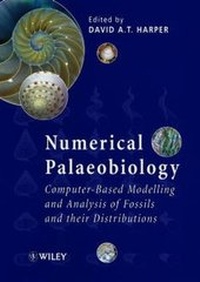
Numerical Palaeobiology
Computer Based-Modelling and Analysis of Fossils and their Distributions
Published on 26. April 1999
Book
Hardback
X, 468 pages
978-0-471-97405-5 (ISBN)
Description
Numerical Palaeobiology Computer-Based Modelling and Analysis of Fossils and their Distributions Edited by David A.T. Harper University of Copenhagen, Denmark Microcomputers have become an everyday part of the palaeobiologists tool-kit. Moreover, there is now a wide range of computer software available to handle all sorts of palaeontological data and problems. This book, aimed at final year undergraduates, graduate students and professional palaeontologists, biologists and geologists, brings together the many strands of contemporary palaeontology through the medium of numeracy. It provides a comprehensive review, with applications, of the many computer based techniques available for the analysis and modelling of palaeontological data. The first part of the book covers classical phenetic taxonomy through cladistics and the computer-generated reconstructions of fossils to actual models for fossil growth. This leads onto distribution analysis and modelling of fossils in time and space. Detailed stratigraphical distributions of fossils are described in quantitative terms together with the larger-scale patterns in the history of life itself, while palaeoecology, palynofacies, trace fossils and palaeogeography are all introduced through a spectrum of numerical algorithms. The majority of the studies are linked to specific software packages and many are illustrated with case histories. Although there are a number of books available on computer modelling and data analysis in geology, no study has integrated the two with such a range of palaeontological subject material.
Computergestützte Verfahren haben die Methoden paläontologischer Forschung in den vergangenen Jahren radikal geändert: Software zur Auswertung verschiedenster Datensätze und zur Behandlung eines breiten Spektrums von Problemen steht zur Verfügung. Was bisher fehlte, war ein übersichtliches Handbuch, das alle diese Ansätze zusammenfassend erklärt. Diese Lücke ist jetzt geschlossen: Praxisnah erläutern die Autoren dieser Monographie Rechen- und Modellierungsmethoden zur Untersuchung von Fossilien und erdgeschichtlichen Ökologien. In vielen Fällen wird auf geeignete kommerzielle Software hingewiesen.
Computergestützte Verfahren haben die Methoden paläontologischer Forschung in den vergangenen Jahren radikal geändert: Software zur Auswertung verschiedenster Datensätze und zur Behandlung eines breiten Spektrums von Problemen steht zur Verfügung. Was bisher fehlte, war ein übersichtliches Handbuch, das alle diese Ansätze zusammenfassend erklärt. Diese Lücke ist jetzt geschlossen: Praxisnah erläutern die Autoren dieser Monographie Rechen- und Modellierungsmethoden zur Untersuchung von Fossilien und erdgeschichtlichen Ökologien. In vielen Fällen wird auf geeignete kommerzielle Software hingewiesen.
More details
Product info
gebunden
Edition
1. Auflage
Language
English
Place of publication
New York
United States
Target group
College/higher education
Professional and scholarly
Dimensions
Height: 23.2 cm
Width: 17.2 cm
Thickness: 3.1 cm
Weight
796 gr
ISBN-13
978-0-471-97405-5 (9780471974055)
Schweitzer Classification
Person
David A.T. Harper is a British palaeontologist, specialising in fossil brachiopods and numerical methods in palaeontology. He is Professor of Palaeontology in Earth Sciences, Principal of Van Mildert College, and Deputy Head of Colleges in Durham University.
Content
Quantitative and Morphometric Methods in Taxonomy (D. Harper & A. Owen).
Phylogenetic Systematics and Palaeontology (S. Carlson).
Computer-based Serial Section Reconstruction (M. Herbert).
Statistical and Imaging Methods Applied to Deformed Fossils (N. Hughes).
Computer Models of Fossil Morphology (A. Swan).
Quantitative Biostratigraphy (H. Armstrong).
The Quantitative Description of Biotic Change Using Palaeontological Databases (K. Johnson & T. McCormick).
The History of Life: Large Databases in Palaeontology (M. Benton).
Community Analysis (W. Etter).
Multivariate Techniques in Palynofacies Analysis (J. Smith).
Quantitative Approaches to the Resolution of Taxonomic Problems in Invertebrate Ichnology (P. Orr).
A New Approach to Seriation (P. Ryan, et al.).
Indexes.
Phylogenetic Systematics and Palaeontology (S. Carlson).
Computer-based Serial Section Reconstruction (M. Herbert).
Statistical and Imaging Methods Applied to Deformed Fossils (N. Hughes).
Computer Models of Fossil Morphology (A. Swan).
Quantitative Biostratigraphy (H. Armstrong).
The Quantitative Description of Biotic Change Using Palaeontological Databases (K. Johnson & T. McCormick).
The History of Life: Large Databases in Palaeontology (M. Benton).
Community Analysis (W. Etter).
Multivariate Techniques in Palynofacies Analysis (J. Smith).
Quantitative Approaches to the Resolution of Taxonomic Problems in Invertebrate Ichnology (P. Orr).
A New Approach to Seriation (P. Ryan, et al.).
Indexes.