

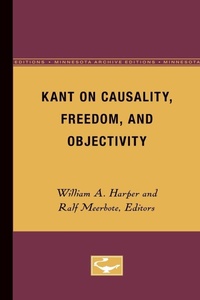
Kant on Causality, Freedom, and Objectivity
Published on 5. November 1984
Book
Paperback/Softback
200 pages
978-0-8166-1267-3 (ISBN)
Description
Kant on Causality, Freedom, and Objectivity was first published in 1984. Minnesota Archive Editions uses digital technology to make long-unavailable books once again accessible, and are published unaltered from the original University of Minnesota Press editions.
Kant's account of causation is central to his views on objective truth and freedom. The Second Analogy of Experience, in the Critique of Pure Reason,where he provides his defense of the causal principle, has long been the focus of intense philosophical research. In the past twenty years, there have been two major periods of interest in Kantian themes, The first coincided with a general turn away from positivism by analytic philosophers, and resulted in a fruitful interchange between Kant scholars and those who applied Kantian ideas to contemporary philosophical problems. In recent years, a new surge of interest in Kant's work occurred along with the developing controversy over realism generated by the work of Dummett and Putnam. Scholars now appreciate the extent to which the Kantian causal principle is illuminated by the philosopher's argument that his transcendental idealism supports an empirical realism. And in turn, Kant's views on objectivity, causation, and freedom are especially relevant to the philosophical concerns raised by the new debate over realism.
The eight papers in this book are drawn from two conferences that honored Lewis White Beck, an influential Kant scholar. Together with the introductory essay by the editors, they show the continuing relevance of Kant's analysis for the present-day philosophy of causation.
Kant's account of causation is central to his views on objective truth and freedom. The Second Analogy of Experience, in the Critique of Pure Reason,where he provides his defense of the causal principle, has long been the focus of intense philosophical research. In the past twenty years, there have been two major periods of interest in Kantian themes, The first coincided with a general turn away from positivism by analytic philosophers, and resulted in a fruitful interchange between Kant scholars and those who applied Kantian ideas to contemporary philosophical problems. In recent years, a new surge of interest in Kant's work occurred along with the developing controversy over realism generated by the work of Dummett and Putnam. Scholars now appreciate the extent to which the Kantian causal principle is illuminated by the philosopher's argument that his transcendental idealism supports an empirical realism. And in turn, Kant's views on objectivity, causation, and freedom are especially relevant to the philosophical concerns raised by the new debate over realism.
The eight papers in this book are drawn from two conferences that honored Lewis White Beck, an influential Kant scholar. Together with the introductory essay by the editors, they show the continuing relevance of Kant's analysis for the present-day philosophy of causation.
More details
Language
English
Place of publication
Minnesota
United States
Target group
College/higher education
Professional and scholarly
Dimensions
Height: 229 mm
Width: 152 mm
Thickness: 11 mm
Weight
298 gr
ISBN-13
978-0-8166-1267-3 (9780816612673)
Copyright in bibliographic data and cover images is held by Nielsen Book Services Limited or by the publishers or by their respective licensors: all rights reserved.
Schweitzer Classification
Persons
Ralf Meerbote is professor of philosophy at the University of Rochester.