

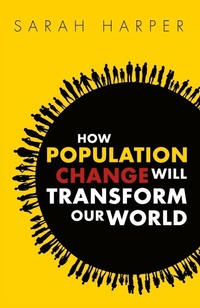
How Population Change Will Transform Our World
Published on 28. February 2019
Book
Paperback/Softback
272 pages
978-0-19-878399-2 (ISBN)
Description
Predicting the shape of our future populations is vital for installing the infrastructure, welfare, and provisions necessary for society to survive. There are many opportunities and challenges that will come with the changes in our populations over the 21st century. In this new addition to the 21st Century Challenges series, Sarah Harper works to dispel myths such as the fear of unstoppable global growth resulting in a population explosion, or that climate change will lead to the mass movement of environmental refugees; and instead considers the future shape of our populations in light of demographic trends in fertility, mortality, and migration, and their national and global impact.
How Population Change Will Transform Our World looks at population trends by region to highlight the key issues facing us in the coming decades, including the demographic inertia in Europe, demographic dividend in Asia, high fertility and mortality in Africa, the youth bulge in the Middle East, and the balancing act of migration in the Americas. Harper concludes with an analysis of global challenges we must plan for such as the impact of climate change and urbanization, and the difficulty of feeding 10 billion people, and considers ways in which we can prepare for, and mitigate against, these challenges.
How Population Change Will Transform Our World looks at population trends by region to highlight the key issues facing us in the coming decades, including the demographic inertia in Europe, demographic dividend in Asia, high fertility and mortality in Africa, the youth bulge in the Middle East, and the balancing act of migration in the Americas. Harper concludes with an analysis of global challenges we must plan for such as the impact of climate change and urbanization, and the difficulty of feeding 10 billion people, and considers ways in which we can prepare for, and mitigate against, these challenges.
Reviews / Votes
An excellent, succinct guide. * Robert Mayhew, Literary Review * ... provides a powerful reminder that debates over immigrations, social welfare, and inequality will intensify in the decades ahead. * Foreign Affairs * Global Change is a major concern of the Martin Institute, and this book is a solid contribution in that area. It presents a comprehensive and balanced treatment of global demography ... The text is [...] enlivened by brief narratives on the life experiences and aspirations of young persons in the various regions. * L. MacK, Population and Development Review * ... this paperback dates little from the hardback three years ago: the issues are still germane and the ground Harper covers still hugely relevant. * Jonathan Cowie, Concatenation *More details
Language
English
Place of publication
Oxford
United Kingdom
Target group
College/higher education
Professional and scholarly
Illustrations
46 black and white images
Dimensions
Height: 198 mm
Width: 129 mm
Thickness: 14 mm
Weight
287 gr
ISBN-13
978-0-19-878399-2 (9780198783992)
Copyright in bibliographic data and cover images is held by Nielsen Book Services Limited or by the publishers or by their respective licensors: all rights reserved.
Schweitzer Classification
Person
Sarah Harper is Professor of Gerontology at Oxford University, Director of the Oxford Institute of Ageing, a multi-disciplinary research unit concerned with the implications of population ageing, and Director of the Clore Programme on Population-Environment Change. Her research concerns globalization and global ageing, and the impact of population change, in particular the implications at the global, societal and individual level of the age-structural shift from predominantly young to predominantly older societies. She has authored, edited and contributed to several books, including Families in Ageing Societies (Editor, OUP, 2004), Ageing Societies: Myths, Challenges, and Opportunities (Hodder Arnold, 2005) and Demography: A Very Short Introduction (OUP, 2018). She is also the editor of the Journal of Population Ageing (Springer).
Content
1: The Age Narrative2: How Did We Get Here?3: The Grey Burden4: Youth: Peril or Dividend?5: Too Many Children?6: Our Future SelvesAfterwordAppendicesNotes and ReferencesBibliography