

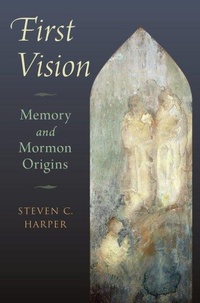
First Vision
Memory and Mormon Origins
Published on 26. September 2019
Book
Hardback
288 pages
978-0-19-932947-2 (ISBN)
Description
This is the biography of a contested memory, how it was born, grew, changed the world, and was changed by it. It's the story of the story of how the Church of Jesus Christ of Latter-day Saints began. Joseph Smith, the church's founder, remembered that his first audible prayer, uttered in spring of 1820 when he was about fourteen, was answered with a vision of heavenly beings. Appearing to the boy in the woods near his parents' home in western New York State, they told Smith that he was forgiven and warned him that Christianity had gone astray.
Smith created a rich and controversial historical record by narrating and documenting this event repeatedly. In First Vision, Steven C. Harper shows how Latter-day Saints (beginning with Joseph Smith) and others have remembered this experience and rendered it meaningful. When and why and how did Joseph Smith's first vision, as saints know the event, become their seminal story? What challenges did it face along the way? What changes did it undergo as a result? Can it possibly hold its privileged position against the tides of doubt and disbelief, memory studies, and source criticism-all in the information age? Steven C. Harper tells the story of how Latter-day Saints forgot and then remembered accounts of Smith's experience and how Smith's 1838 account was redacted and canonized. He explores the dissonance many saints experienced after discovering multiple accounts of Smith's experience. He describes how, for many, the dissonance has been resolved by a reshaped collective memory.
Smith created a rich and controversial historical record by narrating and documenting this event repeatedly. In First Vision, Steven C. Harper shows how Latter-day Saints (beginning with Joseph Smith) and others have remembered this experience and rendered it meaningful. When and why and how did Joseph Smith's first vision, as saints know the event, become their seminal story? What challenges did it face along the way? What changes did it undergo as a result? Can it possibly hold its privileged position against the tides of doubt and disbelief, memory studies, and source criticism-all in the information age? Steven C. Harper tells the story of how Latter-day Saints forgot and then remembered accounts of Smith's experience and how Smith's 1838 account was redacted and canonized. He explores the dissonance many saints experienced after discovering multiple accounts of Smith's experience. He describes how, for many, the dissonance has been resolved by a reshaped collective memory.
Reviews / Votes
I find this book to be an impotrant argument for how we handle memory as historians; it is not simply monuments, plays, hazy thoughts, or locating the "true source" of accurate memory or fact. It is a complex cognitive process that requires our attention both to the psychological sciences and increased sophistication over how we adjudicate historical sources. * Christopher Allison, University of Chicago, Journal of Mormon History * As the 200th anniversary of the First Vision approaches, those interested in better understanding what that vision has meant to Latter-day Saints over these last two centuries will benefit from reading First Vision: Memory and Mormon Origins. * Pearl of Great Price Central * Steven C. Harper has produced some fascinating and excellently researched scholarship here, and we highly recommend the book for the shelves of lay readers and experienced scholars alike. * FairMormon * Harper's treatment in First Vision is excellent. He demonstrates an obvious command of the primary sources and secondary literature, and writes with clarity and coherence. * Ploni Almoni, Ploni Almoni: A Latter-day Saint Blog * Harper offers a deeply insightful analysis of how individuals and groups remember events * in this case Joseph Smith's first visionas they tell the story of who they are over time. In extending research on memory to the process through which groups develop, internalize, and reshape their memory of their origins, Harper makes a major contribution to our understanding of the way that collective identity is formed and transformed.Ann Taves, author of Revelatory Events: Three Case Studies of the Emergence of New Spiritual Paths * Harper has written an erudite, but accessible book about Mormonism's origin story, its 'First Vision.' As a history of a history and one held sacred and energetically contested for nearly two centuries, it is a very interesting story and an illuminating one for scholar and general reader alike. Religious Studies scholars will be especially benefited from such a modern, which is to say transparent, example of how human speech becomes scripture and scripture becomes canon and not as a contemporary dead letter, but rather the lodestar of a vibrant and itself very modern religion. * Kathleen Flake, Richard Lyman Bushman Professor of Mormon Studies, Department of Religion, University of Virginia * As the biography of a theophany, this book beautifully narrates the long, complicated life of Joseph Smith's First Vision in the history, theology and culture of the Latter-day Saints. But it is also much more than that. It provides powerful analytical insights into matters of history and memory, faith and fact, canonization and identity formation that resonate far beyond Mormon Studies. Steven Harper has accomplished a remarkable thing. * David F. Holland, John A. Bartlett Professor of New England Church History, Harvard Divinity School *More details
Language
English
Place of publication
New York
United States
Target group
Professional and scholarly
Product notice
sewn/stitched
Cloth over boards
With dust jacket
Dimensions
Height: 231 mm
Width: 155 mm
Thickness: 25 mm
Weight
612 gr
ISBN-13
978-0-19-932947-2 (9780199329472)
Copyright in bibliographic data and cover images is held by Nielsen Book Services Limited or by the publishers or by their respective licensors: all rights reserved.
Schweitzer Classification
Other editions
Additional editions
E-Book
07/2019
OUP eBook
€18.99
Available for download
E-Book
07/2019
OUP eBook
€18.99
Available for download
Person
Steven C. Harper earned a PhD in early American history from Lehigh University, where he was Lawrence Henry Gipson Fellow. He taught at Brigham Young University campuses in Hawaii and Utah, and served as a volume editor of The Joseph Smith Papers and later as managing historian and a general editor of Saints: The Story of The Church of Jesus Christ in the Latter Days. He is the author of Promised Land (2006) a study of colonial Pennsylvania's dispossession of the Lenape or Delawares. He is also the author of dozens of articles and two books on early Latter-day Saint history. He is currently editor of BYU Studies Quarterly and professor of Church History and Doctrine at Brigham Young University.
Content
Introduction: A Boy Who Asked God a Question
Part 1: Joseph Smith's Memory
1. A Few Days After
2. Past, Present, and Persecution: The 1838/39 Account
3. An Account of His Marvelous Experience: The 1832 Account
4. First Communication: The 1835 Account
5. Consolidation
Part 2: Collective Memory
6. Extract from His History
7. I Heard Him Relate His First Vision
8. Interesting Account
9. Addition, Subtraction, and Canonization
10. Collective Consolidation Begins
11. An Interview with Joseph Smith in 1859
12. Our History, 1869-1874
13. Collective Consolidation Culminates
14. The Inception of Mormonism and the Persecuted Present
15. Recursion, Distortion, and Source Amnesia
16. Straightforward Recital
17. Filling the Void
18. The Joseph (F.) Smith Story
19. The Golden Age of that First Great Revelation
20. The Objective Reality of the First Vision is Questioned
21. One Hundred Years of Mormonism
Part 3: Contested Memory
22. Fundamentalism
23. Censoring Joseph Smith's Story
24. New Light
25. Under Attack
26. Our Whole Strength
27. I Did Not Know
28. Gone Are the Days
Afterword: Deep Learning
Part 1: Joseph Smith's Memory
1. A Few Days After
2. Past, Present, and Persecution: The 1838/39 Account
3. An Account of His Marvelous Experience: The 1832 Account
4. First Communication: The 1835 Account
5. Consolidation
Part 2: Collective Memory
6. Extract from His History
7. I Heard Him Relate His First Vision
8. Interesting Account
9. Addition, Subtraction, and Canonization
10. Collective Consolidation Begins
11. An Interview with Joseph Smith in 1859
12. Our History, 1869-1874
13. Collective Consolidation Culminates
14. The Inception of Mormonism and the Persecuted Present
15. Recursion, Distortion, and Source Amnesia
16. Straightforward Recital
17. Filling the Void
18. The Joseph (F.) Smith Story
19. The Golden Age of that First Great Revelation
20. The Objective Reality of the First Vision is Questioned
21. One Hundred Years of Mormonism
Part 3: Contested Memory
22. Fundamentalism
23. Censoring Joseph Smith's Story
24. New Light
25. Under Attack
26. Our Whole Strength
27. I Did Not Know
28. Gone Are the Days
Afterword: Deep Learning