

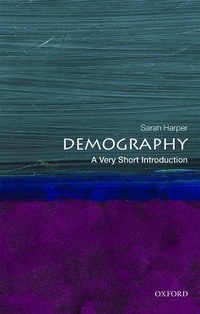
Demography
A Very Short Introduction
Published on 24. May 2018
Book
Paperback/Softback
160 pages
978-0-19-872573-2 (ISBN)
Description
The generation into which each person is born, the demographic composition of that cohort, and its relation to those born at the same time in other places influences not only a person's life chances, but also the economic and political structures within which that life is lived; the person's access to social and natural resources (food, water, education, jobs, sexual partners); and even the length of that person's life. Demography, literally the study of people, addresses the size, distribution, composition, and density of populations, and considers the impact the drivers which mediate these will have on both individual lives and the changing structure of human populations.
This Very Short Introduction considers the way in which the global population has evolved over time and space. Sarah Harper discusses the theorists, theories, and methods involved in studying population trends and movements, before looking at the emergence of new demographic sub-disciplines and addressing some of the future population challenges of the 21st century.
ABOUT THE SERIES: The Very Short Introductions series from Oxford University Press contains hundreds of titles in almost every subject area. These pocket-sized books are the perfect way to get ahead in a new subject quickly. Our expert authors combine facts, analysis, perspective, new ideas, and enthusiasm to make interesting and challenging topics highly readable.
This Very Short Introduction considers the way in which the global population has evolved over time and space. Sarah Harper discusses the theorists, theories, and methods involved in studying population trends and movements, before looking at the emergence of new demographic sub-disciplines and addressing some of the future population challenges of the 21st century.
ABOUT THE SERIES: The Very Short Introductions series from Oxford University Press contains hundreds of titles in almost every subject area. These pocket-sized books are the perfect way to get ahead in a new subject quickly. Our expert authors combine facts, analysis, perspective, new ideas, and enthusiasm to make interesting and challenging topics highly readable.
Reviews / Votes
incisive overview * Times Higher Education * Sarah Harper has given those studying demographics a useful book as an aid to revision. * Science Fact & Science Fiction Concatenation *More details
Series
Language
English
Place of publication
Oxford
United Kingdom
Target group
College/higher education
Illustrations
11 black and white images
Dimensions
Height: 176 mm
Width: 112 mm
Thickness: 13 mm
Weight
119 gr
ISBN-13
978-0-19-872573-2 (9780198725732)
Copyright in bibliographic data and cover images is held by Nielsen Book Services Limited or by the publishers or by their respective licensors: all rights reserved.
Schweitzer Classification
Other editions
Additional editions
Person
Sarah Harper is Professor of Gerontology at Oxford University, Director of the Oxford Institute of Ageing, and Director of the Clore Programme on Population-Environment Change. She is a Governor of the Pensions Policy Institute and author of Migration, Ageing and the Environment for the UK government Foresight Programme on Global Migration. She is also the Director of the Royal Institute, London. Sarah is the author and editor of several books including Ageing Societies: Myths, Challenges and Opportunities (Hodder Arnold, 2006); the International Handbook of Ageing and Public Policy (Edward Elgar, 2014); and How Population Change will Transform our World (OUP, 2016). She is the founding co-editor of the Journal of Population Ageing (Springer).
Content
Preface
1: Demography is destiny...or not
2: From 55,000 to 7 billion
3: The founding fathers
4: A statistical science
5: Demographic drivers
6: The demographic transition
7: Demographer's tool box
8: Population pyramids and projections
9: Sub-disciplines arise
10: Population policies and future challenges
Glossary
References
Further Reading
Index
1: Demography is destiny...or not
2: From 55,000 to 7 billion
3: The founding fathers
4: A statistical science
5: Demographic drivers
6: The demographic transition
7: Demographer's tool box
8: Population pyramids and projections
9: Sub-disciplines arise
10: Population policies and future challenges
Glossary
References
Further Reading
Index