

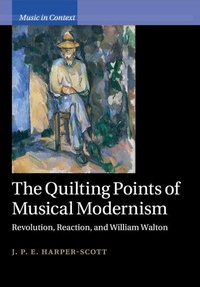
The Quilting Points of Musical Modernism
Revolution, Reaction, and William Walton
Published on 30. January 2020
Book
Paperback/Softback
300 pages
978-1-108-74683-0 (ISBN)
Description
Modernism is both a contested aesthetic category and a powerful political statement. Modernist music was condemned as degenerate by the Nazis and forcibly replaced by socialist realism under the Soviets. Sympathetic philosophers and critics have interpreted it as a vital intellectual defence against totalitarianism, yet some American critics consider it elitist, undemocratic and even unnatural. Drawing extensively on the philosophy of Heidegger and Badiou, The Quilting Points of Musical Modernism proposes a new dialectical theory of faithful, reactive and obscure subjective responses to musical modernism, which embraces all the music of Western modernity. This systematic definition of musical modernism introduces readers to theory by Badiou, Zizek and Agamben. Basing his analyses on the music of William Walton, Harper-Scott explores connections between the revolutionary politics of the nineteenth and twentieth centuries and responses to the event of modernism in order to challenge accepted narratives of music history in the twentieth century.
More details
Series
Language
English
Place of publication
Cambridge
United Kingdom
Target group
Professional and scholarly
Product notice
Paperback (trade)
Illustrations
Worked examples or Exercises; 26 Printed music items; 25 Tables, black and white; 1 Halftones, unspecified; 1 Halftones, black and white
Dimensions
Height: 244 mm
Width: 170 mm
Thickness: 16 mm
Weight
522 gr
ISBN-13
978-1-108-74683-0 (9781108746830)
Copyright in bibliographic data and cover images is held by Nielsen Book Services Limited or by the publishers or by their respective licensors: all rights reserved.
Schweitzer Classification
Other editions
Additional editions
J. P. E. Harper-Scott
The Quilting Points of Musical Modernism
Revolution, Reaction, and William Walton
Book
08/2012
Cambridge University Press
€129.60
Shipment within 15-20 days
Person
J. P. E. Harper-Scott is Reader in Musicology and Theory at Royal Holloway, University of London. He has published widely on Elgar, Wagner, Britten and symphonic music and opera of the late nineteenth and twentieth centuries and his books include Elgar Studies (edited with Julian Rushton), An Introduction to Music Studies (edited with Jim Samson) and Edward Elgar, Modernist. His work has strong intersections with continental philosophy and psychoanalysis (Heidegger, Badiou, Zizek and Lacan) and has increasingly come to espouse an explicitly Leftist perspective.
Content
Preface; Part I. A Ruthless Criticism of Everything Existing: 1. Modernism as we know it, ideology, and the quilting point; Part II. Relationship Problems: 2. Modernism, love, and truth; 3. The love of Troilus and Cressida; Part III. The Revolutionary Kernel of Reactionary Music: 4. Communist modernism; 5. A new community; Afterword: what to do?