

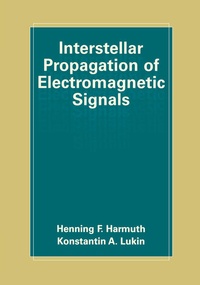
Interstellar Propagation of Electromagnetic Signals
Published on 31. March 2000
Book
Hardback
XIII, 277 pages
978-0-306-46316-7 (ISBN)
Description
Most texts on electromagnetic theory follow the classical approach of steady state solutions of Maxwell's equations. In
Interstellar
Propagation of Electromagnetic Signals
, the authors, H. Harmuth and K. Lukin, point out the deficiencies in Maxwell's theory and present an exciting new way of obtaining transient or signals solutions.
This book can be used by researchers, graduate students and scientists in the areas of physics, astrophysics, astronomy and electromagnetic theory or electromagnetics.
This book can be used by researchers, graduate students and scientists in the areas of physics, astrophysics, astronomy and electromagnetic theory or electromagnetics.
More details
Edition
Biscuit Books ed.
Language
English
Place of publication
New York
United States
Publishing group
Springer Science+Business Media
Target group
Professional and scholarly
Research
Illustrations
XIII, 277 p.
Dimensions
Height: 235 mm
Width: 157 mm
Thickness: 21 mm
Weight
585 gr
ISBN-13
978-0-306-46316-7 (9780306463167)
DOI
10.1007/978-1-4615-4247-6
Schweitzer Classification
Other editions
Additional editions
Henning F. Harmuth | Konstantin Lukin
Interstellar Propagation of Electromagnetic Signals
Book
10/2012
Springer
€53.49
Shipment within 7-9 days
Content
1 Introduction.- 1.1 Dipole Current Densities in Maxwell's Equations.- 1.2 Ohm's Law for Induced Electric Dipoles with Mass.- 1.3 Magnetic Ohm's Law for Magnetic Dipoles with Mass.- 1.4 Dipoles and Quadrupoles Created in Vacuum.- 1.5 Observation of Dipole Currents.- 1.6 Approximation of Signal Functions by Exponential Functions.- 2 Electric Field Strength Due to Electric Excitation.- 2.1 Derivation of the Partial Differential Equation.- 2.2 Electric Field Strength for Eigenfunction Excitation.- 2.3 Algebraic Equation of Sixth Order.- 2.4 Solution of Differential Equation of Sixth Order.- 2.5 Plots of the Electric Field Strength for p < 1/2.- 2.6 Plots of the Electric Field Strength for p > 1/2.- 3 Associated Field Strengths.- 3.1 Associated Magnetic Field Strength.- 3.2 Integration Constants for Electric Excitation.- 3.3 Plots of the Associated Magnetic Field Strength for p < 1/2.- 3.4 Plots of the Associated Magnetic Field Strength for p > 1/2.- 3.5 Field Strengths Due to Magnetic Excitation.- 3.6 Plots for the Associated Electric Field Strength.- 4 Excitation Functions With Finite Rise Time.- 4.1 Electric Excitation Function for p < 1/2.- 4.2 Electric Excitation Function for p > 1/2.- 4.3 Peak Amplitudes of the Precursor.- 4.4 Excitation by Sinusoidal Pulses.- 4.5 Excitation by Rectangular Pulses.- 5 Electromagnetic Signals in Astronomy.- 5.1 Information Obtained from Electromagnetic Waves.- 5.2 Main Lobe of Signals for Various Distances.- 5.3 Precursor of Signals for Various Distances.- 5.4 Sinusoidal Pulses at Various Distances.- 5.5 Rectangular Pulses at Various Distances.- 6 Appendix.- 6.1 Numerical Evaluation for p < 1/2.- 6.2 Numerical Evaluation for p > 1/2.- 6.3 Evaluation of Certain Small Terms for p < 1/2.- 6.4 Evaluation of Certain Small Terms for p >1/2.- 6.5 Associated Magnetic Field Strength for p < 1/2.- 6.6 Associated Magnetic Field Strength for p > 1/2.- 6.7 Relation Between D and E or B and H.- References and Bibliography.