

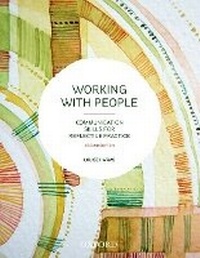
Working with People
Communication Skills for Reflective Practice
2nd Edition
Published on 6. November 2015
Book
Paperback/Softback
376 pages
978-0-19-552228-0 (ISBN)
Description
Working with People explores the place and challenges of communication, interviewing and counselling skills within the context of social work and human service practice. In so doing it encourages the reader to reflect upon their own communication style and to develop good communication skills in order to work constructively with others about their needs and rights.
Now in its second edition the text is updated to include recent developments in social work practice. New to the edition is the chapter on mindfulness, which reflects direct work with clients as well as recognition of a growing need to focus on self-care. Other topics of relevance to current social work practice and covered in the text include ethical decision-making as part of everyday practice, exploration of confidentiality, particularly in relation to situations when it may need to be breached, more emphasis on culturally safe practice, links with the application of skills in group work and family practice.
Working with People successfully Integrates practice theories with case scenarios so that readers can see the development of skills and interventions, as well as the diversity of approaches available for social workers and human service workers to use in their everyday practice.
Now in its second edition the text is updated to include recent developments in social work practice. New to the edition is the chapter on mindfulness, which reflects direct work with clients as well as recognition of a growing need to focus on self-care. Other topics of relevance to current social work practice and covered in the text include ethical decision-making as part of everyday practice, exploration of confidentiality, particularly in relation to situations when it may need to be breached, more emphasis on culturally safe practice, links with the application of skills in group work and family practice.
Working with People successfully Integrates practice theories with case scenarios so that readers can see the development of skills and interventions, as well as the diversity of approaches available for social workers and human service workers to use in their everyday practice.
More details
Edition
2nd Revised edition
Language
English
Place of publication
Melbourne
Australia
Publishing group
Oxford University Press Australia
Target group
College/higher education
Edition type
Revised edition
Dimensions
Height: 245 mm
Width: 194 mm
Thickness: 13 mm
Weight
646 gr
ISBN-13
978-0-19-552228-0 (9780195522280)
Copyright in bibliographic data and cover images is held by Nielsen Book Services Limited or by the publishers or by their respective licensors: all rights reserved.
Schweitzer Classification
Person
Louise Harms is an Associate Professor and Director at University of Melbourne
Content
Part 1: Framing the RelationshipChapter 1: Working Towards ChangeExperiences of human adversity Why do we have human services? Who is involved in human service work? Core values in the client-social worker relationship Transforming values into practice Chapter 2: Understanding Communication and Change Understanding communication Communication as a process Verbal communication processesNon-verbal communication processes Individual and collective communication processesChapter 3: Theorising Communication and Change The influences on our listeningParadigms and worldviews Theoretical knowledge Factual knowledge Stages of change Consumer perspectives Practice knowledge or wisdomA multidimensional approachPart 2: Forming the RelationshipChapter 4: Skills for Your 'Use of Self' Why the 'use of self ' is an important concept for social workers Your use of self in context The purpose of your agency Chapter 5: Self-Care Skills Self-care: Managing the impacts of your workSupervision Debriefing and psychological first aid Chapter 6: Engagement SkillsPreparing to meet Confidentiality Using self-disclosure Part 3: Focusing your Communication Chapter 7: Listening and Questioning Skills The task of establishing the story What other verbal skills can I use to establish and clarify the story? Chapter 8: Reflecting Skills: Paraphrasing and Summarising Building a deeper understanding of people's experiences Active listening in practice Chapter 9: Assessment Skills Moving towards an assessment formulation Who is the assessment for? What are some of the challenges in the assessment process? What assessment frameworks are used? A multidimensional assessment framework What interventions are used? How do we set the goals for the work? Chapter 10: Ethical Decision-Making and Risk Assessment Skills Shifting to a focus on risk Threatening behaviour towards self and others Revisiting confidentiality Part 4: Focusing Your Interventions: Skills for Theoretically Informed Practice Chapter 11: Psychodynamic and Cognitive Behavioural Approaches and Skills Psychodynamic approaches to practiceCognitive behavioural approaches to practice Strengths and limitations of these skills Chapter 12: Narrative and Solution-Focused Approaches and SkillsNarrative approaches to practiceSolution-focused approaches to practiceStrengths and limitations of these skills Chapter 13: Feminist and Critical Social Work Approaches and Skills Feminist and critical social work approaches to practice Strengths and limitations of these skills Chapter 14: Mindfulness Approaches and Skills Mindfulness approaches to practiceStrengths and limitations of these skills Chapter 15: Task-Centred and Crisis-Intervention Approaches and SkillsTask-centred approaches to practiceCrisis-intervention approaches to practice Strengths and limitations of these approaches Part 5: Finishing the Work Chapter 16: Ending and Evaluating SkillsThinking about finishing the work The tasks of finishing the work A final word on strengths, optimism and communication