

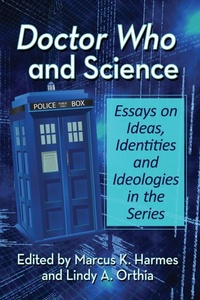
Doctor Who and Science
Essays on Ideas, Identities and Ideologies in the Series
Published on 29. January 2021
Book
Paperback/Softback
243 pages
978-1-4766-8112-2 (ISBN)
Description
Science has always been part of Doctor Who. The first episode featured scenes in a science laboratory and a science teacher, and the 2020 season's finale highlighted a scientist's key role in Time Lord history. Hundreds of scientific characters, settings, inventions, and ethical dilemmas populated the years in between. Behind the scenes, Doctor Who's original remit was to teach children about science, and in the 1960s it even had a scientific advisor.
This is the first book to explore this scientific landscape from a broad spectrum of research fields: from astronomy, genetics, linguistics, computing, history, sociology and science communication through gender, media and literature studies. Contributors ask: What sort of scientist is the Doctor? How might the TARDIS translation circuit and regeneration work? Did the Doctor change sex or gender when regenerating into Jodie Whittaker? How do Doctor Who's depictions of the Moon and other planets compare to the real universe? Why was the program obsessed with energy in the 1960s and 1970s, Victorian scientists and sciences then and now, or with dinosaurs at any time? Do characters like Missy and the Rani make good scientist role models? How do Doctor Who technical manuals and public lectures shape public ideas about science?
This is the first book to explore this scientific landscape from a broad spectrum of research fields: from astronomy, genetics, linguistics, computing, history, sociology and science communication through gender, media and literature studies. Contributors ask: What sort of scientist is the Doctor? How might the TARDIS translation circuit and regeneration work? Did the Doctor change sex or gender when regenerating into Jodie Whittaker? How do Doctor Who's depictions of the Moon and other planets compare to the real universe? Why was the program obsessed with energy in the 1960s and 1970s, Victorian scientists and sciences then and now, or with dinosaurs at any time? Do characters like Missy and the Rani make good scientist role models? How do Doctor Who technical manuals and public lectures shape public ideas about science?
Reviews / Votes
"A distinctly interdisciplinary set of essays...the collection has an interesting variety of methodological approaches beyond those usually seen in traditional literary and cultural studies...admirable...balanced and intriguing...fun and well-rounded...nuanced and intricate...readers will find in this volume a varied and thoroughly researched set of essays whose topical and enthusiastic approach demonstrates the versatility and longevity of Doctor Who scholarship."-SFRA ReviewMore details
Language
English
Place of publication
Jefferson, NC
United States
Target group
Professional and scholarly
Interest Age: From 18 years
Product notice
Paperback (trade)
Illustrations
bibliography, index
Dimensions
Height: 229 mm
Width: 152 mm
Thickness: 15 mm
Weight
402 gr
ISBN-13
978-1-4766-8112-2 (9781476681122)
Copyright in bibliographic data and cover images is held by Nielsen Book Services Limited or by the publishers or by their respective licensors: all rights reserved.
Schweitzer Classification
Persons
Marcus K. Harmes is a professor at the University of Southern Queensland, Toowoomba, Australia. He researches on British popular culture especially science fiction and horror. Lindy A. Orthia is an honorary senior lecturer at the School of Sociology, the Australian National University, Canberra. She has written extensively on Doctor Who and science.
Content
Table of Contents
Acknowledgments
Timeline and Terminology for Doctor Who's Doctors and Eras
Introduction to Doctor Who and Science
Lindy A. Orthia and Marcus K. Harmes
Who's Planet Looks Like Home?
J.J. Eldridge
Who's Moon
Elizabeth R. Stanway
E=mc3: Doctor Who and Energy
Marcus K. Harmes
Translation by TARDIS: Exploring the Science Behind Multilingual Communication in Doctor
Mark Halley and Lynne Bowker
"I don't want to go": How Does Regeneration Work in Doctor Who?
Natalie Ring
Did the Doctor Change Sex or Change Gender? Navigating the Sex and Gender Divide in Doctor
Mike Stack
Candyfloss, Lego and Hope: What Sort of Scientist Is Jodie Whittaker's Doctor?
Lindy A. Orthia and Vanessa de Kauwe
The Mad Scientist Wore Prada: Female Frankensteins in the Universe of Doctor
Kristine Larsen
Maxtible's Mirrors: Victorian Science in -Classic-Era Doctor
Marcus K. Harmes and Richard Scully
The Victorians Sleeping in Our Minds: Victorian Scientific Enquiry in Old and New Series Doctor
Catriona Mills
Doctor Who and the Dinosaurs: Spectacle, Monstrosity, Melodrama and Ideology in Dinosaur Mediations
Ross Garner
The Use and Abuse of Scientific Writing in Doctor Who's Epistolary Paratexts
Tonguc Ibrahim Sezen
The Science of Doctor
Mark Erickson
Concluding Remarks: Science in Twenties Doctor
Lindy A. Orthia and Marcus K. Harmes
About the Contributors
Index
Acknowledgments
Timeline and Terminology for Doctor Who's Doctors and Eras
Introduction to Doctor Who and Science
Lindy A. Orthia and Marcus K. Harmes
Who's Planet Looks Like Home?
J.J. Eldridge
Who's Moon
Elizabeth R. Stanway
E=mc3: Doctor Who and Energy
Marcus K. Harmes
Translation by TARDIS: Exploring the Science Behind Multilingual Communication in Doctor
Mark Halley and Lynne Bowker
"I don't want to go": How Does Regeneration Work in Doctor Who?
Natalie Ring
Did the Doctor Change Sex or Change Gender? Navigating the Sex and Gender Divide in Doctor
Mike Stack
Candyfloss, Lego and Hope: What Sort of Scientist Is Jodie Whittaker's Doctor?
Lindy A. Orthia and Vanessa de Kauwe
The Mad Scientist Wore Prada: Female Frankensteins in the Universe of Doctor
Kristine Larsen
Maxtible's Mirrors: Victorian Science in -Classic-Era Doctor
Marcus K. Harmes and Richard Scully
The Victorians Sleeping in Our Minds: Victorian Scientific Enquiry in Old and New Series Doctor
Catriona Mills
Doctor Who and the Dinosaurs: Spectacle, Monstrosity, Melodrama and Ideology in Dinosaur Mediations
Ross Garner
The Use and Abuse of Scientific Writing in Doctor Who's Epistolary Paratexts
Tonguc Ibrahim Sezen
The Science of Doctor
Mark Erickson
Concluding Remarks: Science in Twenties Doctor
Lindy A. Orthia and Marcus K. Harmes
About the Contributors
Index