

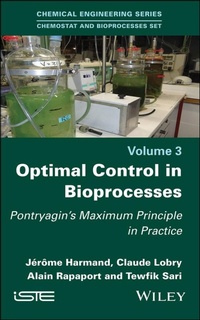
Optimal Control in Bioprocesses
Pontryagin's Maximum Principle in Practice
1st Edition
Published on 26. February 2019
Book
Hardback
272 pages
978-1-78630-045-4 (ISBN)
Description
Optimal control is a branch of applied mathematics that engineers need in order to optimize the operation of systems and production processes. Its application to concrete examples is often considered to be difficult because it requires a large investment to master its subtleties.
The purpose of Optimal Control in Bioprocesses is to provide a pedagogical perspective on the foundations of the theory and to support the reader in its application, first by using academic examples and then by using concrete examples in biotechnology. The book is thus divided into two parts, the first of which outlines the essential definitions and concepts necessary for the understanding of Pontryagin's maximum principle - or PMP - while the second exposes applications specific to the world of bioprocesses.
This book is unique in that it focuses on the arguments and geometric interpretations of the trajectories provided by the application of PMP.
The purpose of Optimal Control in Bioprocesses is to provide a pedagogical perspective on the foundations of the theory and to support the reader in its application, first by using academic examples and then by using concrete examples in biotechnology. The book is thus divided into two parts, the first of which outlines the essential definitions and concepts necessary for the understanding of Pontryagin's maximum principle - or PMP - while the second exposes applications specific to the world of bioprocesses.
This book is unique in that it focuses on the arguments and geometric interpretations of the trajectories provided by the application of PMP.
More details
Language
English
Place of publication
London
United Kingdom
Target group
Professional and scholarly
Product notice
sewn/stitched
Cloth over boards
Dimensions
Height: 236 mm
Width: 160 mm
Thickness: 20 mm
Weight
567 gr
ISBN-13
978-1-78630-045-4 (9781786300454)
Copyright in bibliographic data and cover images is held by Nielsen Book Services Limited or by the publishers or by their respective licensors: all rights reserved.
Schweitzer Classification
Other editions
Additional editions
Jérôme Harmand | Claude Lobry | Alain Rapaport
Optimal Control in Bioprocesses
Pontryagin's Maximum Principle in Practice
E-Book
03/2019
1st Edition
Wiley
€139.99
Available for download
Jérôme Harmand | Claude Lobry | Alain Rapaport
Optimal Control in Bioprocesses
Pontryagin's Maximum Principle in Practice
E-Book
03/2019
1st Edition
Wiley
€139.99
Available for download
Persons
Jerome Harmand is a researcher at the LBE laboratory of INRA in Narbonne, France.
Claude Lobry is a former Professor of both the University of Bordeaux and University of Nice in France.
Alain Rapaport is a researcher at the Applied Mathematics and Informatics Department of INRA in Montpellier, France.
Tewfik Sari is Research Director at the National Research Institute of Science and Technology for Environment and Agriculture (IRSTEA) in Montpellier, France.
Claude Lobry is a former Professor of both the University of Bordeaux and University of Nice in France.
Alain Rapaport is a researcher at the Applied Mathematics and Informatics Department of INRA in Montpellier, France.
Tewfik Sari is Research Director at the National Research Institute of Science and Technology for Environment and Agriculture (IRSTEA) in Montpellier, France.
Content
Introduction ix
Part 1 Learning to use Pontryagin's Maximum Principle 1
Chapter 1 The Classical Calculus of Variations 3
1.1 Introduction: notations 3
1.2 Minimizing a function 4
1.2.1 Minimum of a function of one variable 4
1.2.2 Minimum of a function of two variables 6
1.3 Minimization of a functional: Euler-Lagrange equations 10
1.3.1 The problem 10
1.3.2 The differential of J 11
1.3.3 Examples 14
1.4 Hamilton's equations 20
1.4.1 Hamilton's classical equations 20
1.4.2 The limitations of classical calculus of variations and small steps toward the control theory 23
1.5 Historical and bibliographic observations 25
Chapter 2 Optimal Control 27
2.1 The vocabulary of optimal control theory 27
2.1.1 Controls and responses 27
2.1.2 Class of regular controls 28
2.1.3 Reachable states 31
2.1.4 Controllability 34
2.1.5 Optimal control 37
2.1.6 Existence of a minimum 38
2.1.7 Optimization and reachable states 42
2.2 Statement of Pontryagin's maximum principle 44
2.2.1 PMP for the "canonical" problem 44
2.2.2 PMP for an integral cost 47
2.2.3 The PMP for the minimum-time problem 50
2.2.4 PMP in fixed terminal time and integral cost 52
2.2.5 PMP for a non-punctual target 56
2.3 PMP without terminal constraint 57
2.3.1 Statement 57
2.3.2 Corollary 59
2.3.3 Dynamic programming and interpretation of the adjoint vector 59
Chapter 3 Applications 65
3.1 Academic examples (to facilitate understanding) 65
3.1.1 The driver in a hurry 65
3.1.2 Profile of a road 67
3.1.3 Controlling the harmonic oscillator: the swing (problem) 70
3.1.4 The Fuller phenomenon 75
3.2 Regular problems 77
3.2.1 A regular Hamiltonian and the associated shooting method 77
3.2.2 The geodesic problem (seen as a minimum-time problem) 80
3.2.3 Regularization of the problem of the driver in a hurry 90
3.3 Non-regular problems and singular arcs 92
3.3.1 Optimal fishing problem 92
3.3.2 Discontinuous value function: the Zermelo navigation problem 102
3.4 Synthesis of the optimal control, discontinuity of the value function, singular arcs and feedback 118
3.5 Historical and bibliographic observations 125
Part 2 Applications in Process Engineering 127
Chapter 4 Optimal Filling of a Batch Reactor 129
4.1 Reducing the problem 130
4.2 Comparison with Bang-Bang policies 131
4.3 Optimal synthesis in the case of Monod 135
4.4 Optimal synthesis in the case of Haldane 135
4.4.1 Existence of an arc that (partially) separates ?+ and ?? 136
4.4.2 Using PMP 138
4.5 Historical and bibliographic observations 141
Chapter 5 Optimizing Biogas Production 143
5.1 The problem 143
5.2 Optimal solution in a well-dimensioned case 146
5.3 The Hamiltonian system 148
5.4 Optimal solutions in the underdimensioned case 156
5.5 Optimal solutions in the overdimensioned case 163
5.6 Inhibition by the substrate 167
5.7 Singular arcs 170
5.8 Historical and bibliographic observations 176
Chapter 6 Optimization of a Membrane Bioreactor (MBR) 177
6.1 Overview of the problem 177
6.2 The model proposed by Benyahia et al 185
6.3 The model proposed by Cogan and Chellamb 186
6.4 Historical and bibliographic observations 188
Appendices 191
Appendix 1 Notations and Terminology 193
Appendix 2 Differential Equations and Vector Fields 197
Appendix 3 Outline of the PMP Demonstration 205
Appendix 4 Demonstration of PMP without a Terminal Target 215
Appendix 5 Problems that are Linear in the Control 221
Appendix 6 Calculating Singular Arcs 231
References 237
Index 243
Part 1 Learning to use Pontryagin's Maximum Principle 1
Chapter 1 The Classical Calculus of Variations 3
1.1 Introduction: notations 3
1.2 Minimizing a function 4
1.2.1 Minimum of a function of one variable 4
1.2.2 Minimum of a function of two variables 6
1.3 Minimization of a functional: Euler-Lagrange equations 10
1.3.1 The problem 10
1.3.2 The differential of J 11
1.3.3 Examples 14
1.4 Hamilton's equations 20
1.4.1 Hamilton's classical equations 20
1.4.2 The limitations of classical calculus of variations and small steps toward the control theory 23
1.5 Historical and bibliographic observations 25
Chapter 2 Optimal Control 27
2.1 The vocabulary of optimal control theory 27
2.1.1 Controls and responses 27
2.1.2 Class of regular controls 28
2.1.3 Reachable states 31
2.1.4 Controllability 34
2.1.5 Optimal control 37
2.1.6 Existence of a minimum 38
2.1.7 Optimization and reachable states 42
2.2 Statement of Pontryagin's maximum principle 44
2.2.1 PMP for the "canonical" problem 44
2.2.2 PMP for an integral cost 47
2.2.3 The PMP for the minimum-time problem 50
2.2.4 PMP in fixed terminal time and integral cost 52
2.2.5 PMP for a non-punctual target 56
2.3 PMP without terminal constraint 57
2.3.1 Statement 57
2.3.2 Corollary 59
2.3.3 Dynamic programming and interpretation of the adjoint vector 59
Chapter 3 Applications 65
3.1 Academic examples (to facilitate understanding) 65
3.1.1 The driver in a hurry 65
3.1.2 Profile of a road 67
3.1.3 Controlling the harmonic oscillator: the swing (problem) 70
3.1.4 The Fuller phenomenon 75
3.2 Regular problems 77
3.2.1 A regular Hamiltonian and the associated shooting method 77
3.2.2 The geodesic problem (seen as a minimum-time problem) 80
3.2.3 Regularization of the problem of the driver in a hurry 90
3.3 Non-regular problems and singular arcs 92
3.3.1 Optimal fishing problem 92
3.3.2 Discontinuous value function: the Zermelo navigation problem 102
3.4 Synthesis of the optimal control, discontinuity of the value function, singular arcs and feedback 118
3.5 Historical and bibliographic observations 125
Part 2 Applications in Process Engineering 127
Chapter 4 Optimal Filling of a Batch Reactor 129
4.1 Reducing the problem 130
4.2 Comparison with Bang-Bang policies 131
4.3 Optimal synthesis in the case of Monod 135
4.4 Optimal synthesis in the case of Haldane 135
4.4.1 Existence of an arc that (partially) separates ?+ and ?? 136
4.4.2 Using PMP 138
4.5 Historical and bibliographic observations 141
Chapter 5 Optimizing Biogas Production 143
5.1 The problem 143
5.2 Optimal solution in a well-dimensioned case 146
5.3 The Hamiltonian system 148
5.4 Optimal solutions in the underdimensioned case 156
5.5 Optimal solutions in the overdimensioned case 163
5.6 Inhibition by the substrate 167
5.7 Singular arcs 170
5.8 Historical and bibliographic observations 176
Chapter 6 Optimization of a Membrane Bioreactor (MBR) 177
6.1 Overview of the problem 177
6.2 The model proposed by Benyahia et al 185
6.3 The model proposed by Cogan and Chellamb 186
6.4 Historical and bibliographic observations 188
Appendices 191
Appendix 1 Notations and Terminology 193
Appendix 2 Differential Equations and Vector Fields 197
Appendix 3 Outline of the PMP Demonstration 205
Appendix 4 Demonstration of PMP without a Terminal Target 215
Appendix 5 Problems that are Linear in the Control 221
Appendix 6 Calculating Singular Arcs 231
References 237
Index 243