

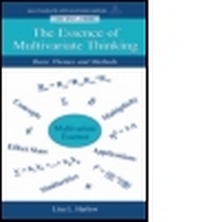
The Essence of Multivariate Thinking
Basic Themes and Methods
Published on 18. January 2005
Book
Hardback
264 pages
978-0-8058-3729-2 (ISBN)
Description
The Essence of Multivariate Thinking is intended to make multivariate statistics more accessible to a wide audience. To encourage a more thorough understanding of multivariate methods, author Lisa Harlow suggests basic themes that run through most statistical methodology. The most pervasive theme is multiplicity. The author argues that the use of multivariate methods encourages multiple ways of investigating phenomena. She explains that widening our lens to identify multiple theories, constructs, measures, samples, methods, and time points provide greater reliability and validity in our research. Dr. Harlow then shows how these themes are applied to several multivariate methods, with the hope that this will ease understanding in the basic concepts of multivariate thinking. Formulas are kept at a minimum.
The first three chapters review the core themes that run through multivariate methods. Seven different multivariate methods are then described using 10 questions that illuminate the main features, uses, multiplicity, themes, interpretations, and applications. The seven methods covered are multiple regression, analysis of covariance, multivariate analysis of variance, discriminant function analysis, logistic regression, canonical correlation, and principal components/factor analysis. The final chapter pulls together the principal themes and features charts that list common themes and how they pertain to each of the methods discussed.
The Essence of Multivariate Thinking, features:
A unique focus on the underlying themes that run through most multivariate methods.
A dual focus on significance tests and effect sizes to encourage readers to adopt a thorough approach to assessing the significance and magnitude of their findings.
A detailed example for each method to delineate how the multivariate themes apply.
Tabular results from statistical analysis programs that mirror sections of the output files.
A common dataset throughout the chapters to provide continuity with the variables and research questions.
A CD with data, SAS program setup and output, homework exercises, and chapter lectures.
This book is useful to advanced students, professionals, and researchers interested in applying multivariate methods in such fields as behavioral medicine, social, health, personality, developmental, cognitive, and industrial-organizational psychology, as well as in education and evaluation. A preliminary knowledge of basic statistics, research methods, basic algebra, and finite mathematics is recommended.
The first three chapters review the core themes that run through multivariate methods. Seven different multivariate methods are then described using 10 questions that illuminate the main features, uses, multiplicity, themes, interpretations, and applications. The seven methods covered are multiple regression, analysis of covariance, multivariate analysis of variance, discriminant function analysis, logistic regression, canonical correlation, and principal components/factor analysis. The final chapter pulls together the principal themes and features charts that list common themes and how they pertain to each of the methods discussed.
The Essence of Multivariate Thinking, features:
A unique focus on the underlying themes that run through most multivariate methods.
A dual focus on significance tests and effect sizes to encourage readers to adopt a thorough approach to assessing the significance and magnitude of their findings.
A detailed example for each method to delineate how the multivariate themes apply.
Tabular results from statistical analysis programs that mirror sections of the output files.
A common dataset throughout the chapters to provide continuity with the variables and research questions.
A CD with data, SAS program setup and output, homework exercises, and chapter lectures.
This book is useful to advanced students, professionals, and researchers interested in applying multivariate methods in such fields as behavioral medicine, social, health, personality, developmental, cognitive, and industrial-organizational psychology, as well as in education and evaluation. A preliminary knowledge of basic statistics, research methods, basic algebra, and finite mathematics is recommended.
More details
Series
Language
English
Place of publication
Philadelphia
United States
Publishing group
Taylor & Francis Inc
Target group
College/higher education
Professional and scholarly
Dimensions
Height: 229 mm
Width: 152 mm
Weight
530 gr
ISBN-13
978-0-8058-3729-2 (9780805837292)
Copyright in bibliographic data and cover images is held by Nielsen Book Services Limited or by the publishers or by their respective licensors: all rights reserved.
Schweitzer Classification
Other editions
New editions
Book
02/2014
2nd Edition
Routledge
€259.98
Article exhausted; check for reprint
Additional editions
Book
01/2005
Psychology Press
€64.56
Article exhausted; check for reprint
Content
Contents: Preface. Part I: Overview. Introduction. Multivariate Themes. Background Themes. Part II: Intermediate Multivariate Methods With One Continuous Outcome. Multiple Regression. Analysis of Covariance. Part III: Matrices. Matrices and Multivariate Methods. Part IV: Multivariate Group Methods. Multivariate Analysis of Variance. Discriminant Function Analysis. Logistic Regression. Part V: Multivariate Correlational Methods With Continuous Variables. Canonical Correlation.