

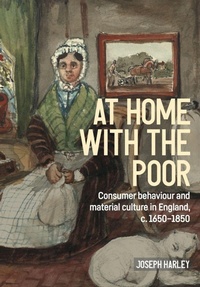
At Home with the Poor
Consumer Behaviour and Material Culture in England, C.1650-1850
Will be published approx. on 20. January 2026
Book
Paperback/Softback
272 pages
978-1-5261-9474-9 (ISBN)
Description
This book opens the doors to the homes of the forgotten poor and traces the goods they owned before, during and after the industrial revolution (c. 1650-1850). Using a vast and diverse range of sources, it gets to the very heart of what it meant to be 'poor' by examining the homes of the impoverished and mapping how numerous household goods became more widespread. As the book argues, poverty did not necessarily equate to owning very little and living in squalor. In fact, its novel findings show that most of the poor strove to improve their domestic spheres and that their demand for goods was so great that it was a driving force of the industrial revolution. -- .
Reviews / Votes
'This is a fabulous addition to the fields of material culture, consumption, and economic history during the period 1650-1850.' - CHOICE Reviews -- .More details
Series
Language
English
Place of publication
Manchester
United Kingdom
Target group
College/higher education
Professional and scholarly
Illustrations
41 black & white illustrations, 1 graph
Dimensions
Height: 244 mm
Width: 170 mm
Thickness: 15 mm
Weight
475 gr
ISBN-13
978-1-5261-9474-9 (9781526194749)
Copyright in bibliographic data and cover images is held by Nielsen Book Services Limited or by the publishers or by their respective licensors: all rights reserved.
Schweitzer Classification
Person
Joseph Harley is a Senior Lecturer in History at Anglia Ruskin University, Cambridge -- .
Content
Introduction
1 Accommodating the poor
2 Material wealth and material poverty
3 Building blocks of the home
4 Comforts of the hearth
5 Eating and drinking
6 Non-essential goods
7 Contrasting genders and locations
Conclusion
Index -- .
1 Accommodating the poor
2 Material wealth and material poverty
3 Building blocks of the home
4 Comforts of the hearth
5 Eating and drinking
6 Non-essential goods
7 Contrasting genders and locations
Conclusion
Index -- .