

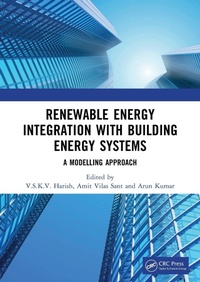
Renewable Energy Integration with Building Energy Systems
A Modelling Approach
1st Edition
Published on 26. August 2024
Book
Paperback/Softback
138 pages
978-1-032-07798-7 (ISBN)
Description
Construction, as an industry sector, is responsible for around one-third of the total worldwide energy usage and about 20% of greenhouse gas emissions. The rise in the number of buildings and floor space area for residential and commercial purposes has imposed enormous pressure on existing energy sources. Implementations such as efficient usage of building energy systems, design measures, utilization of local energy resources, energy storage, and the use of renewable energy sources to meet electricity demands are currently under development and deployment for improving the energy performance index. However, integrating all such measures and the development of nearly zero-energy and zero-emission buildings is yet to be explored.
In this book, the different control techniques and intelligent technologies used to improve the energy performance of buildings are illustrated. Every building energy control system has a two-fold objective for energy and comfort requirements to achieve a high comfort index (for thermal, visual, air quality, humidity, and various plug loads) and increase the energy performance index. The most significant aspect in the design of a building's energy control system is modelling. All the components, methodologies, and processes involved in developing a renewable energy-driven building are covered in detail.
This book is intended for graduates and professionals working towards the development of a sustainable built environment using renewable energy sources.
In this book, the different control techniques and intelligent technologies used to improve the energy performance of buildings are illustrated. Every building energy control system has a two-fold objective for energy and comfort requirements to achieve a high comfort index (for thermal, visual, air quality, humidity, and various plug loads) and increase the energy performance index. The most significant aspect in the design of a building's energy control system is modelling. All the components, methodologies, and processes involved in developing a renewable energy-driven building are covered in detail.
This book is intended for graduates and professionals working towards the development of a sustainable built environment using renewable energy sources.
More details
Language
English
Place of publication
London
United Kingdom
Publishing group
Taylor & Francis Ltd
Target group
College/higher education
Professional and scholarly
Adult education
Academic, Adult education, Postgraduate, Professional, Professional Practice & Development, and Undergraduate Advanced
Illustrations
102 s/w Abbildungen, 102 s/w Zeichnungen, 16 s/w Tabellen
16 Tables, black and white; 102 Line drawings, black and white; 102 Illustrations, black and white
Dimensions
Height: 246 mm
Width: 174 mm
Thickness: 8 mm
Weight
281 gr
ISBN-13
978-1-032-07798-7 (9781032077987)
Copyright in bibliographic data and cover images is held by Nielsen Book Services Limited or by the publishers or by their respective licensors: all rights reserved.
Schweitzer Classification
Other editions
Additional editions
V.S.K.V. Harish | Amit Vilas Sant | Arun Kumar
Renewable Energy Integration with Building Energy Systems
A Modelling Approach
E-Book
07/2022
1st Edition
CRC Press
€65.99
Available for download
V.S.K.V. Harish | Amit Vilas Sant | Arun Kumar
Renewable Energy Integration with Building Energy Systems
A Modelling Approach
E-Book
07/2022
1st Edition
CRC Press
€65.99
Available for download
V.S.K.V. Harish | Amit Vilas Sant | Arun Kumar
Renewable Energy Integration with Building Energy Systems
A Modelling Approach
Book
07/2022
1st Edition
CRC Press
€121.40
Shipment within 10-20 days
Persons
Content
1. Fundamentals of Energy Transfer in Buildings. 2. Modelling and Simulation of Building Energy Elements. 3. Modelling and Simulation of Heating Ventilation and Air-Conditioning System. 4. Review of Power Converters. 5. Grid Integration of Renewable Energy Sources for Buildings. 6. Electric Vehicle Technology. 7. Techno-Economic Analysis of Electric Vehicles.