

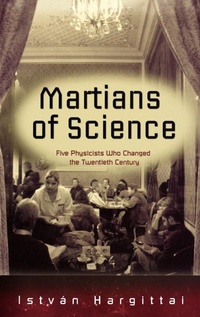
The Martians of Science
Five Physicists Who Changed the Twentieth Century
Published on 17. August 2006
Book
Hardback
376 pages
978-0-19-517845-6 (ISBN)
Description
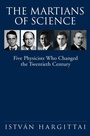
If science has the equivalent of a Bloomsbury group, it is the five men born at the turn of the 20th century in the same neighborhood in Budapest: Theodore von Karman, Leo Szilard, Eugene Wigner, John von Neumann, and Edward Teller. Through immigration from Hungary to Germany to the United States, they remained friends and continued to work together and influence each other throughout their lives. As a result, their work was integral to some of the most important scientific and political developments of the 20th century.
They were an extraordinary group of talents: Wigner won a Nobel Prize in theoretical physics without ever having taken a formal college-level physics course, Szilard was the first to see that a chain reaction based on neutrons was possible but left physics to try to restrict nuclear arms, von Neumann could solve problems in his head for which most people needed computers, von Karman became the first director of NASA's Jet Propulsion Lab, and Teller was the father of the hydrogen bomb, whose name is now synonymous with the controversial "Star Wars" defense initiative of the 1980s. Each was fiercely opinionated and politically active, reactionaries against the fascism and anti-Semitism with which they had grown up. Istvan Hargittai, as a young Hungarian physicist, was able to get to know these great men in their later years, and the depth of information and human interest in this book is the result of his personal relationships with the subjects, their families and their contemporaries.
They were an extraordinary group of talents: Wigner won a Nobel Prize in theoretical physics without ever having taken a formal college-level physics course, Szilard was the first to see that a chain reaction based on neutrons was possible but left physics to try to restrict nuclear arms, von Neumann could solve problems in his head for which most people needed computers, von Karman became the first director of NASA's Jet Propulsion Lab, and Teller was the father of the hydrogen bomb, whose name is now synonymous with the controversial "Star Wars" defense initiative of the 1980s. Each was fiercely opinionated and politically active, reactionaries against the fascism and anti-Semitism with which they had grown up. Istvan Hargittai, as a young Hungarian physicist, was able to get to know these great men in their later years, and the depth of information and human interest in this book is the result of his personal relationships with the subjects, their families and their contemporaries.
Reviews / Votes
This is an important story that needs to be told, and Hargittai tells it well. Nature, November 2006. The similarities between character and fate with the Martians are not the only thing that makes Hargittai well suited to the job of writing their biographies; he also writes clearly and with dry humour. 3-2006, Lab Times, p55.More details
Language
English
Place of publication
New York
United States
Target group
Professional and scholarly
Illustrations
56 Fotos bzw. Rasterbilder, 26 Abbildungen
56 halftones, 26 line illus.
Dimensions
Height: 240 mm
Width: 161 mm
Thickness: 24 mm
Weight
719 gr
ISBN-13
978-0-19-517845-6 (9780195178456)
Copyright in bibliographic data and cover images is held by Nielsen Book Services Limited or by the publishers or by their respective licensors: all rights reserved.
Schweitzer Classification
Other editions
Additional editions
Book
07/2008
Oxford University Press Inc
€36.20
Shipment within 15-20 days
E-Book
06/2008
OUP eBook
€20.99
Available for download
E-Book
07/2006
OUP eBook
€20.99
Available for download
Person
Istvan Hargittai is Professor of Chemistry and head of the George A. Olah PhD School of Chemistry and Chemical Engineering at the Budapest University of Technology and Economics and research professor at E oetv oes University. He is a member of the Hungarian Academy of Sciences, foreign member of the Norwegian Academy of Science and Letters, and member of the Academia Europaea (London). He holds a PhD degree from E oetv oes
University, D.Sc. degree from the Hungarian Academy of Sciences, and honorary doctorates from Moscow State University, the University of North Carolina, and the Russian Academy of Sciences. He has lectured in some 30 countries and taught at
several universities in the United States. He has published extensively on structural chemistry and on symmetry-related topics. His books include the Candid Science series of his collected interviews with famous scientists, The Road to Stockholm about the Nobel Prize, and Our Lives, which includes a considerable amount of autobiographical material. He and his fellow professor wife live in Budapest. Their grown children, both PhDs, live in the United States.
University, D.Sc. degree from the Hungarian Academy of Sciences, and honorary doctorates from Moscow State University, the University of North Carolina, and the Russian Academy of Sciences. He has lectured in some 30 countries and taught at
several universities in the United States. He has published extensively on structural chemistry and on symmetry-related topics. His books include the Candid Science series of his collected interviews with famous scientists, The Road to Stockholm about the Nobel Prize, and Our Lives, which includes a considerable amount of autobiographical material. He and his fellow professor wife live in Budapest. Their grown children, both PhDs, live in the United States.
Content
Preface ; Acknowledgements ; List of Plates ; Introduction ; 1. Arrival and Departure ; 1.1 Family Origin and Early Childhood ; 1.2 Gem and Less: Gimnazium Experience ; 1.3 Background in Hungary and First Transition ; 2 Turning Points in Germany ; 3 Second Transition: to the United States ; 4 "To Protect and Defend": World War II ; 5 To Deter: Cold War ; 6 Being Martian ; 6.1 Comparisons ; 6.1.1 Szilard and Fermi ; 6.1.2 Teller and Oppenheimer ; 6.2 Traits ; 6.3 Religion and Jewishness ; 6.4 Being Hungarian ; Epilogue ; Greatness in Science ; Had They Lived ; Conclusion ; Appendix: Quotable Martians ; Notes ; Select Bibliography ; Annotated Name Index ; Subject Index