

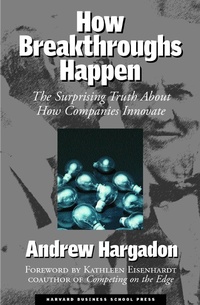
How Breakthroughs Happen
The Surprising Truth About How Companies Innovate
Published on 10. July 2003
Book
Hardback
320 pages
978-1-57851-904-0 (ISBN)
Description
This book presents lessons from the famous 'Invention Factories' past and present. Did you know that the incandescent lightbulb first emerged some thirty years before Thomas Edison famously 'turned night into day'? Or that Henry Ford's revolutionary assembly line came from an unlikely blend of observations from Singer sewing machines, meatpacking, and Campbell's Soup? In this fascinating study of innovation, engineer and social scientist Andrew Hargadon argues that our romantic notions about innovation as invention are actually undermining our ability to pursue breakthrough innovations. Based on ten years of study into the origins of historic inventions and modern innovations from the lightbulb to the transistor to the Reebok Pump athletic shoe, How Breakthroughs Happen takes us beyond the simple recognition that revolutionary innovations do not result from flashes of brilliance by lone inventors or organizations. In fact, innovation is really about creatively recombining ideas, people, and objects from past technologies in ways that spark new technological revolutions.
This process of 'technology brokering' is so powerful, explains Hargadon, because it exploits the networked nature--the social side--of the innovation process. Moving between historical accounts of labs and factory floors where past technological revolutions originated and field studies of similar processes in today's organizations, Hargadon shows how technology brokers create an enduring capacity for breakthrough innovations. Technology brokers simultaneously bridge the gaps in existing networks that separate distant industries, firms, and divisions to see how established ideas can be applied in new ways and places, and build new networks to guide these creative recombinations to mass acceptance. How Breakthroughs Happen identifies three distinct strategies for technology brokering that managers can implement in their organizations. Hargadon suggests that Edison and his counterparts were no smarter than the rest of us-they were simply better at moving through the networked world of their time. Intriguing, practical, and counterintuitive, How Breakthroughs Happen can help managers transform their own firms into modern-day invention factories.
This process of 'technology brokering' is so powerful, explains Hargadon, because it exploits the networked nature--the social side--of the innovation process. Moving between historical accounts of labs and factory floors where past technological revolutions originated and field studies of similar processes in today's organizations, Hargadon shows how technology brokers create an enduring capacity for breakthrough innovations. Technology brokers simultaneously bridge the gaps in existing networks that separate distant industries, firms, and divisions to see how established ideas can be applied in new ways and places, and build new networks to guide these creative recombinations to mass acceptance. How Breakthroughs Happen identifies three distinct strategies for technology brokering that managers can implement in their organizations. Hargadon suggests that Edison and his counterparts were no smarter than the rest of us-they were simply better at moving through the networked world of their time. Intriguing, practical, and counterintuitive, How Breakthroughs Happen can help managers transform their own firms into modern-day invention factories.
More details
Language
English
Place of publication
United States
Product notice
Cloth over boards
Illustrations
Illustrations
Dimensions
Height: 239 mm
Width: 162 mm
Thickness: 25 mm
Weight
562 gr
ISBN-13
978-1-57851-904-0 (9781578519040)
Copyright in bibliographic data and cover images is held by Nielsen Book Services Limited or by the publishers or by their respective licensors: all rights reserved.
Schweitzer Classification
Person
Andrew Hargadon is Assistant Professor of Technology Management at the Graduate School of Management at the University of California, Davis.