

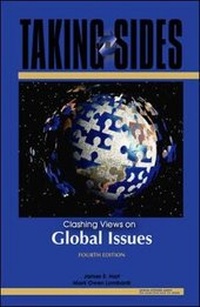
Taking Sides: Clashing Views on Global Issues
4th Edition
Published on 16. November 2006
Book
Paperback/Softback
400 pages
978-0-07-352724-6 (ISBN)
Description
This Fourth Edition of TAKING SIDES: CLASHING VIEWS ON GLOBAL ISSUES presents current controversial issues in a debate-style format designed to stimulate student interest and develop critical thinking skills. Each issue is thoughtfully framed with an issue summary, an issue introduction, and a postscript. An instructor's manual with testing material is available for each volume. USING TAKING SIDES IN THE CLASSROOM is also an excellent instructor resource with practical suggestions on incorporating this effective approach in the classroom. Each TAKING SIDES reader features an annotated listing of selected World Wide Web sites and is supported by our student website, www.mhcls.com/online.
More details
Edition
4th edition
Language
English
Place of publication
United States
Publishing group
McGraw-Hill Education - Europe
Target group
College/higher education
Dimensions
Height: 231 mm
Width: 150 mm
Thickness: 22 mm
Weight
540 gr
ISBN-13
978-0-07-352724-6 (9780073527246)
Copyright in bibliographic data and cover images is held by Nielsen Book Services Limited or by the publishers or by their respective licensors: all rights reserved.
Schweitzer Classification
Content
PART 1. Global Population ISSUE 1. Are Declining Growth Rates Rather Than Rapid Population Growth Today's Major Global Population Problem? YES: Michael Meyer, from "Birth Dearth," Newsweek (September 27, 2004) NO: Danielle Nierenberg and Mia MacDonald, from "The Population Story...So Far," World Watch Magazine (September/October 2004) Michael Meyer, a writer for Newsweek International, argues that the new global population threat is not too many people as a consequence of continuing high growth rates. On the contrary, declining birth rates will ultimately lead to depopulation in many places on Earth, a virtual population implosion, in both the developed and developing worlds. Danielle Nierenberg, a research associate at the Worldwatch Institute, and Mia MacDonald, a policy analyst and Worldwatch Institute senior fellow, argue that the consequences of a still-rising population have worsened in some ways because of the simultaneous existence of fast-rising consumption patterns, creating a new set of concerns.ISSUE 2. Should the International Community Attempt to Curb Population Growth in the Developing World? YES: Robert S. McNamara, from "The Population Explosion," The Futurist (November/December 1992) NO: Steven W. Mosher, from "McNamara's Folly: Bankrolling Family Planning," PRI Review (March/April 2003) Robert McNamara, former president of the World Bank, argues in this piece written during his presidency that the developed countries of the world and international organizations should help the countries of the developing world reduce their population growth rates. Steven W. Mosher, president of the Population Research Institute, an organization dedicated to debunking the idea that the world is overpopulated, argues that McNamara's World Bank and other international financial lending agencies have served for over a decade as "loan sharks" for those groups and individuals who were pressuring developing countries to adopt fertility reduction programs for self-interest reasons.ISSUE 3. Is Global Aging in the Developed World a Major Problem? YES: The Center for Strategic and International Studies (CSIS), from Meeting the Challenge of Global Aging: A Report to World Leaders from the CSIS Commission on Global Aging (CSIS Press, 2002) NO: Rand Corporation, from "Population Implosion?" Research Brief, Rand Europe (2005) The CSIS Report, Meeting the Challenge of Global Aging: A Report to World Leaders from the CSIS Commission on Global Aging, suggests that the wide range of changes brought on by global aging poses significant challenges in the ability of countries to address problems associated with the elderly directly and to the national economy as a whole. This Rand Corporation study suggests that because of declining fertility, European populations are either growing more slowly or have actually begun to decline. Although these trends "portend difficult times ahead," European governments should be able to confront these challenges successfully. ISSUE 4. Does Global Urbanization Lead Primarily to Undesirable Consequences? YES: Divya Abhat, Shauna Dineen, Tamsyn Jones, Jim Motavalli, Rebecca Sanborn, and Kate Slomkowski, from "Today's `Mega-Cities' Are Overcrowded and Environmentally Stressed," (September/October 2005) NO: Robert McDonald, from "A World of the City, by the City, for the City," ZNet/Activism, (December 20, 2005) Jim Motavalli, editor of E/The Environmental Magazine, suggests that the world's major cities suffer from a catalog of environmental ills, among them pollution, poverty, fresh water shortages, and disease. Robert McDonald, a postdoctoral fellow at Harvard University, suggests that global urbanization presents a great opportunity for the world to achieve international peace. It creates new possibilities for democracy and a sharing of common interests across national boundaries.PART 2. Global Resources and the Environment ISSUE 5. Do Environmentalists Overstate Their Case? YES: Ronald Bailey, from "Debunking Green Myths," Reason (February 2002) NO: David Pimentel, from "Skeptical of the Skeptical Environmentalist," Skeptic (vol. 9, no. 2, 2002) Environmental journalist Ronald Bailey in his review of the Bjorn Lomborg controversial book, The Skeptical Environmentalist: Measuring the Real State of the World (Cambridge University Press, 2001), argues in the subtitle of his critique that "An environmentalist gets it right," suggesting that finally someone has taken the environmental doomsdayers to task for their shoddy use of science. Bioscientist David Pimentel takes to task Lomborg's findings, accusing him of selective use of data to support his conclusions. ISSUE 6. Should the World Continue to Rely on Oil as a Major Source of Energy? YES: Red Cavaney, from "Global Oil Production about to Peak? A Recurring Myth," Worldwatch (January/February 2006) NO: James Howard Kunstler, from The Long Emergency (Grove/Atlantic, 2005) Red Cavaney, president and chief executive officer of the American Petroleum Institute, argues that recent revolutionary advances in technology will yield sufficient quantities of available oil for the foreseeable future. James Howard Kunster, author of The Long Emergency 2005, suggests that simply passing the all-time production peak of oil and heading toward its steady depletion will result in a global energy predicament that will substantially change our lives.ISSUE 7. Will the World Be Able to Feed Itself in the Foreseeable Future? YES: Sylvie Brunel, from The Geopolitics of Hunger, 2000-2001: Hunger and Power (Lynne Rienner Publishers, 2001) NO: Janet Raloff, from "Global Food Trends," Science News Online (May 31, 2003) Sylvie Brunel, former president of Action Against Hunger, argues that "there is no doubt that world food production... is enough to meet the needs of" all the world's peoples. Janet Raloff, a writer for Science News, looks at a number of factors-declining per capita grain harvests, world's growing appetite for meat, the declining availability of fish for the developing world, and continuing individual poverty.ISSUE 8. Is the Threat of Global Warming Real? YES: Intergovernmental Panel on Climate Change, from "Climate Change 2001: The Scientific Basis," A Report of Working Group I of the Intergovernmental Panel on Climate Change (2001) NO: Christopher Essex and Ross McKitrick, from Taken by Storm: The Troubled Science, Policy and Politics of Global Warming (Key Porter Books, 2002) The summary of the most recent assessment of climatic change by a UN-sponsored group of scientists concludes that an increasing set of observations reveals that the world is warming and much of it is due to human intervention. Christopher Essex and Ross McKitrick, Canadian university professors of applied mathematics and economics, respectively, attempt to prove wrong the popularly held assumption that scientists know what is happening with respect to climate and weather, and thus understand the phenomenon of global warming.ISSUE 9. Is the Threat of a Global Water Shortage Real? YES: Mark W. Rosegrant, Ximing Cai, and Sarah A. Cline, from "Global Water Outlook to 2025: Averting an Impending Crisis," A Report of the International Food Policy Research Institute and the International Water Management Institute (September 2002) NO: Bjorn Lomborg, from The Skeptical Environmentalist: Measuring the Real State of the World (Cambridge University Press, 2001) Rosegrant and colleagues conclude that if current water policies continue, farmers will find it difficult to grow sufficient food to meet the world's needs. Water is not only plentiful but also a renewable resource that, if properly treated as valuable, should not pose a future problem.PART 3. Expanding Global Forces and Movements ISSUE 10. Can the Global Community "Win" the Drug War? YES: Federico Mayor in collaboration with Jerome Binde, from The World Ahead: Our Future in the Making (UNESCO, 2001) NO: Harry G. Levine, from "The Secret of Worldwide Drug Prohibition," The Independent Review (Fall 2002) Mr. Mayor, former director-general of UNESCO, suggests that drug trafficking and consumption "constitute one of the most serious threats to our planet," and the world must dry up the demand and attack the financial power of organized crime. Harry G. Levine, professor of sociology at Queens College, City University of New York, argues that the emphasis on drug prohibition should be replaced by a focus on "harm reduction," creating mechanisms to address tolerance, regulation, and public health. ISSUE 11. Is the International Community Adequately Prepared to Address Global Health Pandemics? YES: Global Influenza Programme, from "Responding to the Avian Influenza Pandemic Threat," World Health Organization (2005) NO: H. T. Goranson, from "A Primer for Pandemics," Global Envisio
n, (2005) The document from the World Health Organization lays out a comprehensive program of action for individual countries, the international community, and WHO to address the next influenza pandemic. H. T. Goranson, a former top national scientist with the U.S. government, describes the grave dangers posed by global pandemics and highlights flaws in the international community's ability to respond. ISSUE 12. Has the International Community Designed an Adequate Strategy to Address Human Trafficking? YES: Janie Chuang, from "Beyond a Snapshot: Preventing Human Trafficking in the Global Economy," Indiana Journal of Global Legal Studies (Winter 2006) NO: Dina Francesca Haynes, from "Used, Abused, Arrested and Deported: Extending Immigration Benefits to Protect the Victims of Trafficking and to Secure the Prosecution of Traffickers," Human Rights Quarterly (vol. 26, no. 2, 2004) Janie Chuang, practitioner-in-residence at the American University Washington College of Law, suggests that governments have been finally motivated to take action against human traffickers as a consequence of the concern over national security implications of forced human labor movement and the involvement of transnational criminal syndicates. Dina Francesca Haynes, associate professor of law at the New England School of Law, argues that none of the models underlying domestic legislation to deal with human traffickers is "terribly effective" in addressing the issue effectively. ISSUE 13. Is Globalization a Positive Development for the World Community? YES: Johan Norberg, from "How Globalization Conquers Poverty," The Cato Institute (September 9, 2003) NO: J. Scott Tynes, from "Globalization Harms Developing Nations' Cultures," in Berna Miller and James D. Torr, eds., Developing Nations (Greenhaven Press, 2003) Norberg argues that throughout history the expansion of trade through the capitalist system has created wealth in nations. He argues that developing countries need only overcome their own shortcomings and adopt this model within a globalizing world to take advantage of this reality. Tynes contends that globalization not only creates economic poverty among developing states but first world countries through mass media control, corporate action, and policies that exacerbate this problem and create deeper gaps between rich and poor.ISSUE 14. Is the World a Victim of American Cultural Imperialism? YES: George Monbiot, from "Thanks to Corporations Instead of Democracy We Get Baywatch," The Guardian (September 13, 2005) NO: Philippe Legrain, from "In Defense of Globalization," The International Economy (Summer 2003) George Monbiot argues that U.S. media control and the desire for profits have not created a political or social awakening around the globe but rather a quest for profits that spreads American culture in its basest forms without any inherent benefits. Thus, by implication, the world is suffering under the yoke of American cultural imperialism. Philippe Legrain is a British economist who presents two views of cultural imperialism and argues that the notion of American cultural imperialism "is a myth" and that the spreading of cultures through globalization is a positive, not negative, development.ISSUE 15. Do Global Financial Institutions and Multinational Corporations Exploit the Developing World? YES: The Global Exchange, from "The Top 10 Reasons to Oppose the IMF" (2005) NO: Flemming Larsen, from "The IMF's Views and Actions in Dealing with Its Poorest Member Countries," Introductory Remarks at World Council of Churches-World Bank-IMF Meeting (September 11, 2003) The Global Exchange, an international group with an egalitarian agenda, argues that the IMF is a Western construct designed purely to exploit the developing world and promote corporate interests against those of the people. Flemming Larsen, director of the IMF office in Europe contends that the IMF exists solely to promote the expansion of development and wealth throughout the world using capitalist strategies of loans and assistance designed to make countries economically sustainable within the global system.PART 4. The New Global Security Dilemma ISSUE 16. Does Immigration Policy Affect Terrorism? YES: Mark Krikorian, from "Keeping Terror Out," The National Interest (Spring 2004) NO: Daniel T. Griswold, from "Don't Blame Immigrants for Terrorism," The Cato Institute (May 24, 2006) Mark Krikorian argues that immigration and security are directly and inexorably linked. He contends that the nature of terrorism is such that individual and small-group infiltration of our U.S. borders is a prime strategy for terrorists and thus undermines individual calls for relaxed or open immigration. Daniel T. Griswold argues that by coupling security and immigration, we simplify a complex issue and in fact do little to enhance security while we demonize a huge segment of the population who are by and large law abiding and not a threat.ISSUE 17. Are We Headed Toward a Nuclear 9/11? YES: David Krieger, from "Is a Nuclear 9/11 in Our Future?" Nuclear Age Peace Foundation (October 6, 2003) NO: Graham Allison, from "Preventing Nuclear Terrorism," Los Angeles World Affairs Council (September 22, 2005) David Kreiger, president of the Nuclear Age Peace Foundation argues that a nuclear 9/11 is very likely in a U.S. city due to the prevalence of nuclear weapons and the failure of nuclear member states to adequately enforce a true non-proliferation regime. Graham Allison, noted international scholar argues, that a nuclear 9/11 is preventable provided that the United States and other states halt proliferation to states predisposed toward assisting terrorists, particularly North Korea.ISSUE 18. Are Cultural and Ethnic Wars the Defining Dimensions of Twenty-First Century Conflict? YES: Samuel P. Huntington, from "The Clash of Civilizations?" Foreign Affairs (Summer 1993) NO: Wendell Bell, from "Humanity's Common Values: Seeking a Positive Future," The Futurist (September/October 2004) Political scientist Samuel P. Huntington argues that the emerging conflicts of the twenty-first century will be cultural and not ideological. He identifies the key fault lines of conflict and discusses how these conflicts will reshape global policy. Wendell Bell, professor emeritus of sociology at Yale University, argues that by emphasizing our common humanity and shared values, cultural divisions will not be the defining wave but rather shared mission and vision will characterize human experience in this century. ISSUE 19. Can Nuclear Proliferation Be Stopped? YES: Ira Straus, from "Reversing Proliferation," National Interest (Fall 2004) NO: Mirza Aslam Beg, from "Outside View: Nuclear Proliferators Can't Be Stopped," SpaceDaily.com (March 2005) Ira Strauss, U.S. coordinator of the Independent International Committee on Eastern Europe and Russia, argues that non-proliferation has historically been a key component of U.S. policy but that it has been subsumed with terrorism of late, and as such, we have lost precious ground in the fight to maintain non-proliferation. As a result, the threat of states such as North Korea and Iran is dangerous and runs the risk of breaking the proliferation regime's back. Mirza Aslam Beg, former chief of staff of the Pakistani army, argues that proliferation combined with deterrence leads to stability and not instability. He contends that proliferation will happen naturally and therefore, the world community should deal with its realities and not try and prevent it, thus creating a set of regional balances that will lead to peace. ISSUE 20. Has U.S. Hegemony Rendered the United Nations Irrelevant? YES: Tom DeWeese, from "The Time Is Now...The United Nations-Irrelevant and Dangerous," American Policy Center (March 28, 2003) NO: Shashi Tharoor, from "Is the United Nations Still Relevant?" Asia Society (June 14, 2004) Tom DeWeese argues that the United Nations is principally responsible for much of the chaos in the world and that its ability to positively impact change is negligible. Therefore, it is irrelevant to U.S. policy, and thus global interests, and should be dismantled. Shashi Tharoor argues that the United Nations does a great deal of good, and in this age of terrorism and U.S. global hegemony, it is necessary to peacefully negotiate and be a force for reason around the world.
n, (2005) The document from the World Health Organization lays out a comprehensive program of action for individual countries, the international community, and WHO to address the next influenza pandemic. H. T. Goranson, a former top national scientist with the U.S. government, describes the grave dangers posed by global pandemics and highlights flaws in the international community's ability to respond. ISSUE 12. Has the International Community Designed an Adequate Strategy to Address Human Trafficking? YES: Janie Chuang, from "Beyond a Snapshot: Preventing Human Trafficking in the Global Economy," Indiana Journal of Global Legal Studies (Winter 2006) NO: Dina Francesca Haynes, from "Used, Abused, Arrested and Deported: Extending Immigration Benefits to Protect the Victims of Trafficking and to Secure the Prosecution of Traffickers," Human Rights Quarterly (vol. 26, no. 2, 2004) Janie Chuang, practitioner-in-residence at the American University Washington College of Law, suggests that governments have been finally motivated to take action against human traffickers as a consequence of the concern over national security implications of forced human labor movement and the involvement of transnational criminal syndicates. Dina Francesca Haynes, associate professor of law at the New England School of Law, argues that none of the models underlying domestic legislation to deal with human traffickers is "terribly effective" in addressing the issue effectively. ISSUE 13. Is Globalization a Positive Development for the World Community? YES: Johan Norberg, from "How Globalization Conquers Poverty," The Cato Institute (September 9, 2003) NO: J. Scott Tynes, from "Globalization Harms Developing Nations' Cultures," in Berna Miller and James D. Torr, eds., Developing Nations (Greenhaven Press, 2003) Norberg argues that throughout history the expansion of trade through the capitalist system has created wealth in nations. He argues that developing countries need only overcome their own shortcomings and adopt this model within a globalizing world to take advantage of this reality. Tynes contends that globalization not only creates economic poverty among developing states but first world countries through mass media control, corporate action, and policies that exacerbate this problem and create deeper gaps between rich and poor.ISSUE 14. Is the World a Victim of American Cultural Imperialism? YES: George Monbiot, from "Thanks to Corporations Instead of Democracy We Get Baywatch," The Guardian (September 13, 2005) NO: Philippe Legrain, from "In Defense of Globalization," The International Economy (Summer 2003) George Monbiot argues that U.S. media control and the desire for profits have not created a political or social awakening around the globe but rather a quest for profits that spreads American culture in its basest forms without any inherent benefits. Thus, by implication, the world is suffering under the yoke of American cultural imperialism. Philippe Legrain is a British economist who presents two views of cultural imperialism and argues that the notion of American cultural imperialism "is a myth" and that the spreading of cultures through globalization is a positive, not negative, development.ISSUE 15. Do Global Financial Institutions and Multinational Corporations Exploit the Developing World? YES: The Global Exchange, from "The Top 10 Reasons to Oppose the IMF" (2005) NO: Flemming Larsen, from "The IMF's Views and Actions in Dealing with Its Poorest Member Countries," Introductory Remarks at World Council of Churches-World Bank-IMF Meeting (September 11, 2003) The Global Exchange, an international group with an egalitarian agenda, argues that the IMF is a Western construct designed purely to exploit the developing world and promote corporate interests against those of the people. Flemming Larsen, director of the IMF office in Europe contends that the IMF exists solely to promote the expansion of development and wealth throughout the world using capitalist strategies of loans and assistance designed to make countries economically sustainable within the global system.PART 4. The New Global Security Dilemma ISSUE 16. Does Immigration Policy Affect Terrorism? YES: Mark Krikorian, from "Keeping Terror Out," The National Interest (Spring 2004) NO: Daniel T. Griswold, from "Don't Blame Immigrants for Terrorism," The Cato Institute (May 24, 2006) Mark Krikorian argues that immigration and security are directly and inexorably linked. He contends that the nature of terrorism is such that individual and small-group infiltration of our U.S. borders is a prime strategy for terrorists and thus undermines individual calls for relaxed or open immigration. Daniel T. Griswold argues that by coupling security and immigration, we simplify a complex issue and in fact do little to enhance security while we demonize a huge segment of the population who are by and large law abiding and not a threat.ISSUE 17. Are We Headed Toward a Nuclear 9/11? YES: David Krieger, from "Is a Nuclear 9/11 in Our Future?" Nuclear Age Peace Foundation (October 6, 2003) NO: Graham Allison, from "Preventing Nuclear Terrorism," Los Angeles World Affairs Council (September 22, 2005) David Kreiger, president of the Nuclear Age Peace Foundation argues that a nuclear 9/11 is very likely in a U.S. city due to the prevalence of nuclear weapons and the failure of nuclear member states to adequately enforce a true non-proliferation regime. Graham Allison, noted international scholar argues, that a nuclear 9/11 is preventable provided that the United States and other states halt proliferation to states predisposed toward assisting terrorists, particularly North Korea.ISSUE 18. Are Cultural and Ethnic Wars the Defining Dimensions of Twenty-First Century Conflict? YES: Samuel P. Huntington, from "The Clash of Civilizations?" Foreign Affairs (Summer 1993) NO: Wendell Bell, from "Humanity's Common Values: Seeking a Positive Future," The Futurist (September/October 2004) Political scientist Samuel P. Huntington argues that the emerging conflicts of the twenty-first century will be cultural and not ideological. He identifies the key fault lines of conflict and discusses how these conflicts will reshape global policy. Wendell Bell, professor emeritus of sociology at Yale University, argues that by emphasizing our common humanity and shared values, cultural divisions will not be the defining wave but rather shared mission and vision will characterize human experience in this century. ISSUE 19. Can Nuclear Proliferation Be Stopped? YES: Ira Straus, from "Reversing Proliferation," National Interest (Fall 2004) NO: Mirza Aslam Beg, from "Outside View: Nuclear Proliferators Can't Be Stopped," SpaceDaily.com (March 2005) Ira Strauss, U.S. coordinator of the Independent International Committee on Eastern Europe and Russia, argues that non-proliferation has historically been a key component of U.S. policy but that it has been subsumed with terrorism of late, and as such, we have lost precious ground in the fight to maintain non-proliferation. As a result, the threat of states such as North Korea and Iran is dangerous and runs the risk of breaking the proliferation regime's back. Mirza Aslam Beg, former chief of staff of the Pakistani army, argues that proliferation combined with deterrence leads to stability and not instability. He contends that proliferation will happen naturally and therefore, the world community should deal with its realities and not try and prevent it, thus creating a set of regional balances that will lead to peace. ISSUE 20. Has U.S. Hegemony Rendered the United Nations Irrelevant? YES: Tom DeWeese, from "The Time Is Now...The United Nations-Irrelevant and Dangerous," American Policy Center (March 28, 2003) NO: Shashi Tharoor, from "Is the United Nations Still Relevant?" Asia Society (June 14, 2004) Tom DeWeese argues that the United Nations is principally responsible for much of the chaos in the world and that its ability to positively impact change is negligible. Therefore, it is irrelevant to U.S. policy, and thus global interests, and should be dismantled. Shashi Tharoor argues that the United Nations does a great deal of good, and in this age of terrorism and U.S. global hegemony, it is necessary to peacefully negotiate and be a force for reason around the world.